 English
 العربية
 Bosanski jezik
 Čeština
 Dansk
 Nederlands
 Wikang Filipino
 Suomi
 Français
 Deutsch
 Magyar
 Íslenska
 Bahasa Indonesia
 Italiano
 日本語
 한국어
 Bahasa Melayu
 Polski
 Português
 Русский
 Cрпски језик
 Español
 ภาษาไทย
 Türkçe
 Tiếng Việt

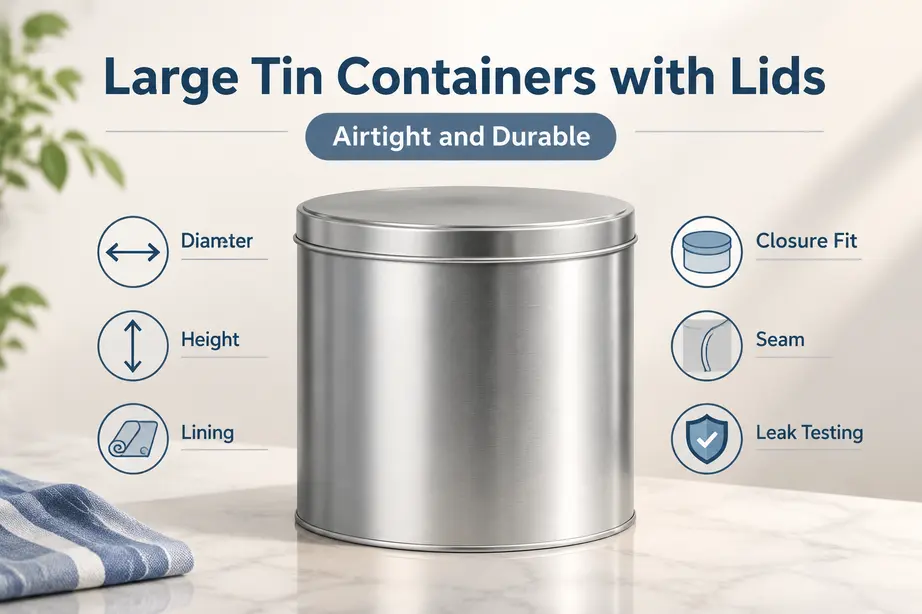
Large aluminum tins with lids look dead simple until freight starts nibbling your margin — a big body hauls mostly air, and air bills like cargo. You’re not buying metal; you’re buying liters that survive a pallet ride and a forklift jockey having a rough Tuesday. Gauge measured, seal tested, paperwork naming the regulation.
Compare cost per usable liter delivered. Include the tin, lid, packing and freight in each quote, then check that the closure suits the fill.
Large Aluminum Tins With Lids: A Field Guide to Buying Air, Metal, and Peace of Mind
→ Cost per liter shipped: Ask whether empty bodies nest and how lids are packed. Compare units per pallet at the quoted shipping height.
→ Gauge, read separately: Wall, lid, and base each carry their own number; thickness is not strength on its own.
→ Seal before size: Specify whether the lid must retain dry goods, contain liquid or protect the fill after repeated opening.
→ Alloy by fill: Compare the finished aluminum and tinplate samples for weight, stiffness and coating compatibility.
→ Paperwork, not promises: Demand coating name, regulation, migration limits, and ISO audit scope — then run a bulk trial before the container ships.
Dimensions, Gauges, and Tolerances of Large Tins With Lids
Big cans fix a dull, expensive problem: squeezing more product into the same truck. Size, wall gauge and tolerance calls decide how well that pays off. Here’s the plain-spoken rundown on buying large aluminum tins with lids in bulk.
Extra-large capacity, same shipping footprint
- Compare internal capacity at the intended fill line.
- At a fixed diameter, a taller body adds volume but may allow fewer pallet layers.
- Check whether nested bodies separate easily on the filling line.
- Ask how the spatial footprint was measured before trusting a big liter number.
- Include the cartons of lids and the maximum loaded pallet height.
What heavy-duty wall thickness really protects
Check the lid seat on samples after handling. A small change in rim shape can matter more to closure fit than a dent midway down the wall.
- Impact resistance — inspect the rim after a handling trial.
- Structural integrity — check that the closure still fits.
- Dent protection — inspect units from the bottom pallet layer.
Those traits stack into one protective barrier around the goods, and that’s why wall thickness and mechanical strength get quoted together. Any supplier, FANXUN included, should put the gauge on the spec sheet rather than in the sales pitch.
Wide diameter cylinders and extended height bodies: where tolerances tighten
Draw a wide pancake and a tall tube from the same sheet and the errors misbehave differently. Cylinder diameter drift widens the lid radial clearance quickly, so a cover that fit last week starts rattling. Body height drift is sneakier — it quietly eats stack height until a pallet won’t cube out. That’s why manufacturing tolerances for both numbers belong on one line of the drawing, not two departments. Wide, tall bodies also amplify draw-depth error, so dimensional accuracy and structural precision have to be checked on a finished large aluminum tins sample. Spec the diameter and the height together; form stability follows.
Reading a gauge chart without the jargon
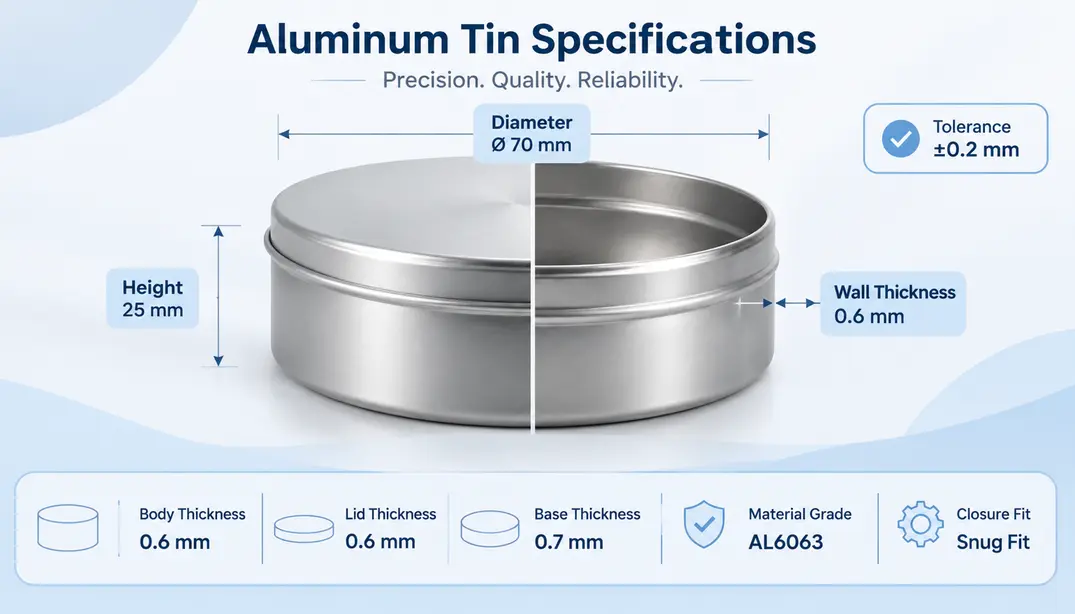
Ask which gauge convention the drawing uses. Record nominal thickness and tolerance in millimeters so the purchasing and inspection teams use the same units.
| Component | Dimension to request | Where to verify it |
|---|---|---|
| Body | Nominal sheet thickness and tolerance | Incoming sheet and agreed wall locations |
| Lid | Lid stock thickness | Closure drawing |
| Base | Base stock or formed base thickness | Drawing for the proposed construction |
Two traps. A conversion table built for steel will steer you wrong on aluminum. And alloy designation plus material grade deserve their own lines, because a 3003 body and a 5052 body behave nothing alike. Good technical specifications list wall, lid and base separately against the same thickness standard. Approve the quote only after those big aluminum cans with covers show three numbers, not one.
Aluminum Vs. Tinplate for Large Tins With Lids
Choosing metal for big containers comes down to weight, rust, and freight bills. Both options do the job. The trick is matching the metal to the fill and to the distance it travels, since a wrong call nags at you for the whole run.
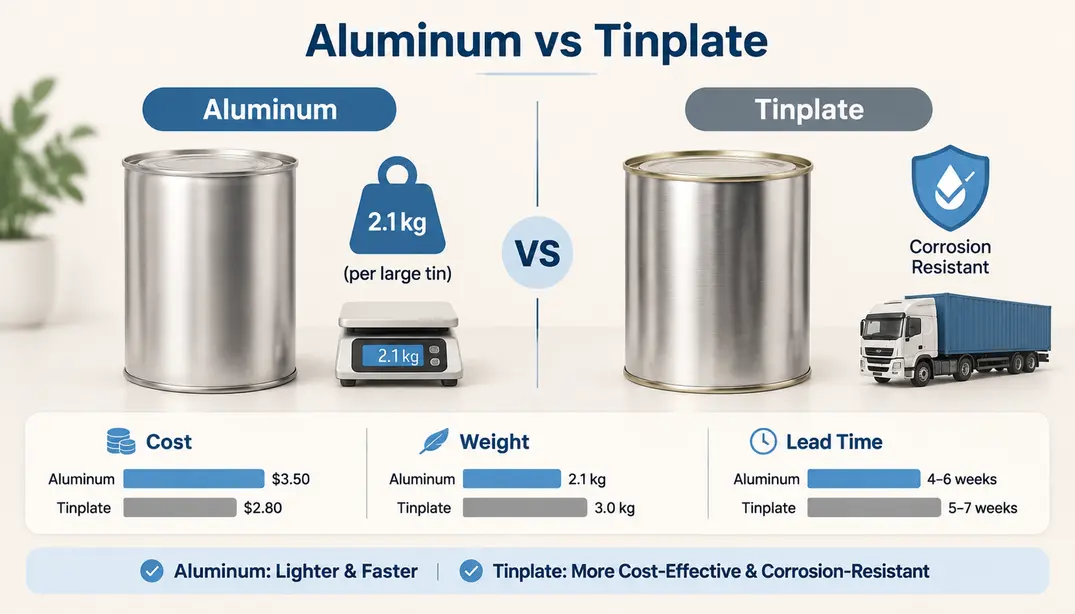
Aluminum
Aluminum can reduce empty packaging weight. Weigh the finished body and lid together, then ask whether the shipment reaches its volume limit before its weight limit.
- Corrosion resistance — check the alloy and coating against the fill and storage environment.
- Malleability — inspect the formed sample around the rim and base.
- Surface finish — approve a printed sample with the specified finish.
For heat-sensitive fills, give the supplier the filling and storage temperatures. If recycled content matters to your purchasing specification, request documentation for the proposed sheet.
Tinplate
Tinplate has a steel body with a thin tin coating. When comparing food can formats, distinguish a resealable storage lid from a closure intended for thermal processing.
Check the tin coating wherever the fill is acidic. For tinplate pails, inspect the rim and seams for damage and ask how exposed areas are protected.
Cost, freight, and lead time compared
Request comparable quotes for the same usable volume, order quantity and delivery point. A change in packed dimensions can affect freight even when the empty tin weighs less.
| Factor | What to compare for aluminum and tinplate |
|---|---|
| Metal and fabrication cost | Price for a complete body and lid at the same quantity |
| Weight per 1,000 tins | Measured sample weight and total packed weight |
| Bulk fabrication lead time | Quoted production window and separate transit estimate |
Weigh raw material expenses against shipping weight, not price per can alone. For food applications, start with FANXUN’s food can range. For an industrial fill that needs a removable head, compare the metal pail and lid options and confirm the material available for your size.
Food-Contact Rules for Large Aluminum Tins With Lids
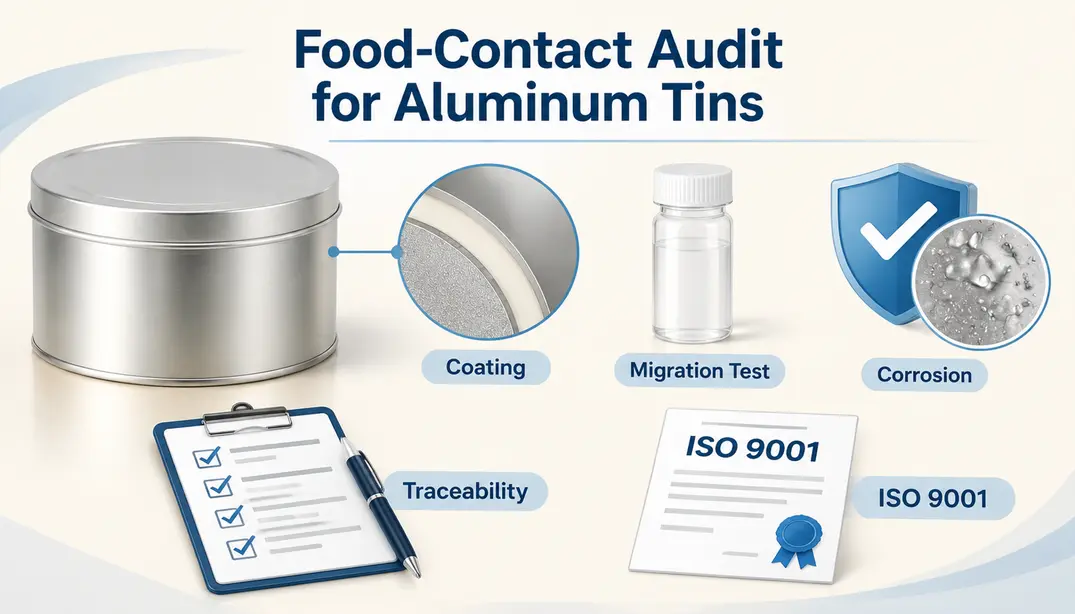
Size is the easy part. What actually decides if a pallet of large aluminum tins with lids clears your buyer’s audit is the coating recipe, the alloy underneath, and the paper trail nobody asks for until something goes wrong.
Food-grade inner coating: what the certificate should actually say
The words “food grade” alone tell you nothing useful. Ask the supplier to identify the intended market and provide documentation for each food-contact component:
- the polymer lining by product code, including the applicable basis for resinous and polymeric coatings in the US;
- the applicable EU food-contact framework and any measures specific to the coating or gasket;
- migration test data where applicable, listing limits, simulant, contact time and temperature;
- if the sheet skips test conditions, treat the number as decoration;
- the basis for any bisphenol claim and, for a reusable food-contact rubber seal sold in the US, whether the provisions for rubber articles intended for repeated use apply.
Corrosion-resistant metal inside a wet food plant
If the tins will be exposed to washdown, give the supplier the cleaner, concentration, temperature and contact time. Inspect the rim and seams after representative cleaning cycles and check for water trapped under the lid.
Chemical reaction resistance when the fill turns acidic
For tomato sauce, vinegar or citrus, give the coating supplier the recipe, pH, fill temperature and expected storage time. Match the evidence to the actual food type and conditions of use. A report for room-temperature storage may leave hot filling outside its scope.
ISO manufacturing compliance, audited rather than assumed
If the supplier cites ISO 9001, check the quality management system certificate, its scope and its current status. For the proposed packaging, ask for:
- quality management scope — does the certificate cover this specific line?
- the third-party audit report, latest cycle, findings closed out;
- traceability from coil lot to finished tin;
- including the standard operating procedure for seaming;
- compliance verification records and the expiry date on the document.
Big aluminum containers with covers are only as good as the quality assurance behind them. Ask for the paperwork on the large aluminum tins with lids you are about to sign for.
3 Checks Before Buying Large Aluminum Tins With Lids
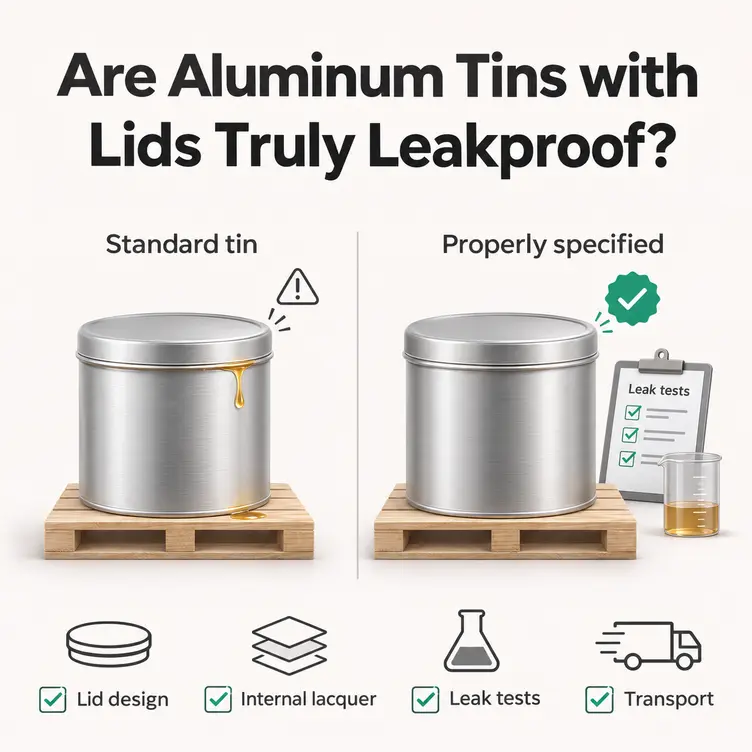
Large aluminum tins with lids are a dull purchase right up until a pallet shows up leaking. Three checks — the seal, the paperwork, the trial run — save you from eating a container of ruined stock.
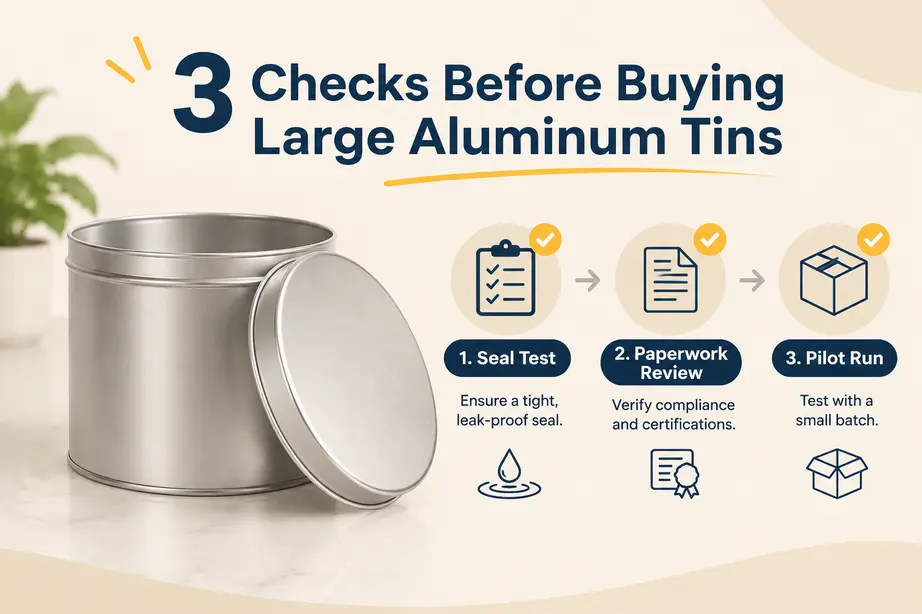
Start with the seal and the intended fil
For dry goods such as cookies stored in metal tins, check how the lid fits after repeated opening. For a liquid fill, inspect the gasket and trial the assembled closure with the actual product. A sideways water check can reveal a visible leak, but establishing airtightness requires a defined method and acceptance limit. For US thermally processed low-acid foods in hermetically sealed double-seam cans, review the required closure inspections and seam examinations.
Which transport tests apply to this package?
Verbal promises cost nothing. Ask for paper.
- Identify the fill, route and applicable transport rules. For US shipments of hazardous materials, check that the design is an authorized packaging for the material.
- Where the US design qualification rules apply, request the relevant stacking test and drop test records.
- For liquid packagings subject to the US leakproofness test, check the packaging type and applicable exceptions.
For an ordinary storage tin, agree on acceptance criteria for the actual package and distribution route:
| Check | What to record |
|---|---|
| Wall thickness | Drawing revision, tolerance and measurement location |
| Stacking | Filled unit weight, stacking arrangement and duration |
| Closure | Lid and gasket identification, test method and acceptance limit |
Order a bulk fabrication trial before you commit
Bulk fabrication lives and dies on schedule, and schedules slip. So:
- Request a pilot batch — agree on the quantity and use production tooling where feasible
- Inspect seams, lid fit, coating coverage
- Run your own quality inspection on arrival
- Push for prototype testing with your actual product inside
- Set material evaluation notes beside the spec sheet
Big metal tins ordered blind are a gamble. A trial sample costs a little; a rejected manufacturing run costs a fortune — settle it before large aluminum tins with lids fill a whole container.
Review FANXUN’s material inspection process, then send the fill details and drawing to FANXUN to confirm which can and lid can be sampled.
References
- 21 CFR 175.300 — Resinous and polymeric coatings — eCFR
- Legislation on food contact materials — European Commission
- 21 CFR 177.2600 — Rubber articles intended for repeated use — eCFR
- Food Types & Conditions of Use for Food Contact Substances — FDA
- ISO 9001:2026 — Quality management systems — Requirements — ISO
- 21 CFR 113.60 — Containers — Cornell Legal Information Institute
- 49 CFR 173.24 — General requirements for packagings and packages — Cornell Legal Information Institute
- 49 CFR 178.606 — Stacking test — Cornell Legal Information Institute
- 49 CFR 178.603 — Drop test — Cornell Legal Information Institute
- 49 CFR 178.604 — Leakproofness test — Cornell Legal Information Institute