
 English
 العربية
 Bosanski jezik
 Čeština
 Dansk
 Nederlands
 Wikang Filipino
 Suomi
 Français
 Deutsch
 Magyar
 Íslenska
 Bahasa Indonesia
 Italiano
 日本語
 한국어
 Bahasa Melayu
 Polski
 Português
 Русский
 Cрпски језик
 Español
 ภาษาไทย
 Türkçe
 Tiếng Việt

To design a standout custom aluminum can, start with the supplier’s approved drawing and print template, keep critical graphics clear of the shoulder and neck, and approve color and coating performance on physical samples. For FANXUN aluminum aerosol projects, confirm the intended contents, valve fit, and application-specific lining before releasing artwork.
A custom aluminum can looks gorgeous on screen, then a stretched logo shows up on pallet number forty. Ouch. That’s the gap between a pretty file and a real production run.
Neck profile, lacquer, and color all push back on your artwork, so smart design starts with the factory floor. Here’s how to get it right before it costs you.
Key Points: Where Custom Aluminum Can Artwork Meets the Factory Floor
→ Know Your Canvas: Diameter sizing, overall height, and the neck profile define your printable area, so keep key graphics clear of tapered zones.
→ Pick the Right Print: Confirm the supplier’s press, setup costs, and proof options for your can format; UV curing alone does not determine economical run length.
→ Match Inks and Coatings: Match exterior inks, base coats, and varnish; specify the internal lining separately for the intended contents.
→ Proof Before Production: Check color shifts, coating adhesion, and dimensional inspection before approving pallets.
Core Elements of Aluminum Can Artwork
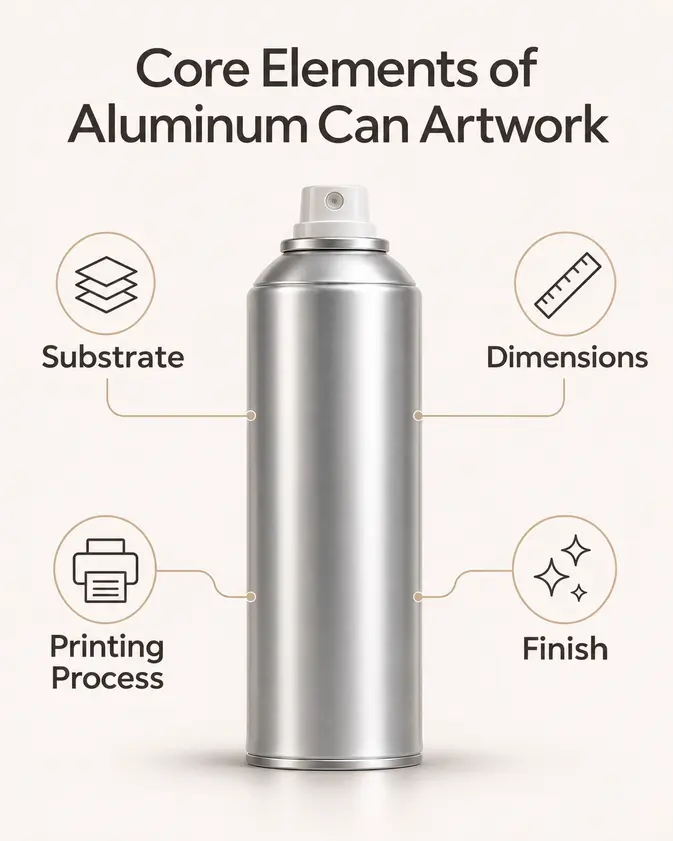
A custom aluminum can works like a tiny billboard people hold in their hands. Before any ink hits the metal, you need to know four things: what you’re printing on, how big the can is, which press fits your plans, and how the finish feels. Get those right and your design does the talking.
Choosing a Recyclable Aluminum Can as Your Canvas
For FANXUN’s monobloc aluminum aerosol format, an aluminum slug is formed into a seamless can body. The metal substrate then needs cleaning and a compatible coating system before printing.
- Why it works
- Sustainability: aluminum cans can be recycled, but collection rules vary by location and contents. Avoid broad, unqualified eco-friendly claims; describe specific, substantiated benefits instead.
- Surface reflectivity: exposed metal can contribute a metallic effect where the approved ink and base-coat system allows; confirm the effect on a physical sample.
- What to watch
- A raw finish can look patchy. Specify the exterior base coat for appearance and ink compatibility; the internal lining serves a separate contents-compatibility purpose.
Why Diameter Sizing and Overall Height Shape Your Layout
Your can dimensions set the printable area. Height and circumference decide the aspect ratio, which is the shape your flat artwork has before it wraps around the can.
| Layout input | What to confirm | Artwork implication |
|---|---|---|
| Body diameter | Approved can drawing | Establish the cylindrical wrap circumference, π × d |
| Overall height | Selected aerosol can format | Do not treat total height as printable height |
| Shoulder and neck | Profile and decoration limits | Keep critical text out of restricted zones |
| Print repeat | Supplier’s artwork template | Confirm the meeting point, gaps, and allowances |
Keep key graphic placement away from the print-repeat meeting point, and plan artwork alignment before anything else. A seamless monobloc can has no welded body seam; this is a decoration-layout boundary. Check the visual proportion too. The container geometry curves, so wide logos can look stretched on a narrow can.
Selecting a Printing Process for Your Can Format
The right print technology for your custom can depends on the can format, press, ink system, artwork, and order volume.
- Offset lithography
- Confirm plate setup and its cost for the selected production route.
- Agree on color vibrancy and repeatability using an approved proof and production checks.
- Curing and finishing
- Confirm the actual curing process with the supplier; UV curing is not itself a short-run printing method.
- Evaluate resolution and ink adhesion on the actual coated substrate.
- Confirm the available finishing style for the selected can.
Planning a big launch or a limited drop? Confirm the available process, setup cost, and sampling plan with FANXUN before choosing.
Matte Finish and Embossed Lettering for Tactile Appeal
The sensory experience matters when buyers handle the finished can.
- A matte varnish coating creates light diffusion, which cuts harsh glare under store lights.
- Raised relief lettering adds texture; confirm its feasibility for the selected can and assess handling on a sample.
- Ask whether a soft-touch specialty coating is available for your selected aluminum aerosol can; approve its feel and durability on a sample.
To compare finishes consistently, agree on a specular-gloss measurement method and suitable specimen geometry; a curved can requires an agreed measurement setup.
5 Steps to Build Your Custom Aluminum Can Artwork
A great custom aluminum can design doesn’t happen by luck. It comes from a clear plan, smart file prep, and a few checks that save you headaches later. Here’s how to get from a rough idea to print-ready art without wasting cash on a reprint or blowing your launch date.
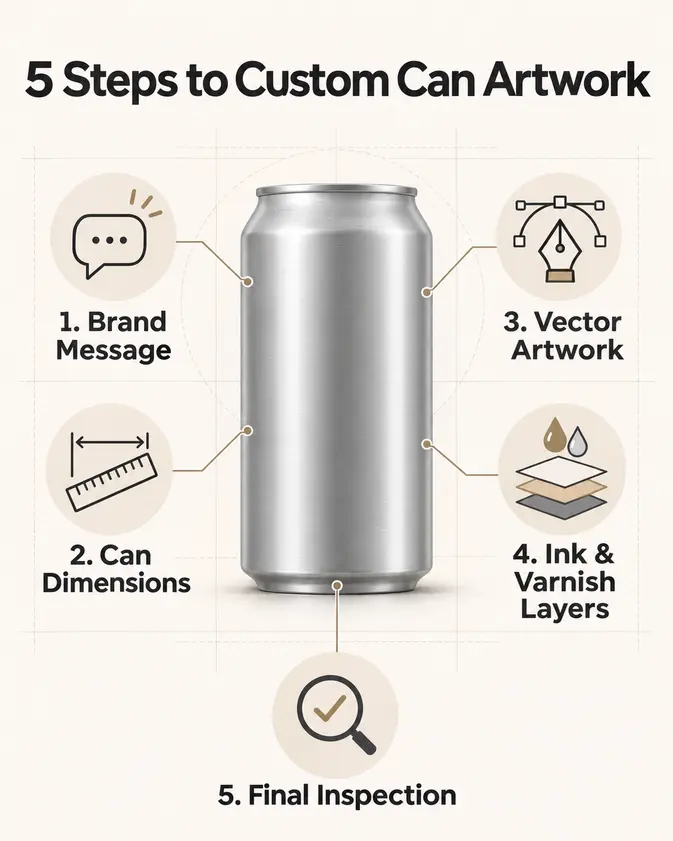
Define Your Brand Message and Can Dimensions
- Message
- Nail down your brand identity and target audience before you sketch anything.
- Pick visual elements that say one thing clearly.
- Size
- Confirm can dimensions, capacity, and the container silhouette.
- Your graphic design has to fit the actual custom aluminum can, not a guess.
For aerosol projects, confirm the valves and actuators and overcap fit before finalizing the silhouette and artwork clearance.
Prepare Artwork Files Around the Neck Profile
The neck profile is where the metal gets squeezed inward, so art placed there can warp. Keep logos and small text below that curvature.
- Build artwork files as vector graphics on the supplier’s print template.
- Add the specified bleed area and double-check design alignment at the print-repeat boundary.
Match Inks and Linings to the Intended Application
- Safety
- Specify the intended contents and destination market. For food-contact applications, assess constituent transfer under intended use rather than treating “food grade” as a universal ink approval. Applicable EU GMP rules address transfer from exterior printing to the food-contact side.
- Performance
- Confirm substrate adhesion between the exterior base coat, printing inks, and varnish.
- Validate the internal lining’s chemical resistance against the intended formulation; exterior print durability is a separate requirement.
Add Varnish Protection for Lasting Durability
A coat of varnish is cheap insurance for any custom aluminum can.
▸ Protective coating adds scratch resistance on busy filling lines.
▸ An exterior surface seal can reduce moisture exposure and scuffing; confirm performance under the intended handling conditions.
▸ A gloss finish pops on the shelf, while a matte finish feels premium in the hand.
Confirm Dimensional Inspection Before Final Approval
- Check the build
- Dimensional inspection on a prototype confirms height, diameter, and neck tolerance.
- Sign off
- Compare the results to your specifications during pre-press.
- Solid quality control and a clear proof approval reduce rework risk on your custom aluminum aerosol can run.
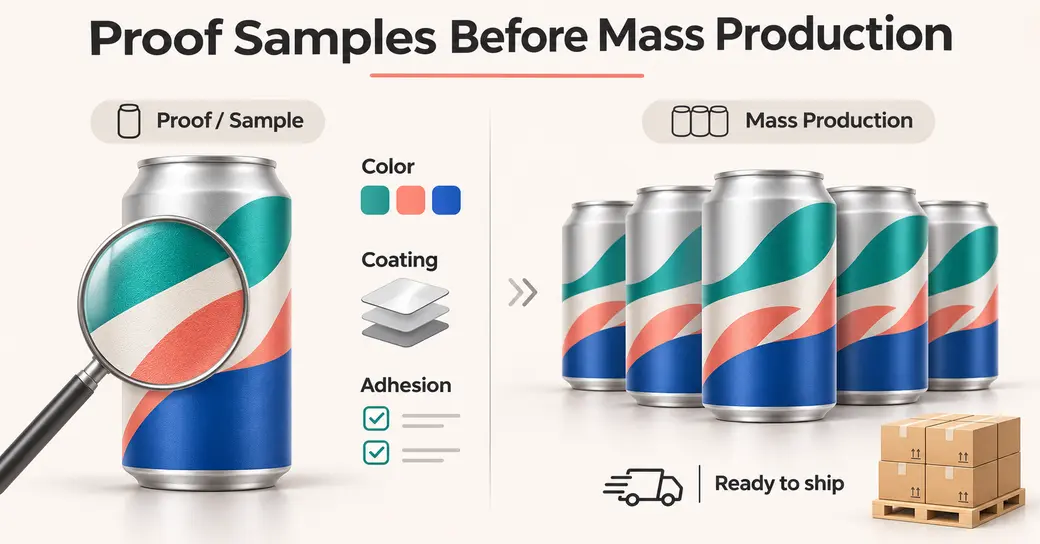
Colors Look Off? Request Proof Samples Before Mass Production.
Nobody wants 50,000 cans in the wrong shade of red. Before a custom aluminum can order goes full speed, proof samples show how your colors, coatings, and finish really behave. Catch problems early, and fixing them stays cheap.
Spotting Color Shifts Caused by Surface Degreasing and Coatings
Your design file and the finished custom aluminum can rarely match right away. Here’s where the drift sneaks in:
- Before printing
- Surface degreasing cleans oil off the aluminum substrate. Residue or inadequate preparation can impair coating adhesion; a color change alone does not identify a chemical reaction.
- Base coats can tint whites gray or warm.
- After printing
- A protective coating can deepen tones a little.
- Check pigment consistency across several cans, not just one.
- Checking it
- Do a visual inspection under the same lamp every time. Spot a color shift? Flag it now.
Agree on viewing conditions for print comparison and a physical reference before judging color; the cited standard’s public abstract covers reflective prints and excludes soft-proofing displays.
Coating Adhesion and Deformation Resistance Checks on Samples
Pretty colors on a custom aluminum can mean nothing if the ink flakes off in a cooler. Solid sample evaluation includes some hands-on physical testing:
→ Adhesion test: agree on a suitable tape-test method for coated metal and acceptance criteria; surface preparation and coating thickness matter.
→ Scratch and hardness checks: dragging a key is not a standardized adhesion test. A pencil-hardness method assesses film hardness on a hard substrate, not overall package durability.
→ Bend, squeeze, and drop checks: agree on specimen geometry, conditions, and acceptance criteria with the supplier; use empty samples and qualified testing personnel.
These checks address different failure modes. For UK-bound filled aerosols, applicable leakproofness testing before carriage is a separate requirement; informal handling checks do not replace it.
Locking In Approval Before Pallet Configuration and Shipping
Get final approval in writing before anyone touches pallet configuration. Once branded aerosol cans are shrink-wrapped and stacked, fixing a bad batch is a total headache.
A proper quality sign-off confirms a specification match on color, coating, and size. Only then should mass production and shipping preparation start.
For filled aerosols shipped as dangerous goods, confirm applicable package marking, labelling, and transport documentation with the filler and logistics provider before shipping preparation.
FANXUN’s customization workflow includes design collaboration and sample development. Agree on the proof, inspection criteria, and release conditions for your specific order.
References
- How Do I Recycle Common Recyclables — U.S. Environmental Protection Agency
- Environmental Claims: Summary of the Green Guides — Federal Trade Commission
- ASTM D523-25: Standard Test Method for Specular Gloss — ASTM International
- Regulation (EC) No 1935/2004: Materials and articles intended to come into contact with food — European Parliament and Council / EUR-Lex
- Regulation (EC) No 2023/2006: Good manufacturing practice for food-contact materials — European Commission / EUR-Lex
- ISO 3664:2025: Graphic technology and photography — Viewing conditions — International Organization for Standardization
- ASTM D3359-23: Standard Test Methods for Rating Adhesion by Tape Test — ASTM International
- ASTM D3363-22: Standard Test Method for Film Hardness by Pencil Test — ASTM International
- Leakproofness Testing of Aerosols — UK Vehicle Certification Agency
- Consignment procedures — UK Health and Safety Executive



