 English
 العربية
 Bosanski jezik
 Čeština
 Dansk
 Nederlands
 Wikang Filipino
 Suomi
 Français
 Deutsch
 Magyar
 Íslenska
 Bahasa Indonesia
 Italiano
 日本語
 한국어
 Bahasa Melayu
 Polski
 Português
 Русский
 Cрпски језик
 Español
 ภาษาไทย
 Türkçe
 Tiếng Việt

For automotive aerosol buyers, the first question is whether the proposed lining will hold up against the actual fill. Spec the can before the PO.
Specify five items together: can body, internal lacquer, valve, propellant and crimp. Have the filler review the combination before you compare quotes.
Quick Answers: Custom Aerosol Packaging Automotive — Spec the Can Before the PO
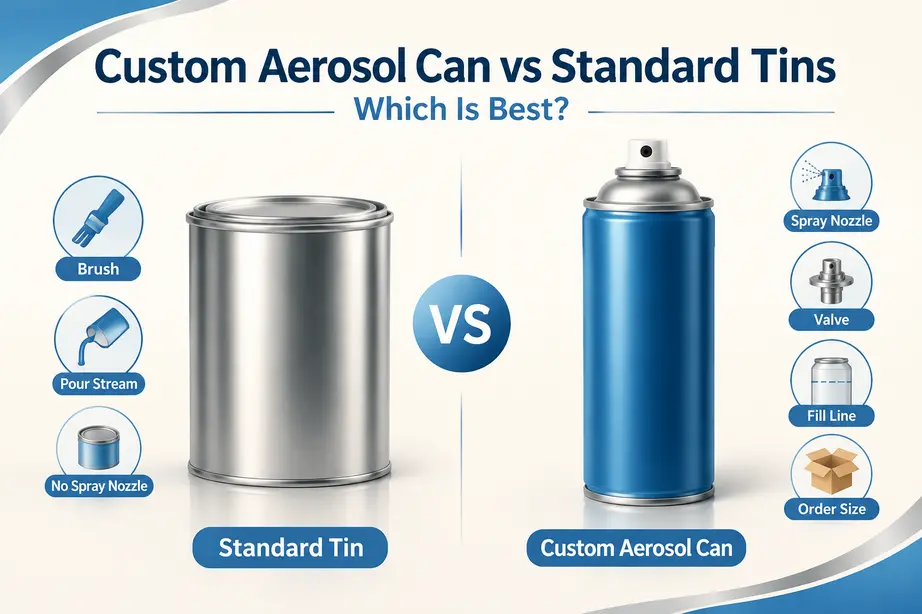
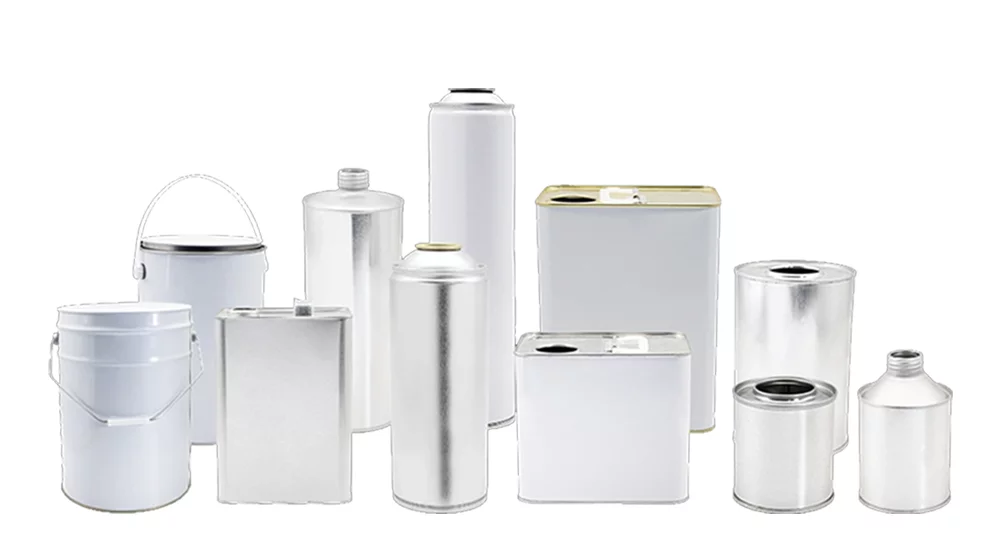
- Tinplate vs. aluminum: Compare tinplate aerosol cans and aluminum aerosol cans at the same fill volume, pressure rating and order quantity.
- Internal lacquer: Epoxy-phenolic linings resist solvent attack, but compatibility depends on your actives — run accelerated aging panels before approving tooling.
- Valve choice: Consider continuous spray for panel coverage. Specify the required dose separately if a touch-up application needs metering.
- Propellant match: Compare propellant options against the formula, working pressure and target valve delivery rate.
- Crimp and burst testing: Obtain the crimp dimensions for the selected assembly and identify the pressure tests applicable to the can design.
Types of Custom Aerosol Packaging Automotive
Picking a shell for underbody spray or brake cleaner is unglamorous work, yet the wrong one bites you at the fill head and again at the claims desk. Four practical angles come up whenever custom aerosol packaging automotive projects get specified.
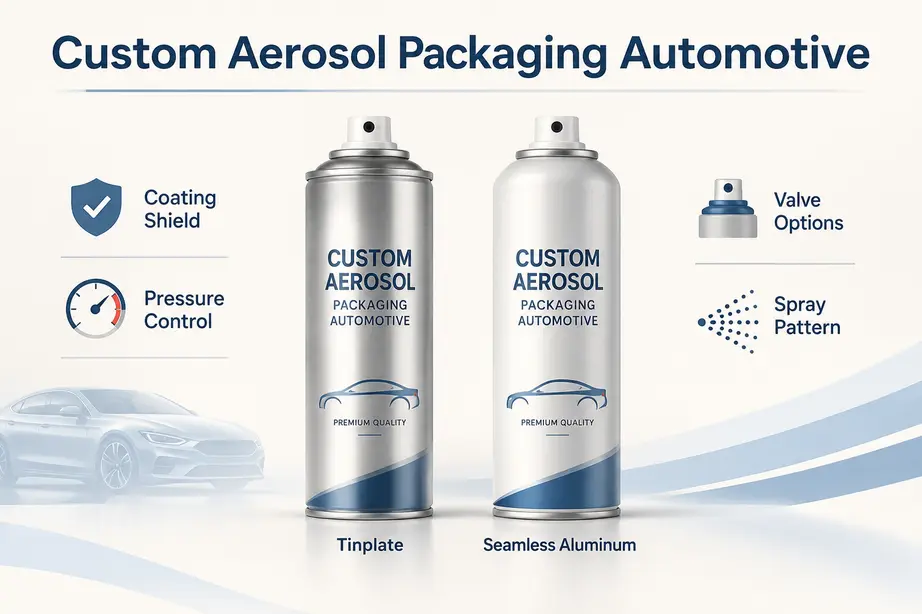
Tinplate aerosol can: the workhorse for chassis anti-rust spray
For a DOT 2P design, electro-tin plate is among the permitted materials. With solvent-heavy undercoating spray, two decisions belong on the can specification:
- Wall gauge and the protective coating get locked in before tooling is cut
- check the specified gauge against the applicable minimum wall thickness for DOT 2P if that design is selected
- metal packaging specs agreed in writing, not over the phone
- Chassis anti-rust formulas get checked against that lining
- record the lining chemistry and film thickness used on the samples
- confirm compatibility with the proposed fill before approving that coating
Aluminum aerosol container
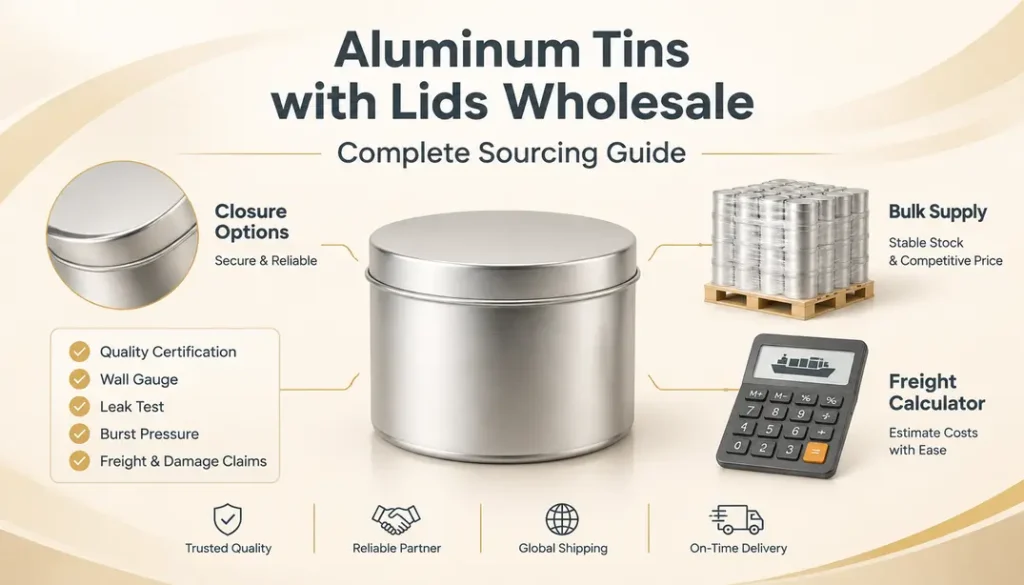
Seamless aluminum skips the side seam entirely. For DOT 2P, the manufacturing requirements also cover the pressure design of the ends. Compare the supplier’s rated designs at the size you need: DOT 2P limits both capacity and inside diameter. FANXUN offers both tinplate and aluminum, so ask for cost per thousand at the same finish and order quantity.
Can corrosion-resistant coatings survive solvent-based formulations?
Short answer: sometimes. An epoxy-phenolic interior lacquer is a candidate, but chemical compatibility hinges on the exact solvent-based formulation. Inspect aged samples for blistering or loss of adhesion and confirm the result in the finished pack.
- Bench panels come before tooling approval
- accelerated aging at elevated temperature
- adhesion check after a long soak
- Sign-off follows the formula, not the supplier
- corrosion-resistant coating approved one blend at a time
Skip that and a protective lining turns into the thing frustrated customers phone you about.
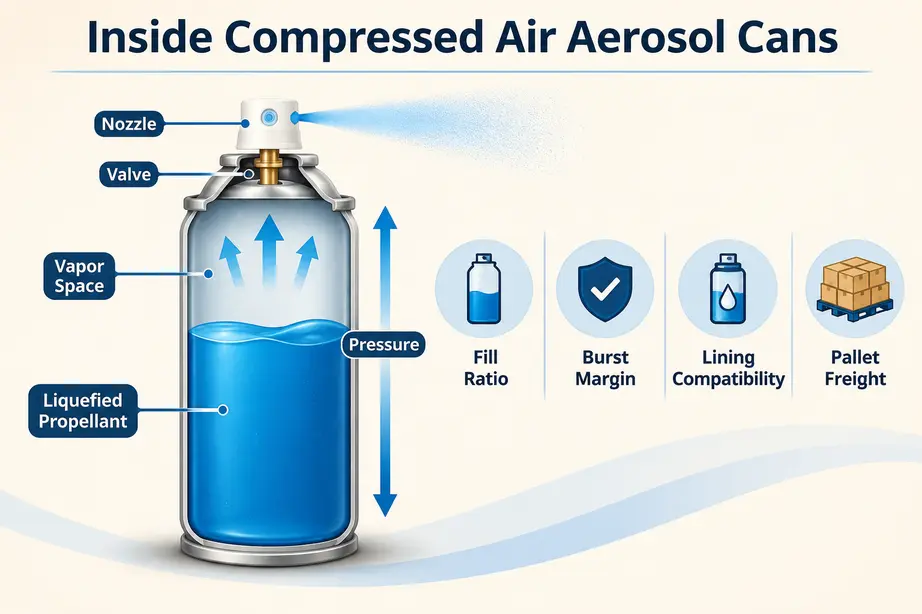
Matching high-pressure propellant to your active ingredients
Work through it in this order:
- Fix the active ingredients and the viscosity target
- Compare liquefied and compressed gases for the proposed fill. For coatings sold in the US, check the applicable aerosol coating emission limits for the formulation.
- Match valves and actuators to that pressure
- Confirm the spray pattern on a test rig, cold and warm
- Re-check formulation stability over the intended shelf life
Get gas pressure wrong and the dispensing system fights you for the life of the product. That sequence saves rework on any custom aerosol packaging automotive job, and it keeps aerosol containers for vehicle care out of the returns pile.
Valve and Actuator Choices for Refinish Spray Cans
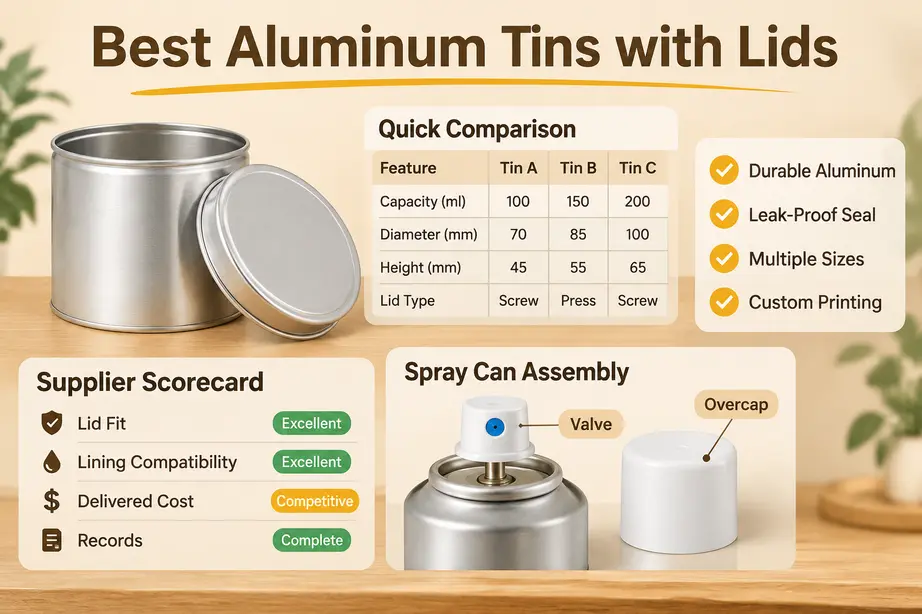
Valve choice decides how a refinish spray can behaves in the hand. When sourcing custom aerosol paint cans, assess the valve, button and cap as an assembly.
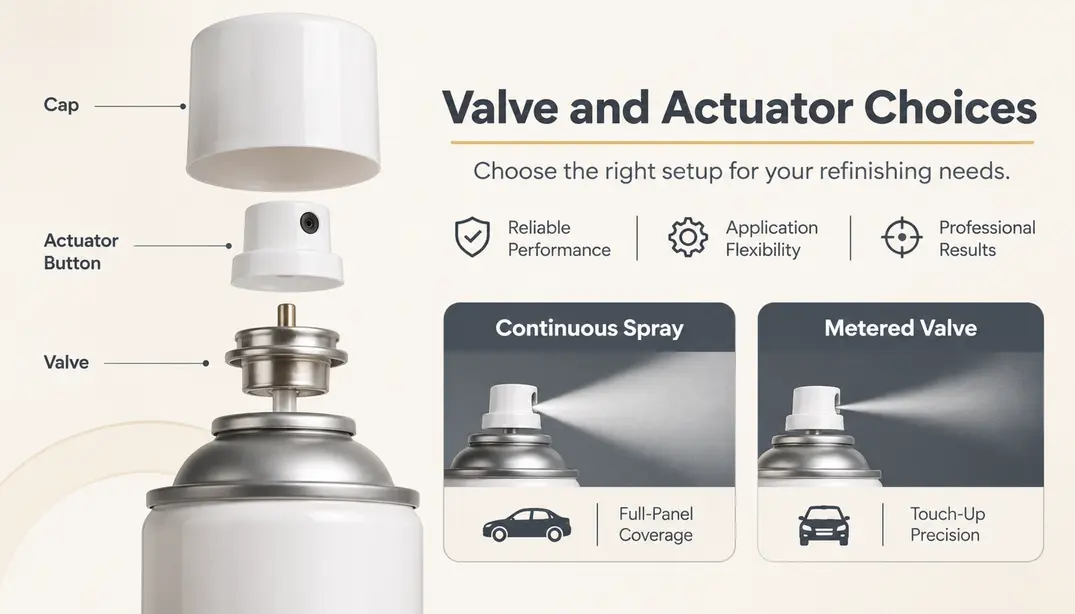
Continuous spray valve for full-panel coverage
A continuous spray valve keeps flowing while the finger stays down. For full-panel coverage, evaluate the wet edge and the number of passes on a representative panel.
- Coverage behavior
- Check whether the wet edge stays open across a door skin
- Measure spray pattern width at the coating supplier’s recommended working distance
- Inspect paint distribution on curves and body returns
- Where it fits
- Busy automotive refinish shops
- Brake cleaner and degreaser fills with a compatible valve and seal
- Clearcoat application where a hot edge would show
- Trade-off
- A continuous valve leaves the delivered quantity dependent on how long the operator presses the button
Metered valve for touch-up trials
For small spot repair jobs, a metering valve dispenses a nominal quantity per actuation. Test the delivered quantity and nozzle pattern with the actual paint before specifying a metered assembly.
- Pick the target application — a chip, a scratch, a door edge.
- Fire one dose, then feather the edge.
- Recoat after the flash time, never on a hunch.
For a FANXUN quotation, include the target delivery rate and the coating used for the trial. Ask which valve and actuator combinations are available for sampling.
Ergonomic spray button paired with a tamper-evident cap
Overhead work is where hands start complaining.
- Ergonomic spray button — wide face, less finger cramp on long underbody runs.
- Tamper-evident cap — a broken seal signals possible interference before use.
- Operator comfort — the boring win that keeps a tech steady past lunch.
- Packaging security — specify the closure features needed during distribution.
Specify the button and cap separately on the purchase order and confirm availability for the selected can.
Unstable Spray? Valve Selection for Automotive Aerosols
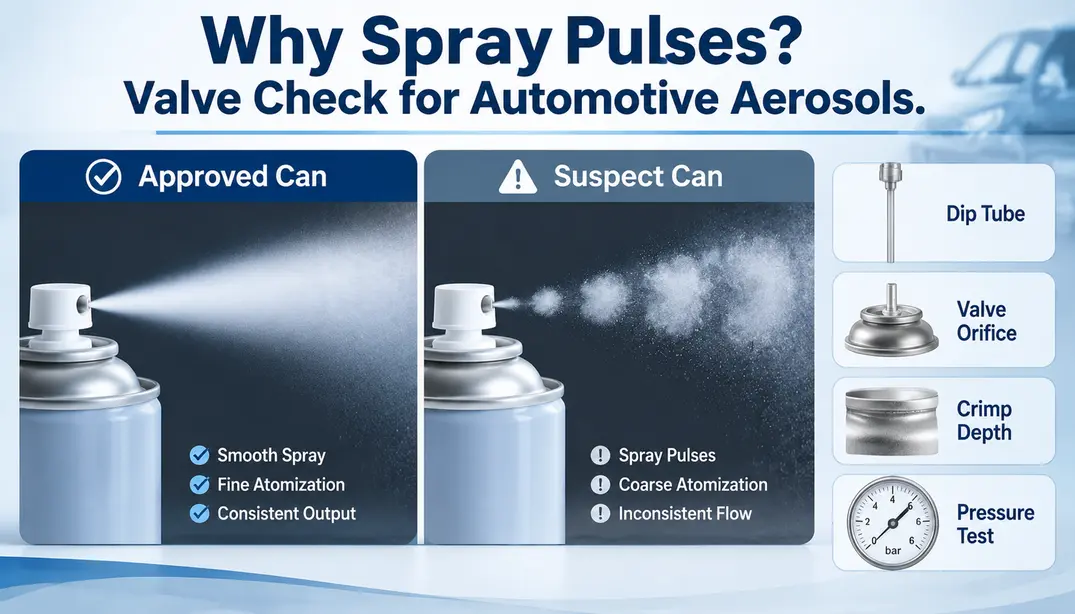
Consider both the formula and the hardware when a spray starts to spit. Compare a suspect pack with an approved sample under the same conditions.
Why does your spray pattern pulse and spit?
A pulse can occur when liquid and propellant reach the orifice unevenly. Check for these symptoms during a trial:
- Air locked in the dip tube
- a hiccup on the opening second of each burst
- spitting that settles once flow steadies
- Pressure drop behind a partly blocked orifice
- coarse atomization, fat droplets
- thick viscosity in cold weather making it uglier
Dip tube assembly and valve delivery rate
Tube length, bore and cut angle affect liquid pickup and delivery rate. A short tube can draw vapor while liquid remains. Check flow rate and gasket condition on the complete assembly.
Crimping machine settings that quietly ruin atomization
Depth and diameter affect gasket compression. Obtain the approved crimp dimensions for the can and valve cup, then check measured crimps and leakage on filled samples. Investigate deviations against those dimensions.
Pressure tests and records for US transport
For US shipments, identify the authorized container and filled-package conditions for the product first. If DOT 2P applies, request the lot pressure-test record for the finished empty container. Check the required markings against the sample and verify the full specification before accepting a claim of conformity. Mark the failure point too — dome, seam, or valve.
Before placing the PO, send FANXUN your fill volume, formula compatibility requirements and trial results to request samples and a comparable quote.
References
- 49 CFR § 178.33-5 — Material — U.S. Department of Transportation, via Cornell Legal Information Institute
- 49 CFR § 178.33-7 — Wall thickness — U.S. Department of Transportation, via Cornell Legal Information Institute
- 49 CFR § 178.33-6 — Manufacture — U.S. Department of Transportation, via Cornell Legal Information Institute
- 49 CFR § 178.33-2 — Type and size — U.S. Department of Transportation, via Cornell Legal Information Institute
- 49 CFR § 173.24 — General requirements for packagings and packages — U.S. Department of Transportation, via Cornell Legal Information Institute
- Aerosol Coatings: National Volatile Organic Compound Emission Standards — US EPA
- 49 CFR § 173.306 — Limited quantities of compressed gases — U.S. Department of Transportation, via Cornell Legal Information Institute
- 49 CFR § 178.33-8 — Tests — U.S. Department of Transportation, via Cornell Legal Information Institute
- 49 CFR § 178.33-9 — Marking — U.S. Department of Transportation, via Cornell Legal Information Institute
- 49 CFR § 178.33-1 — Compliance — U.S. Department of Transportation, via Cornell Legal Information Institute