 English
 العربية
 Bosanski jezik
 Čeština
 Dansk
 Nederlands
 Wikang Filipino
 Suomi
 Français
 Deutsch
 Magyar
 Íslenska
 Bahasa Indonesia
 Italiano
 日本語
 한국어
 Bahasa Melayu
 Polski
 Português
 Русский
 Cрпски језик
 Español
 ภาษาไทย
 Türkçe
 Tiếng Việt

Buying a lubricant oil can shouldn’t feel like a gamble. Compare quotes against the same drawing, closure and printed finish. Ask each supplier how you can check the assembled can with your oil before placing the order.
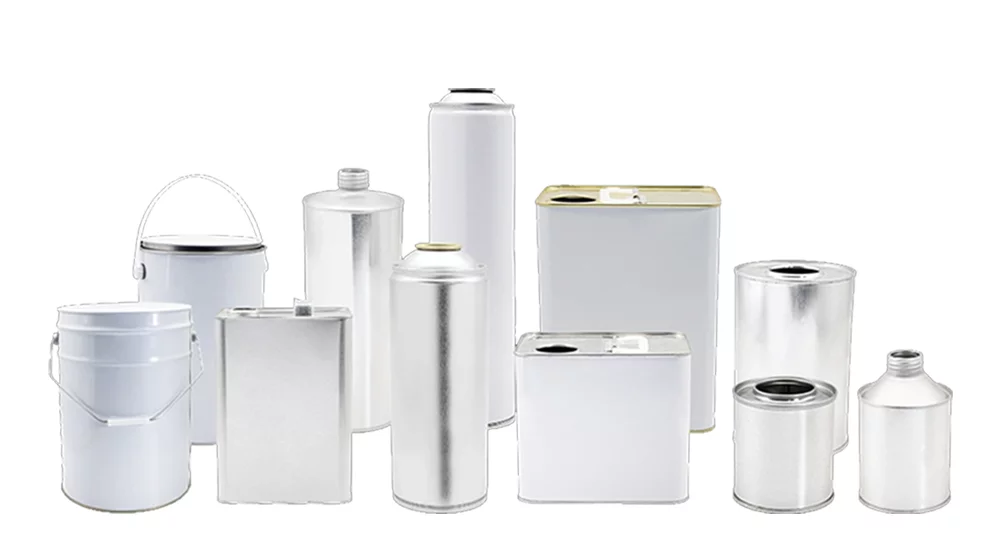
Start with FANXUN’s engine oil cans to shortlist formats for your filling line. If the customer dispenses from a larger container, compare metal pails and specify how the operator will lift and pour a full pack.
Quick Answers: Choosing a Lubricant Oil Can That Arrives Intact
- Material choice: Compare the filled weight, footprint and handling of actual samples.
- Lining match: Check the proposed interior finish with the lubricant you will sell.
- Five quality checks: Agree on handling, closure integrity, traceability, documentation and finish before production.
- MOQ economics: Setup, QC sampling and printing plates amortize across volume. Request separate prices for initial and repeat runs.
Tinplate vs. Aluminum: Lubricant Oil Can Materials
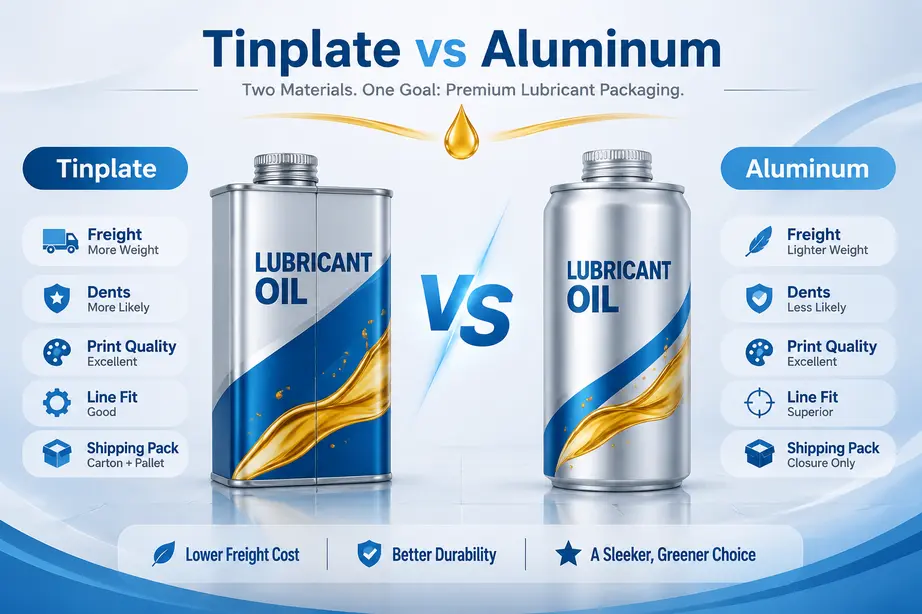
Choosing a shell for a lubricant oil can looks like a small call until freight bills and dented pallets show up. Two metals do most of the work, and each earns its keep in a different way.
Tinplate
Tinplate is steel with a thin tin coating. When comparing engine oil can shapes, take the shortlisted samples to the line. A square can and a round can of the same nominal capacity can require different guides and carton layouts.
- Body: Record the sheet specification and dimensions on the approved drawing.
- Surface: Approve a printed sample under the light used for incoming inspection.
- Seams: Inspect the side weld and end seams on the filled sample.
- Shipping pack: Ask for the packed weight, carton dimensions and agreed stacking limit.
Print quality is the quiet winner here. Fine type and tight color blocks come out sharp, which is why so many oil tins carry busy retail graphics.
Aluminum
An extruded aluminum body can eliminate the welded side seam. The end and closure still need checking. If a supplier proposes aluminum, ask whether the quoted format is suitable for non-pressurized oil and whether its neck fits your closure.
- Weigh both finished packs at the same fill volume.
- Compare packed quantities per pallet and freight quotes for your actual route.
- Check the interior finish against your formula and intended filling temperature.
Pick by what your filling line and your shipping lane actually demand.
Matching the Lining to the Lubricant
Start with the oil, the intended storage period and the highest expected filling and storage temperatures. For a container for motor oil, include every surface that touches the product, including the closure liner and exposed metal near seams.
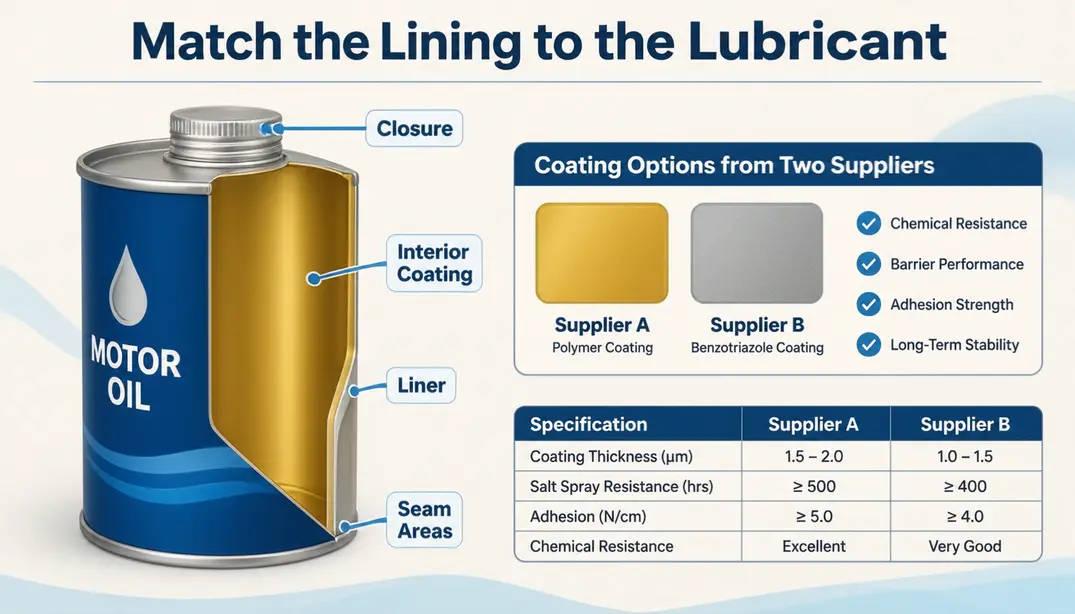
Comparing proposed lining systems
Ask for the coating designation and compatibility evidence for the proposed can. If two suppliers recommend different coatings, give both the same oil sample and acceptance criteria. Inspect retained samples for blistering, loss of adhesion, leakage and changes in the oil. Record the conditions and duration of the comparison.
What to record on the lining specification
| Specification item | What to request | What to compare |
|---|---|---|
| Interior finish | Coating designation and intended use | Match to the sample evaluated with the actual oil |
| Dry film thickness | Supplier’s target, tolerance and measurement locations | Readings on formed parts, including near seams |
| Curing and coverage | Inspection method and acceptance criteria | Results linked to the production lot |
If the additive package changes, review the approval with the filler and can supplier. Keep the previous sample and record which formula and coating were evaluated together.
5 Quality Checks Every Oil Can Needs
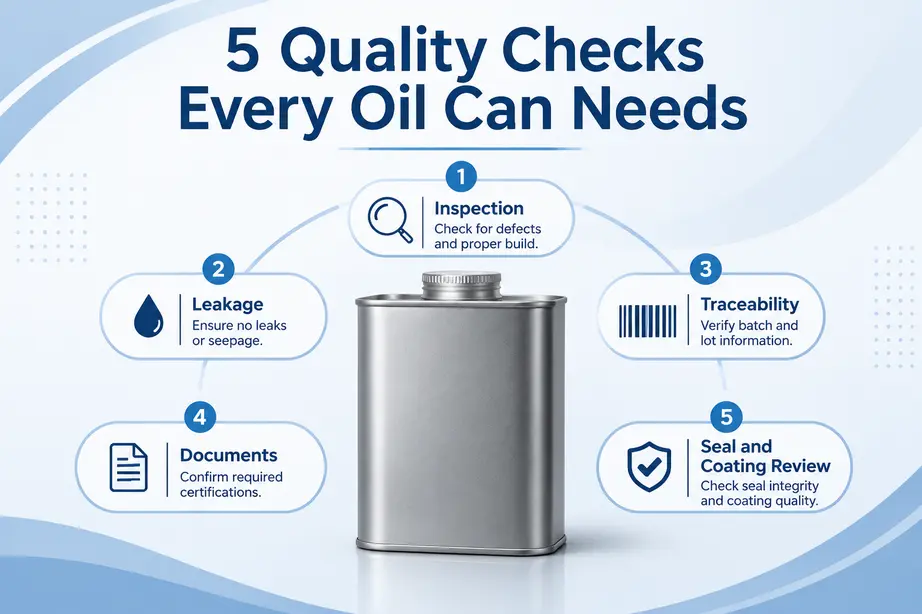
Use these five checks to turn a sample approval into an incoming inspection plan. The U.S. transport provisions below apply where the filled product and its packaging fall within their scope.
Handling, heat and stacking
Ask the filler to check the intended fill volume and headspace over the expected temperature range. For a U.S. hazardous-material shipment, check packaging compatibility and the applicable conditions of transport. For a combination pack, review how the inner cans are secured and cushioned inside the carton. Where Part 178 design testing applies, compare the proposed configuration with the one used for the drop test and stacking test. A result for a different carton or filled weight needs review.
Closure fit and leakage
Select the closure and spout together with the neck finish. Fit the sample on the filling line using the supplier’s closing instructions, then inspect the closure, side weld and end seams for seepage. Record the lot and closing settings so a failed check can be traced.
For regulated packaging, distinguish design qualification from production testing. Where the U.S. leakproofness test applies, check the result for the prescribed method and packaging type.
Batch traceability from carton to production record
When evaluating oil tin manufacturers, pick one carton and ask the supplier to trace it back to the production lot. Request the material record, closure lot and inspection result. Agree which identifier must remain legible at receiving and who can retrieve the records if a leak is reported.
Documents for the oil and the shipment
Start with the filled product’s classification. For U.S. hazardous-material transport, the shipper must determine whether the packaging is authorized. Check whether the shipment requires a shipping paper and which exceptions apply. For hazardous chemicals covered by U.S. workplace rules, review hazard communication requirements with the filler. The safety data sheet identifies handling precautions and storage incompatibilities in Section 7. Use the sheet for the actual lubricant grade.
Tamper-evident seal and anti-rust coating inspection
Inspect the seam and base for damage to the specified finish. If the design includes a tamper-evident seal, open a retained sample and check that the intended evidence of opening is visible. Add photographs of acceptable and rejected examples to the purchasing specification.
Do You Know How MOQ Shapes Unit Price?
Ever wonder why the same lubricant oil can comes back with two wildly different prices at 10,000 versus 50,000 units? Compare the empty packaging at each volume, including the closure, printed finish, cartons and delivery terms.
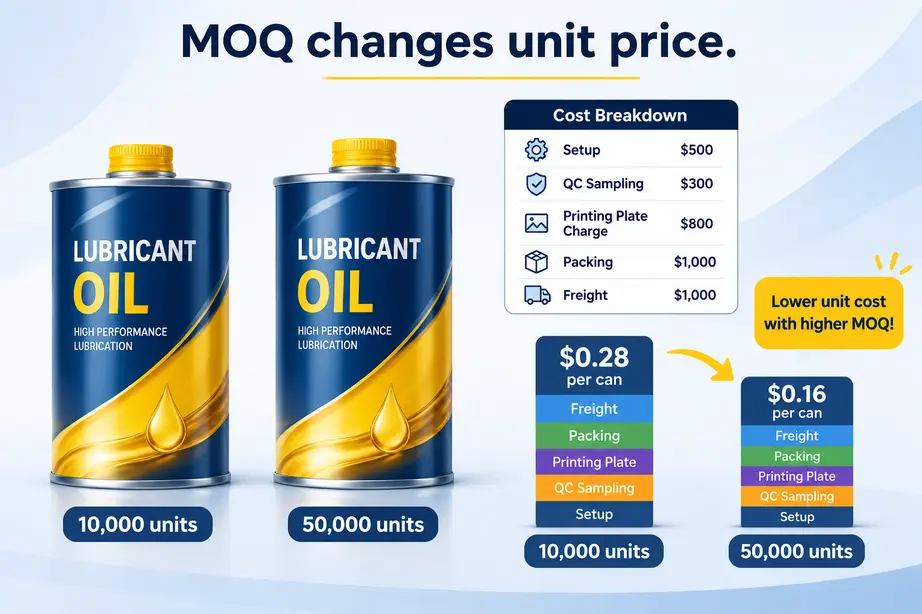
Why a small MOQ quietly raises per-can cost
Ask the supplier to separate the costs that recur per can from the costs charged once per run.
- Setup and changeover: which charges recur for a second order with the same artwork?
- Quality control sampling: what inspection is included at each volume?
- Material procurement: does the price tier require one shipment or a commitment across several releases?
For a fixed setup charge, halving the run doubles that charge per can. The rest of the unit price depends on the quote.
Comparing quotes at 10,000 and 50,000 units
| Cost line | What to hold constant | What to request at each volume |
|---|---|---|
| Empty can and closure | Approved drawing and component list | Unit price for the assembled pack |
| Printing | Artwork, colors and finish | Plate charge and repeat-order terms |
| Packing and freight | Carton, pallet and delivery point | Packed quantity and delivered cost |
Ask for both quotes in the same currency and check which charges are already included. Give the filler a sample to confirm the usable capacity before approving a capacity claim on the artwork.
Private label printing plates and how they amortize
For metal lithography, confirm which artwork changes require a new plate and who pays for it. If the plate charge is the same at both volumes, the allocation is straightforward.
- 10,000 cans → plate cost per can feels heavy
- 50,000 cans → same plate set, a fifth of the weight
To request a packaging quote from FANXUN, send the can drawing or target capacity, closure choice, artwork, quantities and delivery point. Ask for the plate charge as a separate line so you can compare the first order with a repeat run.
References
- 49 CFR § 173.24 – General requirements for packagings and packages. — U.S. Department of Transportation, via Cornell Legal Information Institute
- 49 CFR § 173.24a – Additional general requirements for non-bulk packagings and packages. — U.S. Department of Transportation, via Cornell Legal Information Institute
- 49 CFR § 178.603 – Drop test. — U.S. Department of Transportation, via Cornell Legal Information Institute
- 49 CFR § 178.606 – Stacking test. — U.S. Department of Transportation, via Cornell Legal Information Institute
- 49 CFR § 178.601 – General requirements. — U.S. Department of Transportation, via Cornell Legal Information Institute
- 49 CFR § 178.604 – Leakproofness test. — U.S. Department of Transportation, via Cornell Legal Information Institute
- 49 CFR § 173.22 – Shipper’s responsibility. — U.S. Department of Transportation, via Cornell Legal Information Institute
- 49 CFR § 172.200 – Applicability. — U.S. Department of Transportation, via Cornell Legal Information Institute
- 1910.1200 – Hazard Communication. — Occupational Safety and Health Administration
- 1910.1200 App D – Safety Data Sheets (Mandatory) — Occupational Safety and Health Administration