 Tiếng Việt
 English
 العربية
 Bosanski jezik
 Čeština
 Dansk
 Nederlands
 Wikang Filipino
 Suomi
 Français
 Deutsch
 Magyar
 Íslenska
 Bahasa Indonesia
 Italiano
 日本語
 한국어
 Bahasa Melayu
 Polski
 Português
 Русский
 Cрпски језик
 Español
 ภาษาไทย
 Türkçe

A typical electronics duster sold as “compressed air” contains liquefied propellant and its vapor inside a metal can. Pressing the actuator opens the valve and releases vapor through the nozzle. Some other aerosol packages use compressed gas to push a separate liquid product out.
For a pallet order, the fill specification, khả năng tương thích lót, pressure rating and packed weight all affect the choice of packaging.
Câu trả lời nhanh: What Truly Defines Compressed Air Aerosol Cans
- Shell: Check the construction shown on the can drawing. Both seamless and seamed bodies exist.
- Van: A continuous valve stays open while the actuator is depressed. A metered valve delivers a measured dose.
- Đổ đầy: The specification identifies the propellant. Net weight alone cannot tell you its share.
- Áp lực: Compare ratings at the same temperature.
- Kim loại: Compare the finished can and its lining against the proposed fill.
Five Packaging Features to Check on an Aerosol Duster
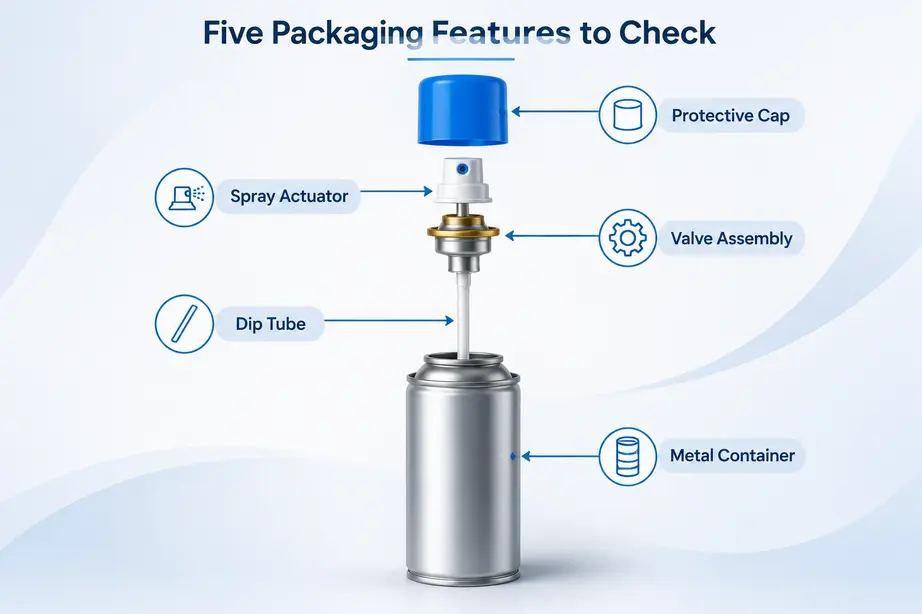
A compressed air aerosol can looks simple from the outside. A drawing lets you trace how the aerosol can works an toàn, từ container and actuator to the outlet.
Metal Container: The Pressurized Shell
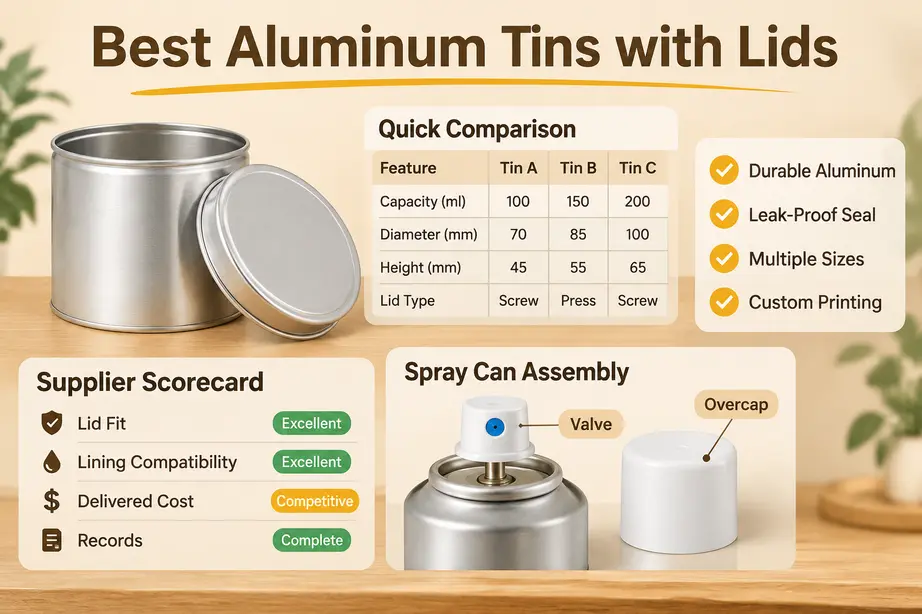
MỘT DOT 2Q container can be seamless or seamed. For an assembled tinplate body, phù hợp với can top and bottom to the body drawing before specifying the valve cup.
Valve Assembly and Flow Control
Under the crimped cup sits the thân van, and it works in three quick beats:
- Các cơ chế mùa xuân holds the stem shut against the đệm cao su.
- Pressing the actuator moves the stem and opens the flow path.
- Let go and the spring snaps it closed again — the real kiểm soát dòng chảy point for every blast of air.
Continuous Spray Actuator and Extension Trigger Nozzle
Two parts do the aiming. Các nút phun — or a miếng đệm ngón tay on trigger models — cracks the valve open, then the đầu vòi phun Và lỗ thoát nước decide how the stream behaves:
- Một chiều rộng directional spout for sweeping dust off a keyboard.
- The clip-on extension straw pokes into vents and instrument gaps.
- Hold the actuator down for the required burst on a continuous valve.
When a Dip Tube Is Needed
In a liquid-dispensing aerosol, a dip tube can carry liquid from the base to the valve. In a typical upright duster the outlet draws vapor from above the liquid. Check the pickup arrangement on the drawing before choosing a valve for a liquid-dispensing aerosol or a vapor duster.
Protective Cap and Valve Protection
A protective cap can shield the actuator from accidental contact. Specify a tamper-evident feature separately if the pack needs one. For US shipments under the recycling or disposal exception, PHMSA explains why removing the nozzle alone may leave the valve exposed to accidental discharge. A cap should never be treated as evidence of a controlled pressure-release feature.
How Much Propellant Sits in a Compressed Air Aerosol Can?
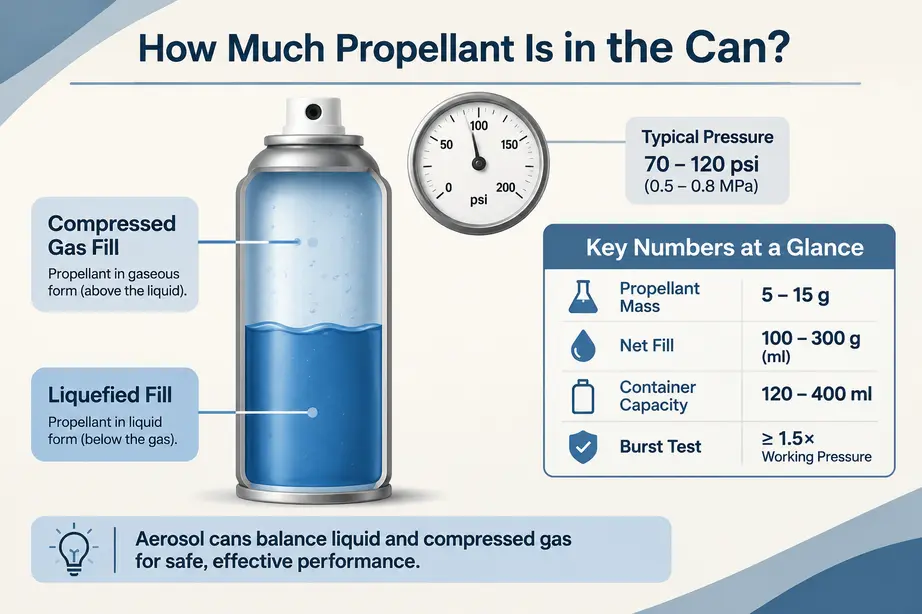
For a typical vapor duster, nearly the entire net fill can be propellant. For a spray that dispenses a separate liquid, the proportion depends on the formulation. Ask the filler for the mass of each component.
Liquefied vs. nén: Two Ways to Fill a Can
Sự lựa chọn của chất đẩy determines how pressure changes during use.
- Liquefied fill
- Khí hóa lỏng like LPG or dimethyl ether rests partly as a liquid
- As vapor leaves, more liquid evaporates. At a given temperature this helps maintain pressure while liquid propellant remains.
- Compressed fill
- Khí nén, nitrogen or a micro filtered air mix, sits above the product
- As liquid leaves, the gas expands into a larger headspace and pressure generally falls. The propellant mass fraction depends on the fill.
Reading Net Quantity on the Label
Các net quantity declaration describes how much commodity the package holds. A net weight in grams alone cannot tell a buyer how many grams are propellant.
| Figure | What it describes | Where to check |
|---|---|---|
| Net fill mass | Total mass of the contents | Label and fill specification |
| Propellant mass | Mass of propellant in the fill | Formulation or filler’s specification |
| Sức chứa container | Internal volume under the stated measurement convention | Can drawing |
| Liquid fill fraction | Liquid volume divided by the specified capacity at the stated temperature | Filling specification |
Comparing Working Pressure and Burst Test Results
Request the filled pack’s expected pressure at the specified temperature and the empty container’s applicable test specification. These figures answer different questions.
- Identify the propellant and the temperature used for the pressure figure.
- Match the container designation to the purchase specification.
- Check the test record for that design. The US DOT 2Q specification calls for a lot sample to be pressure tested to destruction. Its burst criterion is a qualification figure, not a filling pressure.
Tinplate or Aluminum: Compressed Air Aerosol Cans Compared
Two cans with the same nominal capacity can differ in shell construction, lining and packed weight. Compare drawings and filled-package data for the intended use.
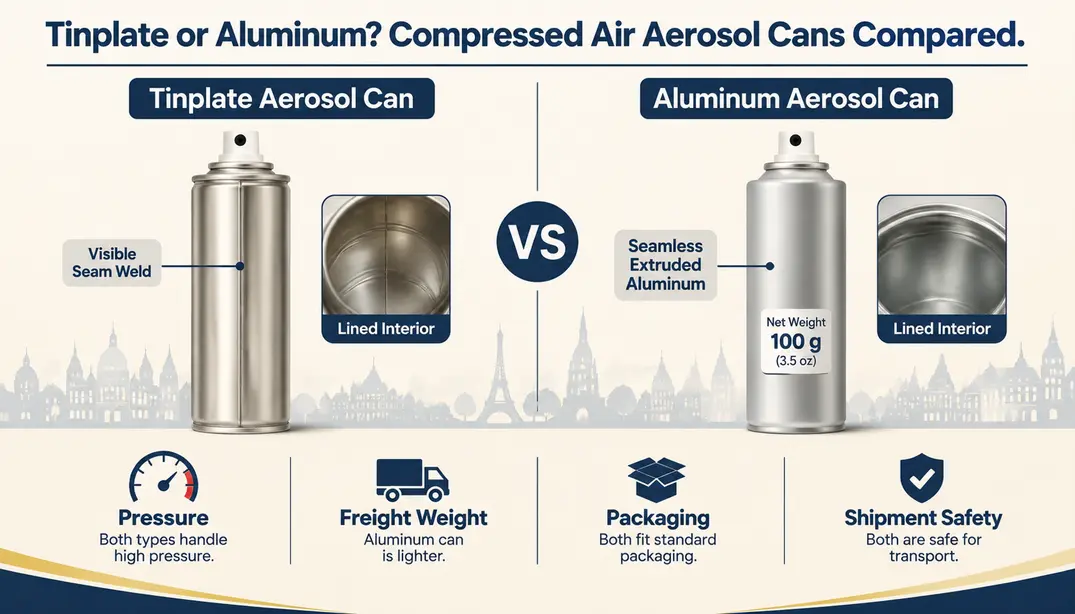
Tinplate Pressurized Cylinder
Vì lon phun sơn thiếc, the drawing identifies the body seam and the way the ends attach.
- Body and build
- vật liệu thiếc, rolled thin, với hàn đường may closing one side
- Where specified, an internal coating separates the formulation from the metal.
- Ends and lining
- For DOT 2P cans, the manufacturing rule requires ends designed for pressure.
- Confirm lining compatibility with the filler for the actual formulation.
Aluminum Aerosol Canister
Among bình xịt nhôm, a one-piece extruded body eliminates the side seam. Ask for the finished can weight and the liner specification. The liner helps separate the fill from the metal. Burst performance needs its own test record for the finished shell.
Specifying the Pack for Shipment
Select the container against the filled product’s pressure and transport classification. A heavier steel body alone does not establish suitability.
Three things to plan around:
- Freight weight, which lands on the invoice
- Các outer packaging and shipping paper requirements for the route, contents and mode
- Protection against accidental discharge during transit
When requesting a pallet quote, liên hệ FANXUN with the fill specification, bản vẽ van, order quantity and destination so the team can identify relevant empty-can options.
Tài liệu tham khảo
- Aerosol Duster Products Containing More Than 18 mg in Any Combination of HFC-152a and/or HFC-134a — CPSC
- Aerosol Dispenser Directive — Ủy ban Châu Âu
- 49 CFR § 178.33a-2 — Type and size - DOT Hoa Kỳ / Cornell LII
- Compressed Air Dusters and Environmental Concerns - EPA Hoa Kỳ
- Phiên dịch 22-0034 —PHMSA
- 16 CFR § 500.7 — Net quantity of contents, method of expression — US FTC / Cornell LII
- 49 CFR § 178.33a-8 — Tests - DOT Hoa Kỳ / Cornell LII
- 49 CFR § 178.33a-6 — Manufacture - DOT Hoa Kỳ / Cornell LII
- 49 CFR § 178.33-6 — Manufacture - DOT Hoa Kỳ / Cornell LII
- 49 CFR § 173.306 - Số lượng khí nén hạn chế - DOT Hoa Kỳ / Cornell LII