
 English
 العربية
 Bosanski jezik
 Čeština
 Dansk
 Nederlands
 Wikang Filipino
 Suomi
 Français
 Deutsch
 Magyar
 Íslenska
 Bahasa Indonesia
 Italiano
 日本語
 한국어
 Bahasa Melayu
 Polski
 Português
 Русский
 Cрпски језик
 Español
 ภาษาไทย
 Türkçe
 Tiếng Việt

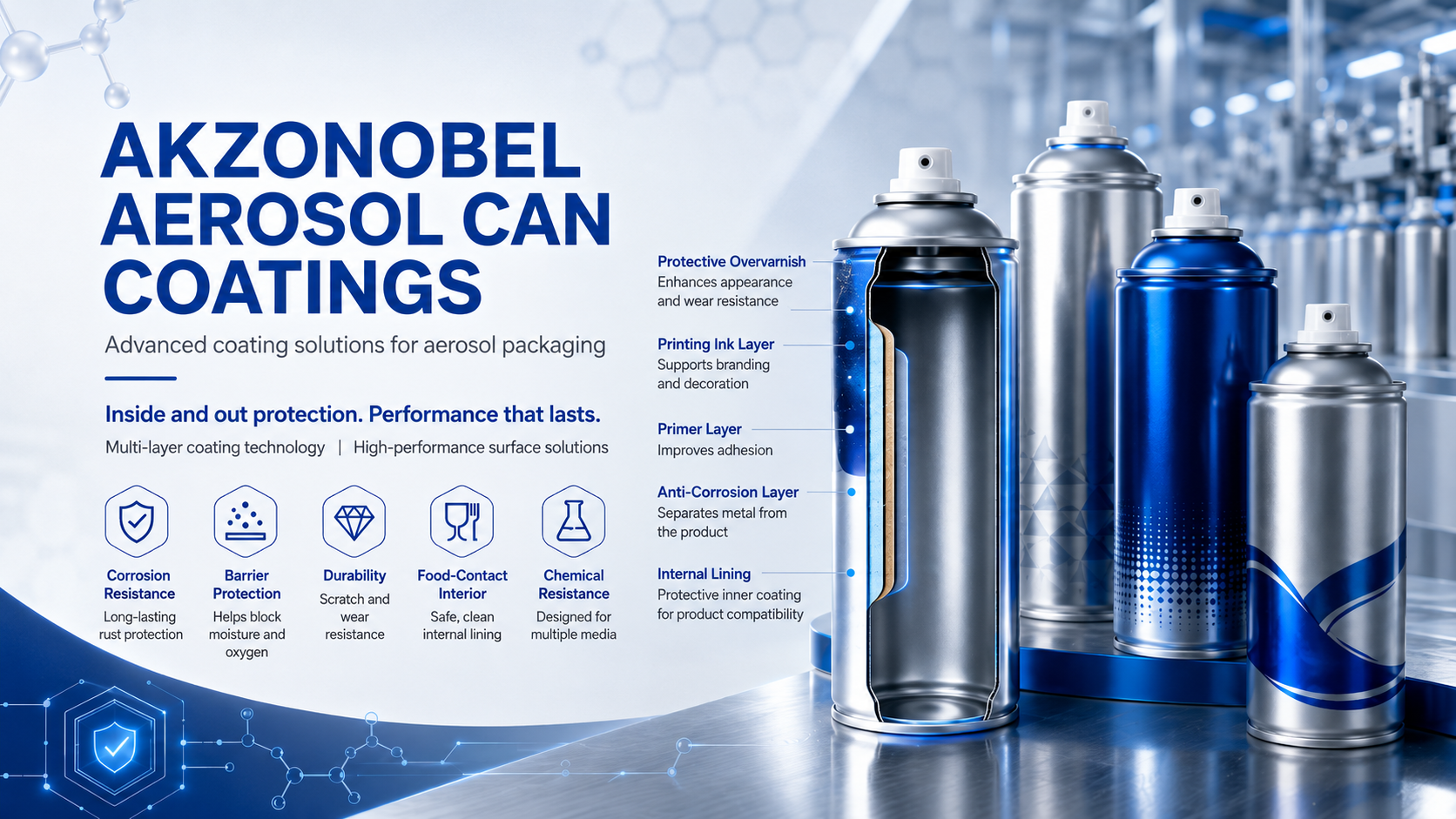

THE DEFINITIVE COATING MANUAL: ADVANCED POLYMER BARRIER ENGINEERING IN PRESSURIZED METAL PACKAGING

CHAPTER 1: THE INVISIBLE FORTRESS — THE CRITICAL ROLE OF INTERIOR BARRIERS
1.1 The Aerosol Can as a High-Pressure Engineering Marvel
In the sphere of global fast-moving consumer goods (FMCG) and industrial supply, the aerosol can is frequently miscategorized as a simple piece of stamped metal tinplate or extruded aluminum. From the perspective of material physics and structural engineering, however, it is a dynamic pressurized system designed to operate under sustained stresses.
A typical aerosol package must safely contain internal pressures ranging from 12 to 18 bar at elevated temperatures (50°C to 55°C) over an operational shelf-life exceeding 36 months. The physical integrity of this pressure vessel is governed by the microscopic organic film applied to its interior. Without an advanced internal liner, an aerosol can becomes a highly reactive electrochemical cell.
1.2 The Three Forces of Container Degradation
[Internal Chemical Matrix] ──(Permeation)──> [Polymer Liner Layer] ──(Galvanic Action)──> [Metal Substrate]
                                                      │
                                             [Failure Scenarios]
                                             ├── 1. Substrate Corrosion (Pitting)
                                             ├── 2. Product Contamination (Ion Leaching)
                                             └── 3. Propellant Loss (Micro-Porosity)
A. Substrate Corrosion and Pitting Mechanics: Corrosion in metal packaging is primarily an electrochemical process. Raw tinplate and aluminum alloys possess native oxide layers that offer minimal protection. When an electrolyte-rich formula makes direct contact with a surface defect, microscopic galvanic cells are established. Anions attack the metal matrix, causing localized pitting corrosion which can breach the pressurized container wall.
B. Product Contamination and Ion Leaching: Concurrently with corrosion, metal ions (Fe2+, Al3+) dissolve and migrate into the liquid product matrix. Even at concentrations measured in parts per billion (ppb), leached metal ions act as catalysts for oxidation. This chemical alteration can prematurely break down active ingredients, destabilize fragrances, and induce severe discoloration.
C. Micro-Porosity and Propellant Escape: Aerosol propellants, such as Dimethyl Ether (DME) or liquefied petroleum gas (LPG), consist of highly volatile molecules. If the internal coating exhibits micro-porosity, these molecules diffuse through the film via micro-channels, resulting in a continuous drop in internal pressure and a failure to atomize the product correctly.
CHAPTER 2: AKZONOBEL’S CORPORATE AUTHORITY AND LEGACY
2.1 Over Two Centuries of Chemical Innovation
When validating packaging materials under 2026 industrial standards, authority must be backed by documented expertise. AkzoNobel’s heritage dates back to 1792, establishing it as a foundational institution in modern industrial chemistry. Their Packaging Coatings division operates dedicated global research hubs focused entirely on food-contact safety, structural adhesion, and regulatory compliance.
2.2 The “People. Planet. Paint.” Sustainable Framework
AkzoNobel operates under the strict “People. Planet. Paint.” corporate framework. This drives the company’s R&D pipelines toward achieving specific targets, including Carbon Neutrality (via low-bake PMT curing), Material Circularity, and Hazardous Substance Elimination, keeping ahead of global chemical restrictions.
CHAPTER 3: CORE TECHNOLOGY DEEP-DIVE: ACCELSHIELD™ BPAni REVOLUTION
3.1 Decoding the BPAni Nomenclature
For decades, the global metal packaging industry relied on epoxy-phenolic coatings synthesized using Bisphenol A (BPA). Due to modern toxicological findings, strict legislative rollouts worldwide have shifted definitions from “BPA-Free” to the much more rigorous BPAni (Bisphenol A non-intentional) classification.
“Non-intentional” means that Bisphenol A, BPF, and BPS are completely excluded as raw materials from the initial resin synthesis pipeline. AkzoNobel’s Accelshield™ range is built entirely around this strict BPAni definition, providing absolute assurance of regulatory compliance for export markets.

3.2 The Chemistry of Polyester-Acrylate Hybrid Systems
To replicate the robust performance of traditional epoxy-phenolics without using bisphenols, AkzoNobel developed a proprietary high-molecular-weight polyester-acrylate hybrid resin network. The synthesis utilizes a modified polyester backbone, which provides the film with its inherent flexibility and structural adhesion. This backbone is chemically grafted with acrylate monomers that impart intense chemical resistance.
During the thermal baking process inside the curing ovens, a multi-functional cross-linking agent activates a dense, three-dimensional chemical network, resulting in steric hindrance at a nano-scale that blocks aggressive solvents.
CHAPTER 4: STRUCTURAL PERFORMANCE AND TECHNICAL COMPARISON
For packaging engineers, selecting an internal lining requires clear, verifiable data. The following technical matrix provides a detailed engineering comparison between traditional epoxy linings, AkzoNobel’s Accelshield™ BPAni technology, and generic non-BPA alternatives.
| Engineering Parameter | Traditional Epoxy-Phenolic | AkzoNobel Accelshield™ (BPAni) | Test Protocol / Standard |
|---|---|---|---|
| Bisphenol A (BPA) Status | Intentionally Added (>100 ppb) | Non-Intentional (Not Detected) | LC-MS |
| Erichsen Cupping Flexibility | 6.5 mm | >8.0 mm (No micro-fractures) | DIN EN ISO 20482 |
| Adhesion Rating (Post-Forming) | GT0 | GT0 (Perfect 100% retention) | ISO 2409 / ASTM D3359 |
| Resistance to Dimethyl Ether (DME) | Excellent | Excellent (Zero swelling/blistering) | Internal High-Pressure Autoclave |
| Peak Metal Temp. Curing Window | 205°C – 215°C | 185°C – 195°C (Energy Saving) | Non-Contact Infrared Pyrometry |
| Simulated Pack Life Stability | 24 Months | 36+ Months (Stable barrier) | 40°C Accelerated Storage Matrix |
CHAPTER 5: ENGINEERING PRECISION IN THE FANXUN PRODUCTION LINE
5.1 The Mechanics of High-Speed Liquid Application
As a direct manufacturer selling complete, whole empty aerosol cans, FANXUN understands that transforming liquid chemistry into a flawless protective barrier requires exact mechanical synchronization. The application of AkzoNobel coatings is carried out via automated high-pressure spray gun arrays synchronized with the line speed.
AkzoNobel’s precise quality control ensures that their coatings deliver excellent shear-thinning behavior. Under the high shear forces of the spray nozzle, the paint liquefies perfectly for uniform distribution; once it strikes the can wall, it instantly stabilizes to form a smooth, continuous wet film.
5.2 The “Plug & Spray” Manufacturing Advantage
One of the most significant engineering achievements of the AkzoNobel Accelshield™ series is its “Plug & Spray” compatibility. The coating chemistry is optimized to match the wet-film weight, flow dynamics, and baking profiles of traditional coatings, allowing FANXUN to run high-performance BPAni coatings with minimal mechanical re-tooling.

5.3 Surviving the Stress of Mechanical Necking
After the internal spray application and subsequent thermal curing, the metal cylinder is moved to the necking station. Here, the open top of the aerosol can is subjected to a series of progressive die reductions to form the tapered neck that accepts the standard 1-inch valve.
AkzoNobel coatings are formulated with an optimized glass transition temperature (Tg) and cross-linking density, allowing the cured film to stretch and re-orient without experiencing mechanical failure or delamination during this brutal physical compression.
CHAPTER 6: CHEMICAL RESISTANCE AND FORMULA COMPATIBILITY
6.1 Personal Care and Cosmetic Matrices
Products such as deodorants and shaving creams are typically water- or alcohol-based emulsions containing active ingredients like aluminum chlorohydrate. Water-based systems act as strong electrolytes. AkzoNobel coatings prevent galvanic corrosion while also ensuring that volatile fragrance oils do not migrate into the polymer, preserving the exact scent profile of the cosmetic.
6.2 Industrial, Automotive, and Technical Formulations
Industrial aerosol cans house highly aggressive chemical matrices, including penetrating oils and brake cleaners, frequently utilizing strong solvent carriers and Dimethyl Ether (DME). DME is a powerful solvent that can rapidly soften standard packaging lacquers. AkzoNobel’s specialized Vitalure™ linings are cross-linked specifically to withstand these harsh solvents.
CHAPTER 7: SUSTAINABILITY, CARBON REDUCTION, AND PFAS COMPLIANCE
7.1 Thermodynamic Optimization via Low-Bake Curing
Traditional coatings require high thermal zones, often needing a Peak Metal Temperature (PMT) of 210°C. AkzoNobel’s modern polymer engineering utilizes low-bake catalyst integration, achieving full density at a reduced PMT window (185°C – 195°C). This lowers the carbon footprint of each aerosol can produced at the FANXUN plant.
7.2 Staying Ahead of the Global PFAS Ban
Per- and polyfluoroalkyl substances (PFAS) are facing sweeping global bans. AkzoNobel has proactively re-engineered its packaging portfolios to be completely PFASni (PFAS non-intentional), utilizing advanced silicone-free and fluorine-free surface modifiers to deliver essential internal slip properties.
CHAPTER 8: FANXUN’S ADVANCED QUALITY CONTROL SPECIFICATIONS
At the FANXUN production plant, we enforce a strict quality management system to verify that AkzoNobel coatings perform flawlessly on every batch of empty cans we export.
| Quality Control Parameter | Target Metric | Industrial Test Protocol |
|---|---|---|
| Dry Film Weight Verification | 4.5 to 6.0 g/m² | ISO 2808 (Gravimetric Balance) |
| Pinhole Porosity Check | <2.0 mA (Target: 0.0 mA) | Enamel Rater Test (1% NaCl, 6.3V) |
| Cross-Hatch Adhesion Stability | GT0 Rating (0% film detachment) | ISO 2409 / ASTM D3359 |
| Impact Deformation Elasticity | >150 kg·cm (No cracking) | GB/T 1732 / ASTM D2794 |
| High-Pressure Sterilization | Pass (Zero blistering) | Steam Autoclave (121°C for 30 mins) |
CHAPTER 9: INDUSTRY FREQUENTLY ASKED QUESTIONS (FAQ)
CHAPTER 10: Authoritative References & Data Sources
The data presented in this manual is cross-referenced with the following bodies:
- AkzoNobel Packaging Coatings Performance Registry: Product Information Sheets and Engineering Manuals for Accelshield™ 300 and Vitalure™ Portfolios (Technical Updates 2025/2026).
- European Food Safety Authority (EFSA) Journal: Scientific Opinion on Bisphenol A (BPA) migration in metal food-contact materials (Directive Reference No. EU 10/2011 & 2024 revisions).
- International Organization for Standardization (ISO): ISO 2808:2019 (Determination of film thickness) & ISO 2409:2020 (Cross-cut test for structural adhesion validation).
- US Food and Drug Administration (FDA): Guidance for Industry on Non-Intentional Chemical Constituents in Polymeric Coatings.
- FANXUN Metallurgy and Electrochemical Evaluation Center: Internal Pack-Test Database & High-Pressure Stress Analysis of Coated Aerosol Cans.



