
 English
 العربية
 Bosanski jezik
 Čeština
 Dansk
Dansk Nederlands
 Wikang Filipino
 Suomi
Suomi Français
 Deutsch
 Magyar
 Íslenska
 Bahasa Indonesia
 Italiano
 日本語
日本語 한국어
한국어 Bahasa Melayu
 Polski
 Português
 Русский
 Cрпски језик
 Español
 ภาษาไทย
 Türkçe
 Tiếng Việt
Shopping for tin canister wholesale isn’t just a box-checking exercise—it’s the moment you realize your packaging is either pulling its weight or quietly costing you sleep. A flimsy container is like a leaky roof: you don’t notice it until the storm hits. Denting in transit, faded branding, compliance headaches… it adds up fast. And when you’re moving serious volume, every penny shaved and every unit perfected matters. Bulk buying should feel like locking in confidence, not rolling the dice.
The right tin canister doesn’t just hold product—it holds reputation. It’s the firm handshake before a word is spoken. Strong walls, crisp printing, food-safe linings, smooth stacking on a pallet—those details tell customers you mean business. In a market where margins are tight and timelines tighter, smart packaging isn’t flashy. It’s dependable, sharp-looking, and built to keep your operation humming without a hitch.
Melody of Tin Canister Wholesale Insights
➔ Cost Efficiency: Bulk purchasing slashes per-unit costs by spreading tooling and logistics across higher volumes.
➔ Quality Assurance: OEM partnerships secure standardized materials, consistent dimensions, and food-safe linings for every batch.
➔ Supply Reliability: Large-volume orders minimize production changeovers, shorten lead times, and support sustainability with recyclable steel.
5 Key Benefits of Tin Canister Wholesale
Choosing tin canister wholesale is not just about buying more; it is about buying smarter. From cost control to sustainability, wholesale tin canisters help brands stabilize supply, protect margins, and upgrade packaging without drama. Here’s how bulk tin purchasing really pays off.
Cost Savings Through Bulk Tin Canister Wholesale
When businesses move into tin canister wholesale, savings stack up in layers, not just pennies.
- Wholesale pricing advantages
- Bulk contracts secure reduced unit cost
- Long-term agreements unlock stable wholesale pricing
- Predictable rates support budget-friendly packaging
- Economies of scale in production
- Tooling fees spread across high volumes
- Raw material sourcing improves cost-effective solutions
- Freight consolidation lowers per-carton logistics spend as tracked by Statista data.
- Operational cost control
- Fewer reorders reduce admin handling
- Simplified SKU management supports cleaner forecasting
- Bulk purchasing strengthens supplier negotiation power
With tin canister wholesale, brands shift from reactive buying to structured bulk purchasing, cutting waste and protecting profit margins.
Consistent Quality Control for OEM Metal Cans
Large-scale tin canister wholesale often runs through aerosol can manufacturer OEM systems built for stability.
- Manufacturing standards alignment
- Standardized molds protect standard tin can dimensions
- Unified coatings ensure material consistency
- Controlled curing processes boost durability
- Inspection layers
- Raw steel verification against OEM specifications
- In-line monitoring for seam integrity based on ASTM International methods.
- Final batch audits securing product integrity
- Reliable production cycles
- Documented SOPs enhance quality assurance
- Repeatable workflows reduce variation
- Data tracking improves traceability according to ISO 9001 protocols.
For brands sourcing tin canisters wholesale, that steady rhythm means fewer surprises and stronger shelf confidence.
Flexible Custom Printing on Wholesale Tin Canisters
Bulk orders do not mean boring design. With tin canister wholesale, customization scales smoothly.
- Design application options
- Offset lithography for sharp logo printing
- CMYK + Pantone matching for tight brand identity
- Interior and exterior coating choices
- Structural enhancements
- Embossing and debossing for tactile visual appeal
- Specialty varnish for standout custom branding
- Window cut-outs for product display
- Labeling flexibility
- Batch-coded runs
- Multi-language labeling options
- Seasonal artwork swaps within master volumes
Wholesale tin canisters make unique packaging solutions realistic without pushing artwork costs through the roof.
Faster Supply Chain with Large-Volume Orders
Scaling through tin canister wholesale also cleans up supply headaches.
- Production efficiency gains
- Reduced line changeovers
- Higher manufacturing capacity allocation
- Planned runs improve production efficiency
- Inventory management control
- Safety stock buffers
- Forecast-linked scheduling
- Streamlined inventory management
- Logistics and fulfillment
- Consolidated shipping improves streamlined logistics
- Scheduled dispatch boosts timely delivery
- Stable lead times enhance order fulfillment as reported by Reuters.
In short, bulk tin buying feeds directly into smarter supply chain optimization, helping brands stay stocked without panic ordering.
Eco-Friendly Packaging Options in Bulk Tin Cans
Sustainability is no side note in tin canister wholesale; it is baked into the material itself.
- Sustainable materials
- High recycled steel content according to the EPA.
- Fully recyclable packaging
- Magnetic separation efficiency in waste streams
- Reusable containers
- Durable builds encourage refill programs
- Decorative finishes extend home use
- Long lifecycle reduces environmental impact
- Resource conservation
- Lightweight optimization cuts freight emissions
- Reduced secondary cartons support green packaging
- Closed-loop recycling promotes resource conservation
Bulk tin cans combine strength and responsibility. For brands balancing cost, quality, and eco goals, tin canister wholesale offers a practical path that just makes sense.
Compare Tin Canister Wholesale Vs. Retail Pricing

Choosing between tin canister wholesale and retail buying can seriously affect your packaging budget. From unit math to supply stability, the gap is bigger than most expect. Let’s break down how tin, canister, and wholesale pricing shift your long‑term game plan.
Wholesale Pricing
When businesses search for tin canister wholesale, the focus stays on scale, stability, and smart math.
- Core Cost Drivers
- Production volume
- Higher output lowers manufacturing costs
- Enables stronger economies of scale
- Supplier agreements
- Locked contracts reduce price swings as noted in Forbes business insights.
- Long-term deals improve planning accuracy
- Bulk discounts
- Tiered pricing based on pallet or container load
- Direct factory cost savings
- Production volume
- Cost Comparison Snapshot
| Order Type | Average Per-Unit Cost | Annual Volume | Savings vs Retail |
|---|---|---|---|
| Retail Buy | $1.20 | 5,000 pcs | — |
| Small Bulk | $0.92 | 20,000 pcs | 23% |
| Large Tin Canister Wholesale | $0.68 | 100,000 pcs | 43% |
For brands scaling fast, tin canister wholesale pricing keeps margins healthy. A reliable tin canister wholesale partner like FANXUN also aligns packaging specs with tin can factory scheduling, preventing delays that kill momentum.
- Operational Advantages
- Stable raw tin sourcing
- Predictable lead times
- Custom molds without retail markups
In short, wholesale tin canister purchasing turns packaging from a cost burden into a controllable asset.
Retail Pricing
Retail works differently. It’s built around the individual purchase, not long-term supply.
- Price Structure Layers
- Per-unit cost
- Includes visible markup percentage
- Reflects store-level overhead costs
- Convenience fee
- Fast checkout
- No contract commitment
- Market demand
- Prices fluctuate seasonally
- Limited negotiation room
- Per-unit cost
When buyers skip tin canister wholesale options and rely on store shelves, margins shrink fast. Retail tin canister pricing often looks simple upfront, yet the math tells another story.
-
- Higher per-piece payment
-
- Limited size or print customization
-
- Inconsistent restocking cycles
For startups testing packaging ideas, retail can work short term. For scaling brands comparing tin canister wholesale vs shop pricing, the difference becomes obvious. FANXUN supports bulk tin, canister, wholesale programs that remove retail uncertainty and give packaging strategy real structure.
Tin Canister Wholesale For Food-Grade Safety
Choosing the right tin canister wholesale partner is not just about price. It’s about safety, compliance, and long-term trust. When food brands source tin, canister, and wholesale packaging at scale, every detail matters—from coatings to traceability.

FDA-Compliant Tin Canister Wholesale
In tin canister wholesale, meeting FDA compliance is the baseline for serious food packaging operations. Under U.S. food safety standards, materials must meet strict regulatory requirements for direct and indirect food contact.
- Material Control in Tin Containers
- Base steel and tinplate coating
- Food-grade tinplate thickness typically ranges from 0.18mm–0.30mm
- Surface coating must pass migration testing according to World Packaging Organisation guidelines.
- Interior lacquer systems
- Must align with CFR Title 21
- Designed for dry foods, powders, and supplements
- Base steel and tinplate coating
- Compliance Testing in Food Packaging
- Chemical migration limits
- Heavy metal content
- Coating adhesion performance
| Test Item | Regulatory Limit | Typical Wholesale Spec | Result Type | Frequency |
|---|---|---|---|---|
| Lead (Pb) | ≤ 0.1 ppm | 0.05 ppm | Pass/Fail | Per batch |
| Cadmium (Cd) | ≤ 0.1 ppm | 0.03 ppm | Pass/Fail | Per batch |
| Overall Migration | ≤ 10 mg/dm² | 6 mg/dm² | Lab Report | Quarterly |
| Coating Adhesion | No peeling | Grade 5B | Visual/Test | Per lot |
| Lacquer Cure | Fully cured | 98%+ | Lab Test | Per batch |
- Wholesale Supplier Accountability
- Documentation
- Compliance declarations
- Third-party lab certificates verified by SGS.
- Factory audits
- Process inspection
- Clean production lines
- Documentation
Brands working with FANXUN for tin canister wholesale often prioritize documented food cans compliance because one failed audit can derail a whole product launch.
BPA-Free Liners for Bulk Tin Containers
For bulk tin packaging, BPA-free liners are now a must-have. These coatings protect food contact materials, preserve container integrity, and reduce migration risks in bulk packaging.
- Why BPA-Free Matters in Tin Canisters
- Consumer safety awareness
- Retailer requirements
- Export market regulations
- Liner Performance Standards
- Chemical stability according to Smithers technical reports.
- Resistant to oils and flavor compounds
- Sensory neutrality
- No odor transfer
- No taste interference
- Mechanical durability
- Scratch resistance
- Adhesion after stamping
- Chemical stability according to Smithers technical reports.
- Application in Tin Canister Wholesale
- Bulk production control
- Coating thickness monitoring
- Oven curing temperature tracking
- Inspection protocols
- Random sampling
- Batch-level testing
- Bulk production control
In tin canister wholesale, cutting corners on liners is risky. Wholesale tin containers with certified BPA-free systems give brands peace of mind, especially in snacks and powdered supplements.
Batch Traceability in Food-Grade Cans
Strong batch traceability turns ordinary tin packaging solutions into reliable food safety systems. In large-scale tin canister wholesale, tracking every lot supports product tracking, faster recalls, and clear food safety management records.
- Raw Material Trace Mapping
- Tinplate supplier ID
- Coil number
- Coating batch code
- Liner production record
- Formula version
- Production date
- Tinplate supplier ID
- Manufacturing Stage Documentation
- Stamping line number
- Shift operator ID
- Quality inspection logs
- Downstream Supply Chain Visibility
- Warehouse entry date
- Shipment tracking number
- Customer order reference
When tin canister wholesale integrates digital coding—laser marks inside lids, printed batch codes under bases—supply chain visibility improves overnight. Wholesale tin packaging is no longer just a metal box; it becomes a trackable unit in a living system.
FANXUN supports coded tin canister wholesale runs so buyers can trace tin, canister, and wholesale production data within minutes. For food brands, that level of control isn’t fancy. It’s just smart business.
How To Avoid Packaging Delays With Bulk Tin Cans
Late packaging shipments can wreck a launch plan fast. If your brand relies on tin canister wholesale orders, timing is everything. From bulk tin purchases to custom OEM runs, smart planning keeps your shelves stocked and your stress low. Here’s how to keep tin supply steady without the last-minute scramble.
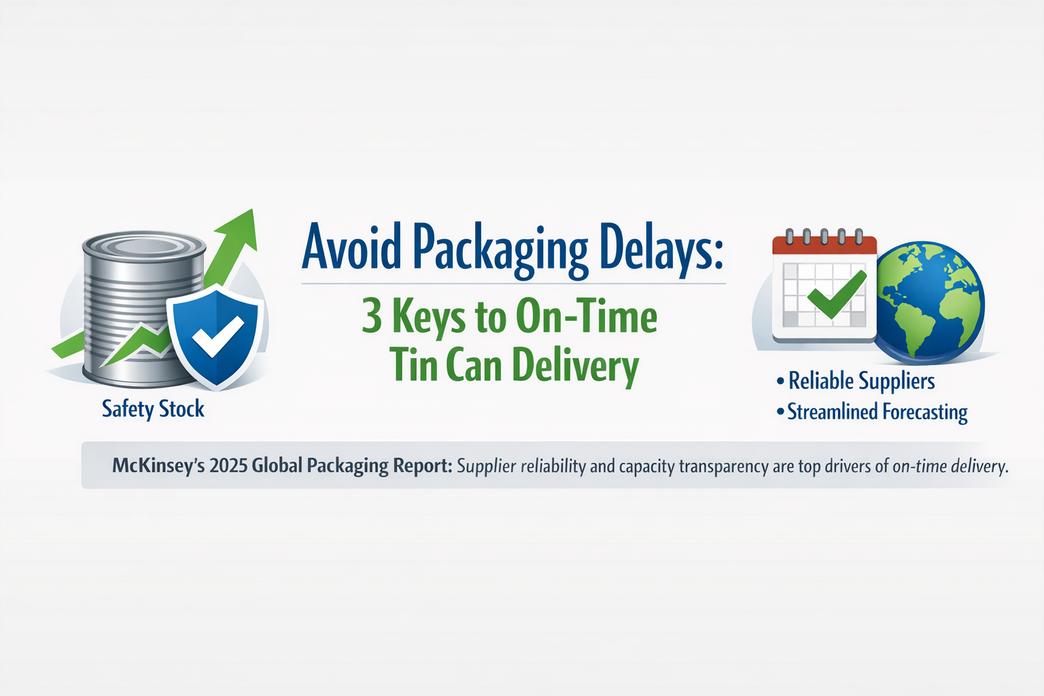
Build Safety Stock with Tin Canister Wholesale
When handling tin canister wholesale, your backup plan matters just as much as your main order. Strong inventory management keeps stock levels aligned with real sales, not guesswork.
- Core goals:
- Maintain practical buffer stock
- Support lead time reduction
- Improve supply chain resilience
- Forecast monthly usage from sales data.
- Add a 10–20% safety margin for seasonal spikes.
- Lock in bulk tin can orders early.
For example:
- Base demand: 50,000 tin units/month
- Safety stock: 8,000–10,000 units
- Reorder trigger: 60% warehouse balance
Under a solid plan:
- Stock Levels
- Minimum threshold
- Target reserve
- Emergency reserve
Working with a stable tin canister wholesale partner like FANXUN helps maintain consistent replenishment cycles. Bulk tin purchasing isn’t just about price breaks; it protects delivery timelines and keeps production humming as highlighted by PMMI.
Choose Reliable OEM Tin Can Suppliers
Not all OEM factories handle tin wholesale orders the same way. Strong supplier vetting reduces risk before it shows up on your dock.
Key checks include:
- Verified production capacity
- Documented quality control
- Clear communication channels
- Certified manufacturing standards
McKinsey’s 2025 Global Packaging Report notes that supplier reliability and capacity transparency rank among the top drivers of on-time delivery performance in global packaging supply chains.
When evaluating OEMs for tin canister wholesale:
- Review monthly output capacity.
- Audit inspection processes using OSHA safety guidelines.
- Confirm contingency production plans.
- Test response time during peak seasons.
Short and simple: if your supplier goes quiet during crunch time, delays are coming. FANXUN, for instance, emphasizes structured reporting and predictable lead times, which makes bulk tin can planning far less chaotic.
Streamline Order Forecasting for On-Time Delivery
Forecasting connects demand planning, sales data analysis, and real-world production scheduling.
Break it down:
- Sales Team
- Monthly projections
- Promotional calendar
- Operations
- Capacity mapping
- Raw material planning
- Logistics
- Confirmed delivery timelines
- Backup logistics coordination
Steps that keep tin wholesale orders smooth:
- Sync forecasts quarterly.
- Share rolling 90-day projections with suppliers.
- Adjust tin canister wholesale quantities before peak seasons as advised by Packaging Gateway.
Quick tip: Don’t rely only on last year’s numbers. Markets shift. Retail velocity changes. A flexible forecasting rhythm keeps bulk tin can orders aligned and avoids those painful rush fees.
Consistent forecasting, steady wholesale tin supply, and the right OEM partner—that’s how delays stay off your radar.
FAQs
What are the key benefits of tin canister wholesale orders?
Bulk purchasing keeps operations steady and margins clear.
- Lower unit cost through volume pricing
- Reduced freight and packing cost per piece
- Stable inventory for food, chemical, or industrial packaging
In long-term supply programs, tin canister wholesale contracts bring pricing stability and fewer surprises during peak seasons.
How does OEM production maintain quality consistency?
OEM factories control the full process, from steel sheets to final inspection.
- Standardized molds ensure uniform shape and wall thickness
- Controlled coating lines protect against corrosion
- Batch testing secures strength and sealing performance
This repeatability matters for aerosol cans, pails, and branded food containers shipped worldwide.
Why is custom printing valuable in wholesale tin packaging?
Custom printing turns plain metal into a brand statement.
- Offset printing for sharp colors
- Embossed logos for texture and memory
- Scalable batch runs for color consistency
For retail shelves, strong visuals on tin canister wholesale orders increase product appeal without raising packaging complexity.
What food-grade protections are used in bulk tin containers?
Food safety is built into the lining and material choice.
| Protection Element | Purpose | Typical Use |
|---|---|---|
| FDA-compliant coating | Prevents contamination | Dry food, powders |
| BPA-free liner | Reduces chemical migration | Additives, spices |
| Anti-rust inner layer | Extends shelf life | Long storage goods |
These layers guard flavor, freshness, and consumer trust.
How does bulk ordering improve supply chain speed?
Large scheduled runs reduce factory changeovers and idle time.
• Fixed production slots
• Predictable shipping cycles
• Fewer urgent reorders
With tin canister wholesale planning, distributors keep lines moving even during raw material swings.
What eco-friendly options exist for tin canister wholesale?
Sustainability is practical, not decorative.
- Recyclable steel lowers waste output
- Reusable structures reduce single-use plastics
- Lighter secondary packaging cuts transport weight
Metal packaging can return to the production loop again and again, making wholesale volumes both efficient and responsible.
References
- Grand View Research: Global Metal Packaging Market Size & Share – grandviewresearch.com
- Statista: Global Logistics Costs and Freight Consolidation Data – statista.com
- ASTM International: Standards for Metal Seam Integrity and Testing – astm.org
- ISO: ISO 9001 Quality Management Systems in Manufacturing – iso.org
- Reuters: Global Supply Chain Disruptions and Manufacturing Lead Times – reuters.com
- U.S. EPA: Steel Recycling and Sustainability Reports – epa.gov
- Forbes: Strategic Sourcing and Wholesale Pricing Models – forbes.com
- U.S. FDA: Food Contact Substances (FCS) Regulatory Information – fda.gov
- World Packaging Organisation: Global Food Safety Standards for Containers – worldpackaging.org
- SGS: Third-Party Lab Testing and Certification Services – sgs.com
- Smithers: 2025 Global Food Contact Materials Outlook – smithers.com
- PMMI: Packaging Machinery and Inventory Management Trends – pmmi.org
- McKinsey & Company: 2025 Global Packaging Report – mckinsey.com
- OSHA: Industrial Manufacturing Safety Guidelines – osha.gov
- Packaging Gateway: Demand Planning and Forecasting in Packaging – packaging-gateway.com



