Bahasa Melayu
 English
 العربية
 Bosanski jezik
 Čeština
 Dansk
 Nederlands
 Wikang Filipino
 Suomi
 Français
 Deutsch
 Magyar
 Íslenska
 Bahasa Indonesia
 Italiano
 日本語
 한국어
 Polski
 Português
 Русский
 Cрпски језик
 Español
 ภาษาไทย
 Türkçe
 Tiếng Việt

Aluminum tins with lids can be leakproof, but only if you specify, ujian, and ship them right. Skip that homework and a pallet turns into a sticky mess.
For sourcing, distinguish ordinary lidded tins from pressure-rated aerosols. bekalan FANXUN Tinplate and aluminum aerosol packaging and related components; discuss the intended system rather than assume every closure format is available.
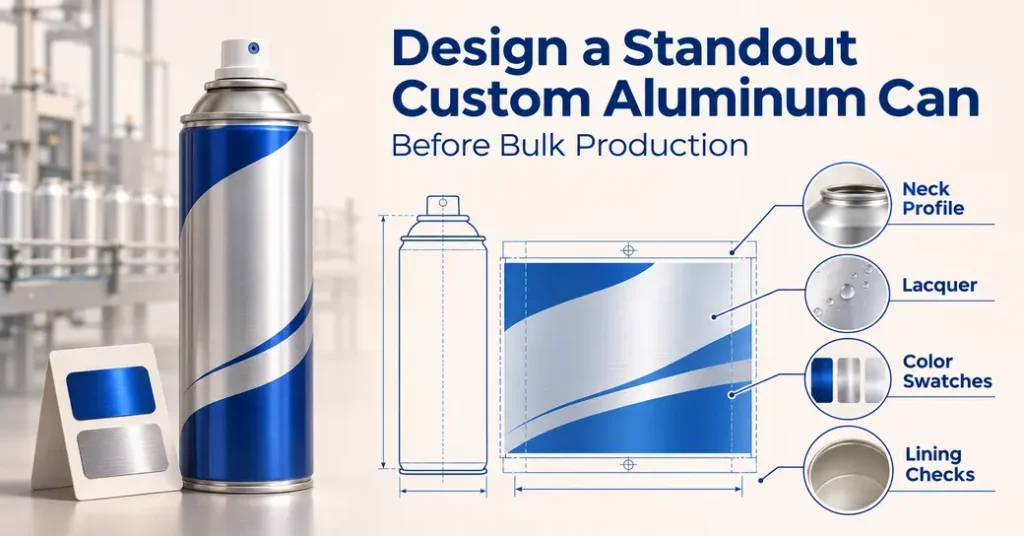
Reka bentuk tudung, Ketebalan dinding, lakuer, ujian kebocoran, and transport habits decide who wins. Here’s how to spot the difference before money changes hands.
Perkara Utama: Sealing Your Aluminum Tins With Lids Against Every Drip
→ Seal Types: Press-on friction lids, lined threaded closures, and crimped aerosol valves serve different packaging systems; tamper-evident bands indicate opening rather than establish leakproofness.
→ Reka Bentuk Tudung: Closure torque, neck diameter fit, and valve/crimp integrity affect sealing; actuator protection helps prevent accidental discharge.
→ Leak Tests: Request tests under real fill conditions, batch-level pressure records, burst margins, and lacquer compatibility data.
→ Pengangkutan: Check stacking pressure, shrink wrap, and corrugated partitions, then validate the spec sheet before bulk shipment.
Types of Seals Used in Aluminum Tins With Lids
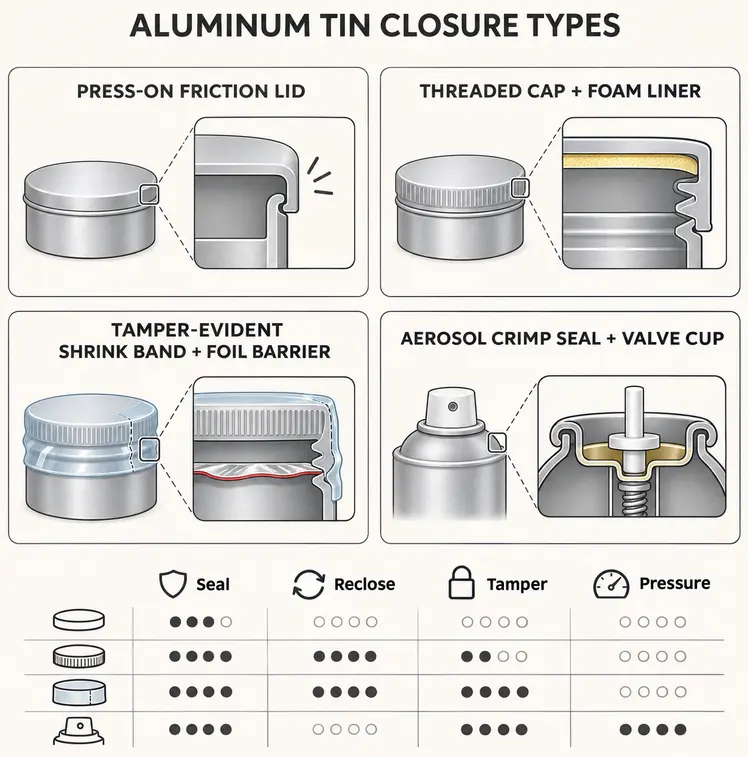
Not every closure works the same way. The seal on aluminum tins with lids decides what stays in, what stays out, and how long your stuff actually lasts on the shelf.
Press-On Lid Friction Seals
Plenty of aluminum tins with lids use the classic snap-shut style. The lid rim engages the container rim through a patut geseran. The exact contact geometry and tolerances depend on the lid and body design.
- Great for balms, lilin, and loose tea
- A Tarik tab saves your fingernails
Heads up, walaupun. A friction fit alone does not establish a Hermetic Seal. Aluminum and Tinplate both need controlled tolerances and a validated closure system for decent keselamatan penutupan.
In U.S. thermally processed low-acid food rules, a hermetically sealed container is designed to prevent microorganism entry and maintain commercial sterility after processing; an ordinary storage tin has not established that performance.
How Threaded Cap Liners Create a Tight Closure
Threaded aluminum tins with lids seal through pressure, not grip.
- What does the sealing
- A foam liner or rubber gasket di dalam topi skru
- An additional seal only where the specific container and sealing process have been validated
- What makes it hold
- Betul tork presses the liner flat on the rim
- Penuh thread engagement spreads that pressure evenly
Both help pencegahan kebocoran, but the complete package still needs testing. Just pick a liner that won’t break down with your contents.
Untuk U.S.. hazardous-material shipments, closures must remain leakproof and secured against loosening under normal transport conditions; compatibility and closure instructions apply to the specific package.
Tamper Evident Seal Options for Chemical and Food Use
- Signs someone opened it
- A shrink band hugging the cap
- A jalur koyak that rips on the opening twist
- Hidden barriers
- A foil seal working as a contaminant barrier
- A product-specific closure selected for the chemical and applicable safety requirements
These extras can support perlindungan pengguna, but tamper evidence does not establish leakproofness or Pematuhan peraturan.
Aerosol Valve Assembly Crimp Seals
Aerosols are a whole different ballgame. The cawan pelekap holding the valve gets crimped onto the curled rim, compressing a meterai gasket ke tempatnya; The penggerak operates the valve. An out-of-spec diameter kelim or depth can compromise sealing. Filled metal aerosols subject to the U.S. transport rule require a ujian kebocoran, biasanya a hot water bath or a permitted alternative, under specified conditions before shipping.
3 Closure Designs That Affect Leakproof Performance
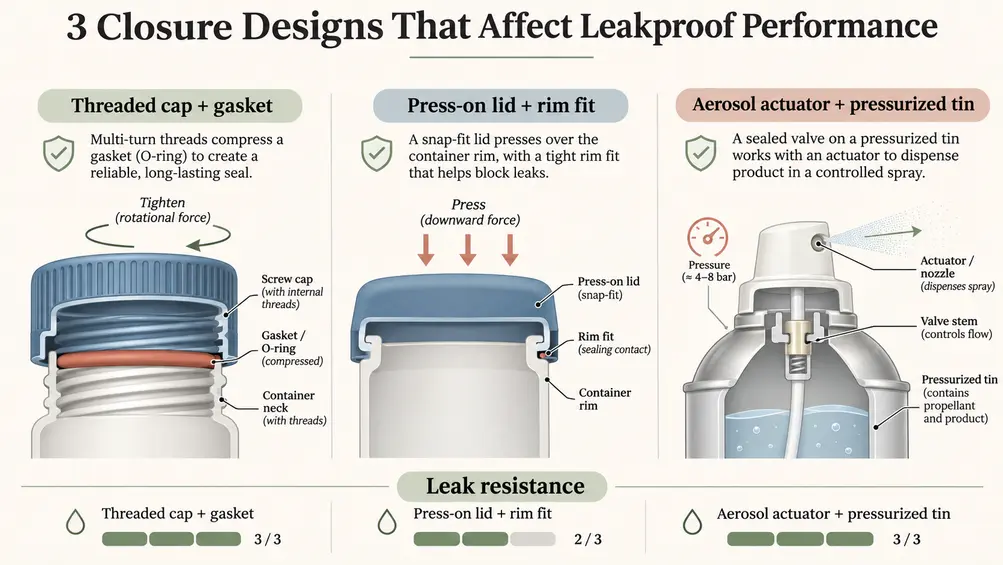
A tin is only as good as its lid. Pick the wrong closure and you’re cleaning up a mess. Here’s how three closure systems differ when keeping liquids and powders inside really matters. Ordinary lidded tins and pressure-rated aerosol cans require different specifications.
Threaded Cap With Compression Gasket
Twist it down, and torque presses the compression gasket flat against the rim. That squeeze does all the work.
- How the seal holds
- A serasi pelapik compresses against the sealing surface
- Correct application torque and closure retention help keep the topi berulir from backing off during shipping
- Where it works best
- Liquids and oils, or chemicals only when the liner, salutan, and container are compatible
- Aluminum tins with lids that get opened and closed every day
For refillable metal tins, a screw closure may support pencegahan kebocoran, but repeated-use integriti meterai needs cycle testing with the intended contents.
Press-On Lid and Neck Diameter Fit
A press-on lid lives or dies by the diameter leher. Too loose and it pops off in your bag. Too tight and you’re prying it open with a butter knife.
The grip comes from a patut geseran, so a tight tolerance level (how far a size can drift from spec) matters a lot. Deep drawing or impact extrusion can form the container, but dimensional checks are still needed to control variation. When checking samples, cari:
- A licin rim design that won’t bend when the lid goes on
- A crisp snap closure you can actually feel click
Both are useful checks, but neither proves an meterai kedap udara for dry goods; verify the complete closure under its intended conditions.
Spray Actuator Closures for Pressurized Tins
A penggerak semburan sits on top of the pemasangan injap and controls every burst. Pada a timah bertekanan, small flaws turn into slow leaks on the shelf.
- Seating
- The protective penutup aerosol should fit securely and protect the muncung pendispensan from accidental operation
- Rintangan tekanan
- Pejal propellant seal keeps gas in during long storage
- A lock mechanism stops accidental sprays in a backpack
Use a purpose-designed, pressure-rated aerosol package for sprays; an ordinary lidded tin is not a substitute.
4 Sealing and Compatibility Checks Every Buyer Should Request
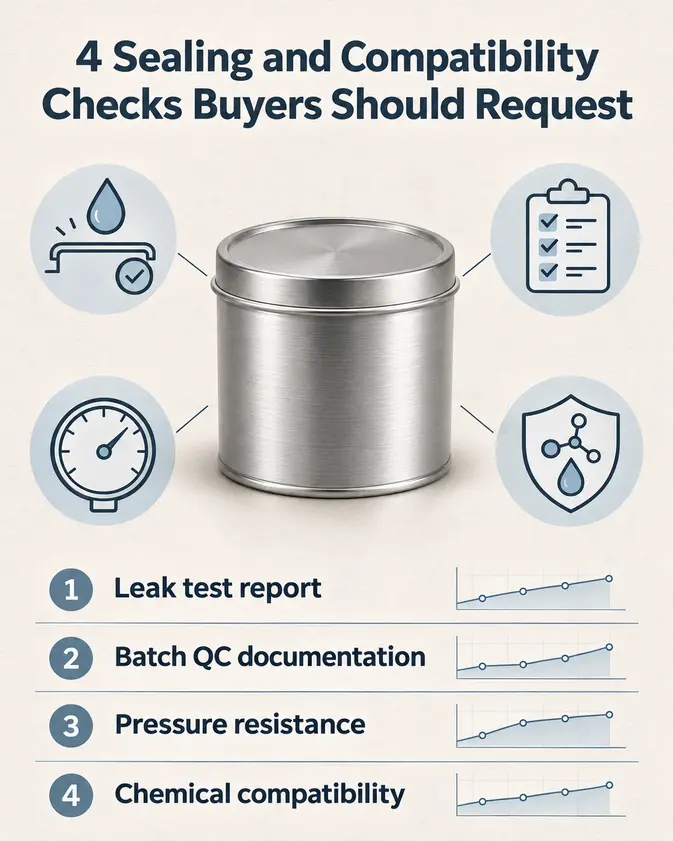
Buying aluminum tins with lids looks simple until a batch starts weeping in the warehouse. Then it’s a headache nobody wants. Good suppliers back their claims with real test data, not just a shiny spec sheet. These four checks help you assess the package and its supporting records, so you know what to ask for before you sign any purchase order.
Leakage Testing Under Real Fill Conditions
For an aerosol project, bandingkan FANXUN tin aerosol aluminium and discuss penyesuaian daripada tin, lapisan, and components before agreeing on sample acceptance criteria.
An empty tin can pass every check and still leak once your product goes in. Ask for trials that copy real life:
- Product match
- Test with your actual liquid product at its true kelikatan. Thin oils slip through gaps that thick balms never find.
- Fill aluminum tins with lids at your normal filling temperature dan kelantangan.
- Closure and travel
- Tetapkan cap torque to your production spec, then confirm integriti meterai.
- Lari simulasi alam sekitar for heat and humidity, tambah lagi transportation stress like vibration and drops.
ASTM D4169 describes distribution testing; its public scope states that suitability for hazardous materials has not been determined, so it does not replace applicable transport rules.
Is Pressure Resistance Verified Batch by Batch?
One great sample from last spring proves nothing about today’s order. Wall thickness drifts, and seals wear. Padat kawalan kualiti requires a documented test method, acceptance limits, and traceable records for the specific package. Where U.S. hazardous-material packaging rules apply, The pengeluaran Ujian pneumatik keperluan can extend to every applicable packaging, subject to the stated exceptions.
When you request records for your aluminum containers with caps, cari:
- A stated sampling rate setiap lot
- Statistical analysis showing trends, not just pass/fail ticks
- Pengesanan kecacatan notes and pengesahan pematuhan sign-offs
If the supplier has no paperwork, treat that as a red flag.
Burst Pressure Limit: Know the Safety Margin
Burst pressure is the maximum threshold a tin can take before kegagalan struktur. Working pressure is what aluminum tins with lids handle day to day. The gap between the two is your cushion.
| Parameter | Perkara yang harus disahkan oleh pembeli |
|---|---|
| Tekanan kerja | Intended pressure and temperature range |
| Tekanan ubah bentuk | Measured onset of permanent distortion under the specified method |
| Tekanan pecah | Destructive test result for the exact can design |
| Acceptance criterion | Applicable can specification and transport requirements |
Ask how the supplier established the acceptance limits. awak nak ujian hidrostatik results where applicable, The deformation point where permanent distortion begins, dan yang julat toleransi across samples. A proof-pressure test does not determine burst pressure; use the method and limits specified for the package. Do not pressure-test an ordinary storage tin as if it were an aerosol can.
Chemical Compatibility With Internal Lacquering
The inside coating does quiet but serious work. Acidic or solvent-heavy fills can eat right through it.
- Apa yang perlu diperiksa
- Your formula’s tahap pH dan masing-masing bahan aktif
- The lacquer type used inside the aluminum tins with lids, often an salutan epoksi
- What the data should show
- Rintangan kakisan selepas ujian penuaan
- Tidak tindak balas kimia that breaks down the filem pelindung or weakens its harta penghalang
For food-contact use in the United States, resinous and polymeric coatings must meet the applicable composition and use conditions; a coating name alone does not establish food-contact suitability.
Leaking During Transport? Check the Lid Seal First.
Nothing kills the vibe like opening a pallet of aluminum tins with lids and finding sticky residue everywhere. Transit leaks can involve the closure, badan, jahitan, salutan, or transport damage; inspect the complete package before deciding on a fix.
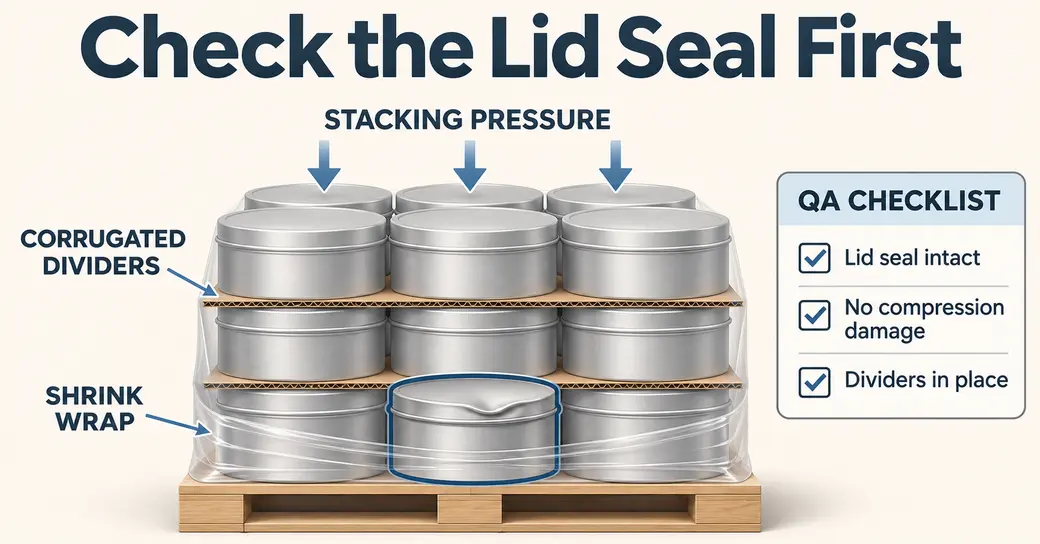
Palletized Stacking Pressure on Lid Seals
Stacking looks harmless until the bottom row starts to give.
- What goes wrong
- A heavy stacking load mencipta lid deflection, which means the lid bows inward.
- Berlebihan vertical pressure can compromise integriti gasket, depending on the closure and load path.
- Apa yang perlu diperiksa
- The compression resistance of your aluminum tins with lids and the cartons holding them.
- Malah pengagihan berat across each layer, plus a firm stack height limit.
For applicable U.S. hazardous-material packaging design types, stacking qualification uses a defined top load, tempoh masa, dan kriteria penerimaan; it is not a universal stack-height recommendation for ordinary tins.
Skipping these checks increases the risk of undetected ubah bentuk bekas.
Shrink Wrapping and Corrugated Partition Protection
Loose pallets wobble. A few tight layers of mengecilkan filem add kestabilan pengangkutan and stop the lateral movement that loosens metal containers with lids on bumpy roads.
Inside the case, the small stuff matters:
- A pembahagi beralun keeps each of your aluminum tins with lids in its own slot, helping reduce rubbing and denting.
- Cushioning material mengendalikan penyerapan impak when a forklift driver gets a little rough.
Baik secondary packaging costs very little compared with reshipping a whole order.
Gunakan representative transport vibration testing to evaluate the filled shipping unit, including dividers, penutupan, and contents, rather than assume wrap and partitions eliminate damage.
Spec Sheet Validation Before Bulk Shipment
Before you sign off on thousands of units, do a quick specification review. It’s boring, but it beats a leaky surprise.
- Fit and finish
- Sahkan ketepatan dimensi of the body, tudung, dan salutan.
- Check the specified dimensional tolerances and compression or crimp settings for the mekanisme penutupan.
- Proof it works
- Minta ujian kebocoran results on the exact aluminum tins with lids you’re ordering.
- Pastikan jaminan kualiti reports match the technical standard your buyer requires.
Untuk U.S.. thermally processed low-acid canned foods, closure inspections and corrective actions must be recorded during production; this food-specific requirement is separate from aerosol and industrial-can testing.
For your next aerosol or industrial metal-packaging order, hubungi FANXUN with the formula, fill conditions, closure specification, destination market, and transport profile so the relevant can type and supporting records can be discussed.
Rujukan
- 21 CFR 113.3 — Definitions — eCFR
- 49 CFR 173.24 — Keperluan am untuk pembungkusan dan pembungkusan — eCFR
- 49 CFR 173.306 — Kuantiti terhad gas termampat — eCFR
- ASTM D4169-23e1 — Performance Testing of Shipping Containers and Systems - ASTM Antarabangsa
- 49 CFR 178.604 - Ujian kalis bocor — eCFR
- 49 CFR 178.605 — Hydrostatic pressure test — eCFR
- 21 CFR 175.300 - Salutan resin dan polimer — eCFR
- 49 CFR 178.606 — Stacking test — eCFR
- ASTM D4728-17(2026) — Random Vibration Testing of Shipping Containers - ASTM Antarabangsa
- 21 CFR 113.60 - Bekas — eCFR