
 English
 العربية
 Bosanski jezik
 Čeština
 Dansk
Dansk Nederlands
 Wikang Filipino
 Suomi
Suomi Français
 Deutsch
 Magyar
 Íslenska
 Bahasa Indonesia
 Italiano
 日本語
日本語 한국어
한국어 Bahasa Melayu
 Polski
 Português
 Русский
 Cрпски језик
 Español
 ภาษาไทย
 Türkçe
 Tiếng Việt
Inconsistent spray can quietly wreck a production run, and the metered valve aerosol sits right at that fault line, controlling dose, pressure, and pattern while your margins hang by a thread.
Get it wrong, and leaks, waste, and compliance headaches pile up; get it right, and your line runs smooth, costs stay predictable.
Key Points: Metered Valve Aerosol Essentials
- Precise Dosage Control: Metering chamber and calibrated spring deliver uniform volume per actuation, vital for pharmaceuticals and medical devices.
- Component Anatomy: Actuator, stem, gasket, dip tube, ferrule, and orifice size work together to ensure reliable spray pattern and prevent leaks.
- Common Failures: Watch for improper crimping, wrong gasket material, spring tension errors, chamber blockages, and orifice dimensional deviations.
- Formulation Savings: Select cost-effective propellants, compatible coatings, and optimized orifice sizes to reduce waste and stabilize pressure.
- OEM Advantages: Scalable assembly, batch traceability, and custom dosage options enhance compliance and meet diverse industry needs.
How A Metered Valve Aerosol Transforms Precision Spraying In Industry

A metered valve aerosol might look simple on the outside, yet inside it’s a carefully tuned system built for precision. Break the phrase down—metered means controlled volume, valve means regulated release, and aerosol means fine dispersion under pressure. Put together, a metered valve aerosol delivers repeatable output, clean handling, and measurable performance across pharmaceutical, industrial, and household use.
Pharmaceutical Dosing with Consistent Dosage Volume
In medical settings, a metered valve aerosol is all about medication accuracy and safe drug delivery. Each press releases a precise dose, protecting patient safety while ensuring the intended therapeutic effect of the active ingredient within the formulated product.
Performance depends on coordinated internal components:
- Metering chamber volume calibration
- Spring compression tolerance
- Valve stem sealing integrity
- Actuator spray geometry
Below is a typical dosage validation reference used during batch testing:
| Parameter | Target Value | Tolerance Range | Test Standard |
|---|---|---|---|
| Dose Volume (µL) | 100 | ±5% | USP <601> |
| Actuation Force (N) | 35 | ±3 N | ISO 20072 |
| Spray Duration (sec) | 0.12 | ±0.02 | Internal SOP |
| Leakage Rate (mg/24h) | ≤1 | Max Limit | Stability Protocol |
Validation process often follows a nested path:
- Dosage Accuracy Verification
- Sample selection
- Gravimetric testing
- Statistical mean calculation
- Compliance Documentation
- Batch coding
- Traceable lot records
- Audit review
The result? A metered valve aerosol that keeps dose after dose consistent. Manufacturers like FANXUN align valve chamber precision with pharmaceutical compliance standards, helping ensure safe and repeatable output in every aerosol valve system.
“Global demand for precise pulmonary and topical drug delivery systems continues to rise, driven by adherence and safety requirements,” noted IQVIA Institute in its 2025 outlook on drug delivery technologies.
Industrial Lubrication: Controlled Flow Rate for Machinery
Inside factories, a metered valve aerosol handles lubricant delivery with sharp control. A regulated aerosol valve ensures steady flow control, targeting machinery components that rely on accurate coating for friction reduction and wear prevention.
Key performance factors include:
- Optimized orifice diameter
- Pressure-balanced valve body
- Sealed gasket stability
Operational flow typically follows this path:
- Actuation force applied
- Valve stem opens
- Metering chamber releases fixed lubricant volume
- Spray pattern disperses evenly across surface
Why it matters:
- Less over-spray
- Reduced waste
- Improved maintenance cycles
- Longer equipment lifespan
Industrial teams appreciate that a metered valve aerosol avoids messy pooling. Instead of flooding bearings, it applies just enough lubricant to protect surfaces under pressure-tested conditions. That balance keeps machines running smoothly without overdoing it.
Household & Veterinary Applications: Spill-Free, Metered Delivery
At home or in pet care clinics, a metered valve aerosol makes topical application simple and clean. For household products and animal health treatments, controlled release prevents drips and accidental overuse.
Core internal structure:
- Dip Tube System
- Draws formulation upward
- Maintains steady feed
- Gasket Seal
- Prevents leakage
- Preserves propellant pressure
- Metering Chamber
- Defines accurate dispensing volume
Users notice small but meaningful benefits:
• Less product waste
• Cleaner storage
• Reliable controlled release
• Predictable accurate dispensing
Hydrocarbon or compressed air propellants push the formula through a calibrated aerosol metered valve, forming a stable spray pattern. The experience feels smooth, not chaotic. For brands like FANXUN, refining the metered valve aerosol design means balancing durability with everyday ease—so each press delivers exactly what’s needed, no spills, no guesswork.
Metered Valve Aerosol Anatomy: Unpacking Each Critical Component
A metered valve aerosol looks simple on the shelf, yet inside it’s a tidy system built for control and repeatability. This walk-through keeps the tone plain and practical, mixing shop-floor talk with engineering sense. You’ll see how each part of a metered valve aerosol works together to deliver a clean, measured spray every time.

Actuator and Stem: Initiating the Spray
- Actuator, button, and nozzle sit where fingers meet function
- Stem links motion to the valve release
- Spray shape shifts with tiny geometry changes
- Press force transfers through the actuator.
- The stem slides, opening the mechanism.
- Product exits as a controlled spray.
Under daily use, this setup decides comfort and accuracy. FANXUN designs keep actuation smooth, so the release never feels stiff, even late in can life. Short presses. Clean output. No drama.
Metering Chamber and Spring: Defining Dosage Volume
- Metering chamber acts as a tiny reservoir
- Spring tension locks in dosage control
Nested view of control logic:
- Measurement system
- Volume setting
- Chamber geometry
- Fill rate
- Spring response
- Compression range
- Return speed
- Volume setting
| Test Point | Target Volume (ml) | Tolerance (±ml) |
|---|---|---|
| Initial dose | 0.10 | 0.01 |
| Mid-can dose | 0.10 | 0.01 |
| End-can dose | 0.10 | 0.02 |
This balance keeps every dose steady, which is why metered valve aerosol systems dominate pharma and personal care. FANXUN validates this with repeat cycle testing on each control setup.
Dip Tube and Ferrule: Ensuring Reliable Product Delivery
✓ Dip tube reaches the last drop
✓ Ferrule grips the container wall
Flow starts at the bottom, pulling liquid and propellant together through the intake. Crimp strength at the ferrule decides long-term flow stability.
Quick checks, steady draw, fewer complaints—classic metered valve aerosol behavior when done right.
Gasket Seal: Preventing Leaks under Pressure
• Gasket forms the primary barrier
• Seal holds under internal pressure
Multi-level sealing logic:
- Valve assembly
- Contact surface
- Sealing compression
- Material memory
- Compatibility
- LPG
- HFCs
- Contact surface
Good integrity means no slow hiss, no loss of thrust. FANXUN material choices focus on real-world leak prevention, keeping every metered valve aerosol tight from filling line to final spray.
Metered Valve Aerosol Failures? Five Root Causes You Must Know
Metered valve aerosol problems don’t start on the shelf. They begin much earlier, during assembly, material choice, and tiny tolerance decisions. This walk-through keeps it real, mixing shop-floor talk with practical checks, while keeping metered valve aerosol performance, safety, and user feel front and center.
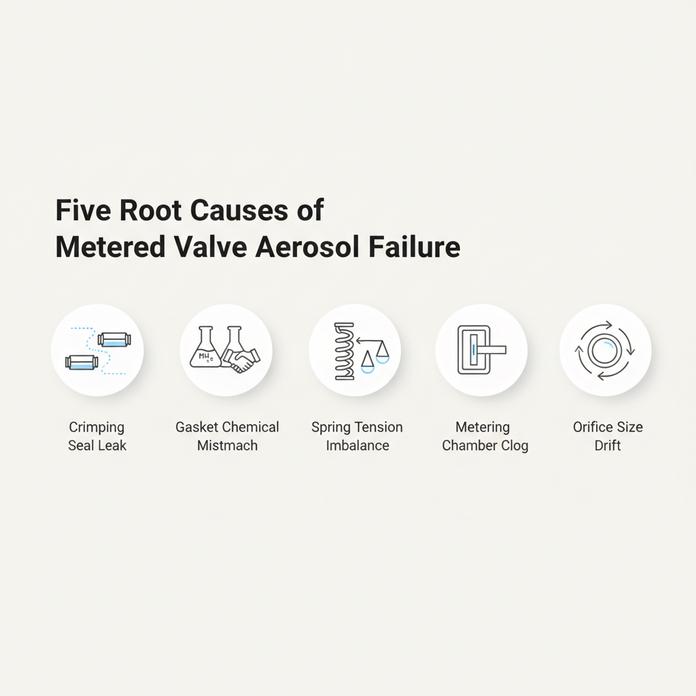
Inadequate Crimping Leads to Propellant Loss
- Loose crimping ruins seal integrity fast.
- Escaping propellant means falling pressure.
- The valve and container stop acting like a team.
Under the hood, the failure stacks up in layers:
- Ferrule isn’t compressed evenly.
- Micro-gaps form around the seal.
- Leakage starts slow, then snowballs.
- Internal pressure drops.
- Spray weakens.
- Metered valve aerosol output drifts off spec.
This is why FANXUN audits crimp profiles instead of trusting visual checks alone.
Wrong Gasket Material Compromises Seal Integrity
A gasket that looks fine on paper can still fail in real chemical exposure.
Key trouble spots tend to cluster:
- Material mismatch with hydrocarbons or DME
- Elastomer swelling and slow degradation
- Lost compatibility, broken seal, shaky integrity
In a metered valve aerosol, once the gasket softens, the aerosol valve becomes unpredictable. Short sprays turn long. Long sprays fade. Dosing valve aerosol designs hate that kind of chaos.
Improper Spring Tension Affects Actuation Force
This one feels personal to users.
- Too much spring tension → sore thumbs
- Too little compression → sloppy actuation
- Off-target force upsets the valve mechanism
Step by step, the issue unfolds: calibration slips, resistance changes, then dosage wanders. FANXUN teams flag this early using functional rigs tuned for metered valve aerosol feedback, not just numbers.
Metering Chamber Blockage Alters Spray Pattern
Blockage rarely shouts. It whispers.
⚠ Particulate sneaks into the metering chamber
⚠ Formulation residue dries
⚠ Clogging chokes the orifice
End result? A warped spray pattern that ruins trust in the aerosol valve. In metered valve aerosol lines, clean filling and filtered gassing keep this quiet failure from spreading.
Dimensional Errors in Orifice Size Cause Inconsistent Flow
Tiny dimension errors carry big consequences.
Nested causes usually look like this:
- Tool wear in manufacturing
- Size drift in the orifice
- Missed inspection windows
- Performance fallout
- Unstable flow rate
- Lost consistency in spray and valve response
For metered valve aerosol products, consistency sells. That’s why FANXUN locks down tolerances before problems ever reach the line.
Save Money: Optimize Your Metered Valve Aerosol Formulation Process

Running a metered valve aerosol line isn’t just chemistry—it’s cost control in motion. From propellant choice to filling pressure, small tweaks shape profit margins. When every metered aerosol valve cycle counts, smart formulation keeps waste low and output steady.
Choosing the Right Propellant (Hydrocarbons vs. HFCs)
Selecting the right propellant for a metered valve aerosol system affects pressure balance, compliance, and long-term cost. Break it down clearly:
- Performance Factors
- Vapor pressure stability
- Spray consistency through the valve
- Compatibility with liquefied gas blends
- Safety & Handling
- Hydrocarbon options (like LPG blends)
- Pros
- Lower cost
- Strong atomization
- Considerations
- Higher flammability
- Storage zoning requirements
- HFC types
- Pros
- Lower flammability risk
- Stable pressure curve
- Trade-offs
- Higher material cost
- Increasing environmental impact scrutiny
- Hydrocarbon options (like LPG blends)
- Regulatory & Market Direction
- Global regulatory compliance trends
- Environmental reporting
“The transition toward lower-GWP propellants continues to accelerate across consumer aerosol categories,” notes the 2025 UNEP Emissions Gap update.
In practical terms, a metered aerosol valve tuned to a cost-efficient hydrocarbon blend often trims unit cost—if facility safety supports it.
Material Compatibility: Container Coating and Internal Lacquer
Your container isn’t just a shell; it’s a chemical partner.
Key checkpoints:
- Internal coating adhesion
- Lacquer resistance to actives
- Long-term corrosion control
- Tested chemical resistance under pressure
In a metered valve aerosol package:
- Substrate Choice
- Aluminum
- Lightweight
- Needs precise internal barrier properties
- Tinplate
- Strong structure
- Requires dependable lacquer curing
- Aluminum
- Compatibility Testing
- Fill formula
- Pressurize
- Store at elevated temperature
- Inspect for blistering or pitting
A failed lining cuts shelf life fast. A stable lining protects both formula and brand reputation.
Fine-Tuning Orifice Size for Cost-Effective Flow Rates
Small hardware, big money impact.
When adjusting the orifice in a metered valve aerosol system:
- Define Target Dosage
- Required output per actuation
- Tolerance window
- Balance Flow Dynamics
- Flow rate vs. pressure
- Interaction with actuator geometry
- Spray Quality Control
- Desired spray pattern
- Controlled particle size
- Efficient atomization
Tiny adjustments to the valve stem opening can reduce over-dispensing. That means fewer grams lost per can. Over a production run, that’s serious savings without changing the metered aerosol valve body itself.
Streamlining Filling & Gassing to Reduce Waste
Production efficiency comes down to discipline in the filling process and gassing process.
Core optimization areas:
- Filling Accuracy
- Calibrated pumps
- Inline weight checks
- Real-time quality control triggers
- Controlled Gassing
- Minimized propellant loss
- Stable chamber pressure
- Verified sealing integrity
- Waste Reduction Loop
- Track deviations
- Isolate valve misfires
- Recycle acceptable off-spec units
• Monitor micro-leaks.
• Standardize crimp dimensions.
• Audit downtime causes.
A tightly managed metered valve aerosol line doesn’t just run smoother—it wastes less product, less propellant, and less money.
OEM Benefits: Metered Valve Aerosols For Large-Scale Chemical Suppliers
Metered valve aerosol systems sit at the core of modern bulk chemical packaging. When large suppliers scale up, every metered, valve, and aerosol component has to perform without drama. This is where smart OEM strategy turns pressure into progress.

Batch Traceability and Material Certification for Compliance
For high-volume metered valve aerosol production, compliance is not a box to tick. It is daily discipline.
- Clear batch tracking records
- Verified material origin
- Archived certification documents
- Digital logs connect supply chain visibility to each metered aerosol valve.
- Inspection checkpoints reinforce quality assurance.
- Final release aligns with strict regulatory adherence.
At FANXUN, documentation flows alongside manufacturing. That means:
- ★ Stronger audit readiness
- ★ Protected product integrity
A 2025 Deloitte manufacturing outlook notes:
“End-to-end traceability is becoming a competitive requirement, not just a compliance exercise.”
For pharmaceutical or personal care aerosol valve lines, traceable metered valve aerosol units reduce recall risk and keep reputations intact.
Scalable Assembly & Crimping Lines for Higher Throughput
Growth demands muscle. A metered valve aerosol line must expand without losing precision.
- Optimized production lines
- High-speed automated assembly
- Stable crimping processes
The flow typically runs:
- Component feeding
- Valve positioning
- Controlled crimp force
- Inline inspection
Under the hood:
- Manufacturing Core
- Increased manufacturing capacity
- Real-time throughput optimization
- Control Layer
- Adaptive sensors
- Smart industrial automation
The result? Noticeable efficiency gains and consistent aerosol metering valve specs. FANXUN supports scalable operations that keep every metered valve aerosol aligned with client volume targets.
Custom Dosage Volumes and Spray Patterns to Meet Client Needs
Not all formulas behave the same. A metered valve aerosol must match the liquid, the pressure, and the user.
- Tuned custom formulations
- Precise dosage precision
- Defined spray characteristics
Adjustment happens in layers:
- Metering chamber sizing
- Orifice calibration
- Actuator geometry
Within each layer:
- Delivery Control
- Verified metering accuracy
- Stable tailored delivery
- Client Alignment
- Exact client specifications
- Specific application requirements
Short bursts. Fine mist. Targeted stream. That’s real product customization.
When suppliers need a metered aerosol valve that feels purpose-built, not off-the-shelf, FANXUN delivers a metered valve aerosol solution shaped around performance and scale.
References
- Delivered Dose Uniformity (DDU) Testing – TSI
- ISO 20072 | ISO Testing – Smithers
- Driving Results in Inhaler Testing – Copley Scientific
- Emissions Gap Report 2024 – UNEP
- 2025 Consumer Products Industry Outlook – Deloitte Malta
- A Complete Guide to Aerosol Propellants – Hydrokem
- Elastomer compatibility in turbine engine oils – Shell Global
- Best Lubricant for O-Rings Guide – Detroit Sealing Components
- Other HFC sectors – European Commission
- Products with non-flammable propellants – AEDA
- Gas Valve Materials & Compatibility Guide – 3G Electric SG
- How food manufacturers can benefit from AI and other technologies – Manufacturing Dive



