 Español
 English
 العربية
 Bosanski jezik
 Čeština
 Dansk
 Nederlands
 Wikang Filipino
 Suomi
 Français
 Deutsch
 Magyar
 Íslenska
 Bahasa Indonesia
 Italiano
 日本語
 한국어
 Bahasa Melayu
 Polski
 Português
 Русский
 Cрпски језик
 ภาษาไทย
 Türkçe
 Tiếng Việt

Choose a standard tin for a product that users brush on or pour. For a pressurized spray, start with a stock aerosol can that fits the formulation and filling line. Consider a custom aerosol can when available sizes, valves or decoration cannot meet the brief.
A custom aerosol can isn’t a prettier tin. It’s a metal argument with your fill line, and somebody always loses.
Custom Aerosol Can: Quick Answers Before You Spec
- Gauge and Wall: Specify finished wall thickness and tolerance in the drawing.
- Llenar volumen: Allow for liquid expansion at the temperature specified for the package.
- Presión de ráfaga: Use the applicable container test and the pressure of the complete formulation.
- Valve and Gasket: Confirm valve dimensions and gasket compatibility with the formulation.
- Lining Fit: Check whether the formulation needs an internal coating.
- Cumplimiento: Identify the destination and transport mode before selecting the container specification.
Standard Tins vs Custom Aerosol Cans
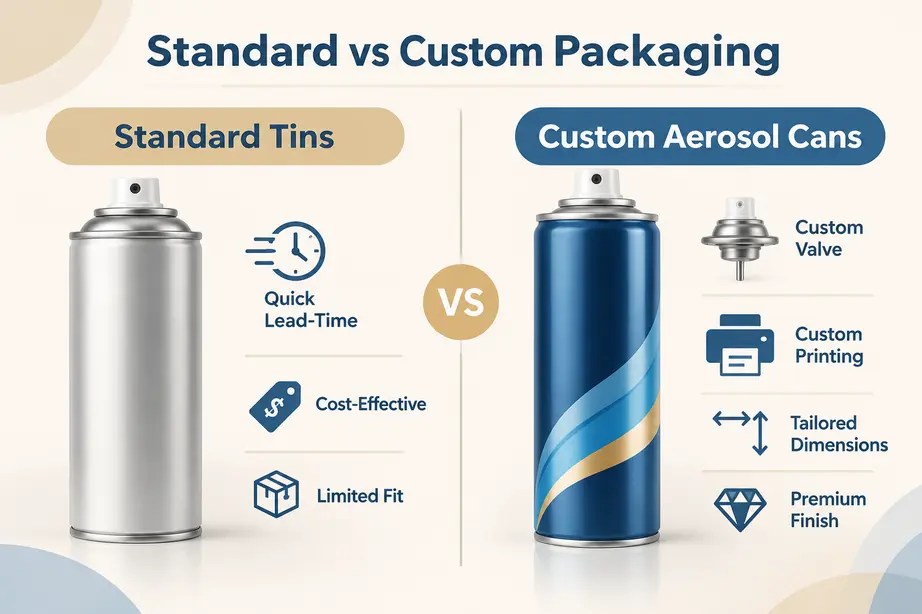
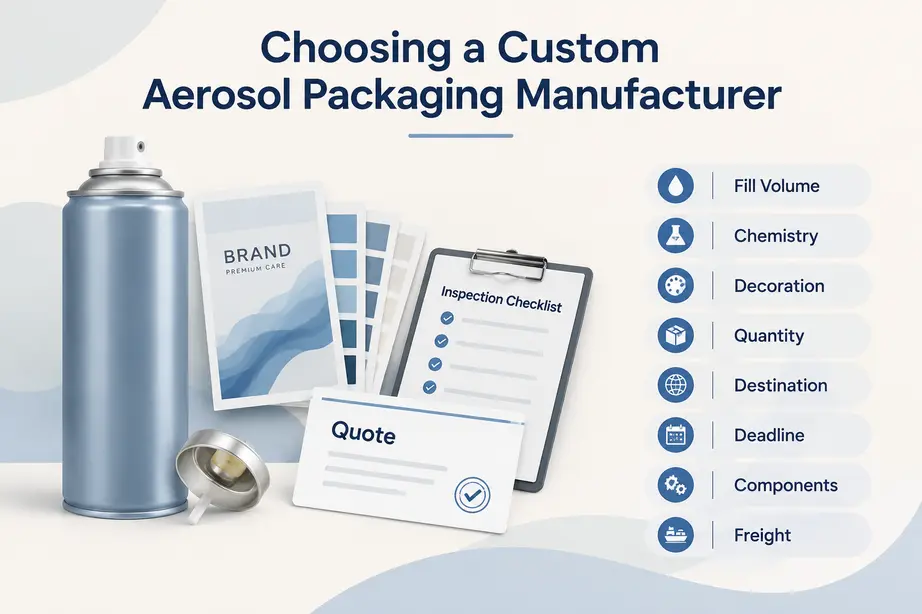
Picking a can sounds simple until fill volume, válvulas, and lead times start pulling in different directions. Ofertas FANXUN latas de pintura for conventional coatings and latas de aerosol para productos en aerosol. Compare stock and custom options within the appropriate packaging family.
Standard Tins
Stock sizes are the whole appeal. Ask which sizes are available, whether existing tooling can be used and what the delivered price would be for your first run.
The trade-offs show up fast, aunque:
- Speed and price, Sí
- confirm lead time and minimum order size
- request the tinplate specification for repeat orders
- Ajuste y acabado, not so much
- for a stock aerosol format, check which válvulas adaptar
- fill volume bends around the can, not the other way round
- gastos generales de fabricación creeps back in through workarounds
A stock format can suit test batches if it uses the dispensing system planned for production.
Custom Aerosol Cans
Custom work may involve printing on an existing body or changing the body dimensions. Ask which diameter, height and valve combinations are available before budgeting for tooling.
Seguro, printing expenses y minimum run volumes bite early. Design complexity drags component complexity along for the ride — artwork has to wrap a curved surface, y acabado superficial choices multiply fast. Spring for finishing options and the can reads as yours, not as catalog stock.
Ask FANXUN to compare an existing format with the proposed custom design. Include the target fill, annual volume and artwork in your enquiry.
Levels of Tinplate Thickness Explained
Thin walls save weight, but a drawing alone cannot establish how the finished can will perform. Revisa el proceso de fabricación de latas de aerosol alongside the material specification and test records.
Reading Gauge Numbers as Wall Thickness
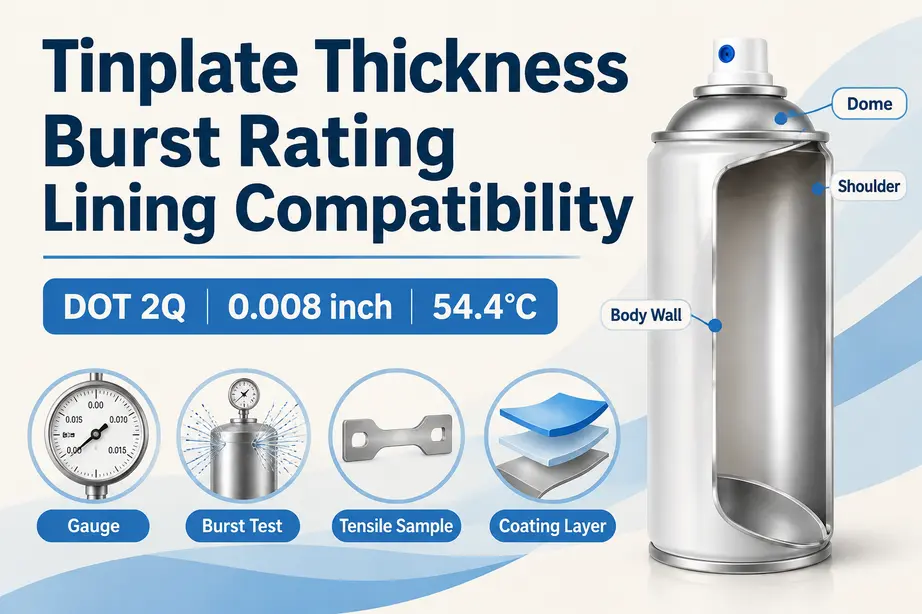
Ask the supplier to identify the measurement points and tolerances on the finished drawing. For a DOT 2Q container, el espesor mínimo de pared es 0.008 pulgada. Check how the drawing treats each component:
- Body wall — compare the measured and specified thickness
- Shoulder — identify the formed area on the drawing
- Dome — confirm which pressure-design termina the specification requires
Compare the body and end specifications separately. Record the units and tolerancia alongside each measurement.
How Much Burst Pressure Does a Lighter Can Hold?
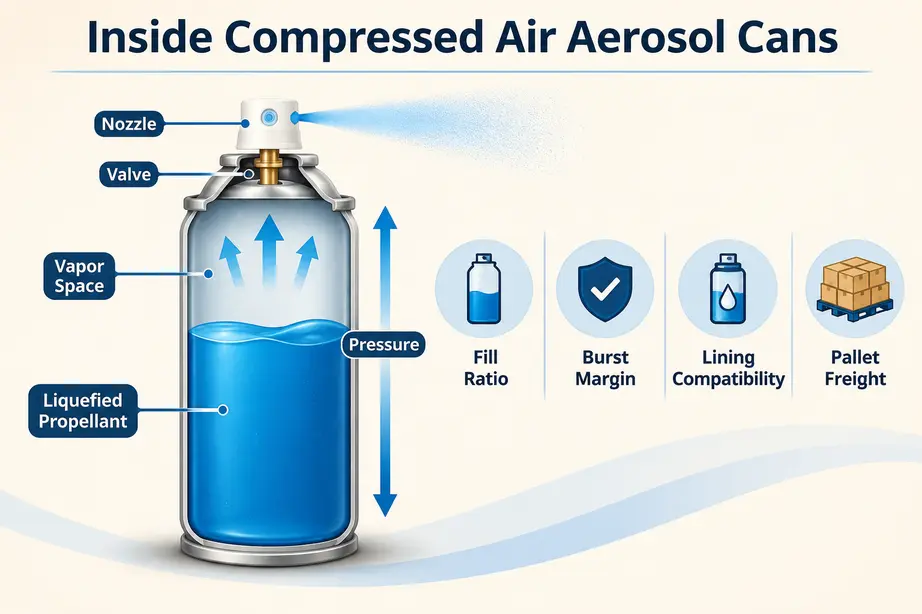
Wall thickness alone does not give a burst rating. Para EE.UU.. limited-quantity metal aerosols under § 173.306(a)(3), the burst criterion uses the equilibrium pressure of the contents en 54.4 ° C. For a DOT 2Q can, request the separate lot test record for the container with its end assembled.
Deep Drawing Limits at Each Grade
For drawn components, confirmar elongation y resistencia a la tracción, set the depth to suit the grade, then trial a small batch before full tooling. For DOT 2Q cans, comprobar el requisitos materiales for acceptable plate and injurious defects.
Choosing a Lining for the Formulation
Evaluar compatibilidad química using the actual formulation, exposed metal and any proposed coating. If the supplier proposes an epoxy phenolic lining, ask for results from filled samples made with that lining.
5 Checks Before You Order Custom Aerosol Cans
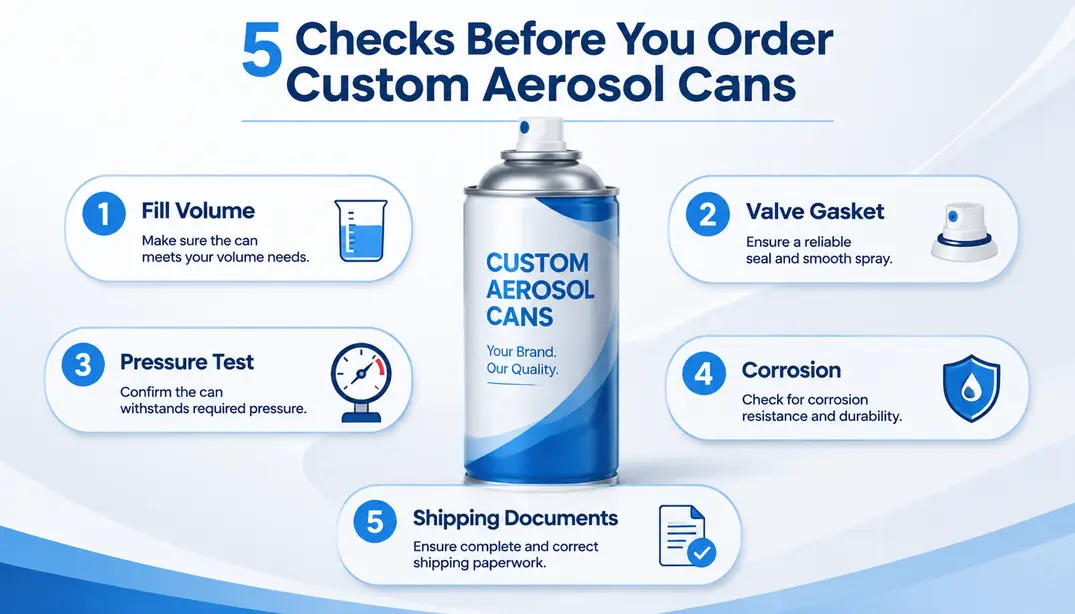
Use these five checks to agree on the specification with the can supplier and filler before you commit volume.
Is Your Fill Volume Matched to the Can Dimensions?
- Llenar volumen has to sit under true capacidad de desbordamiento
- Under § 173.306(a)(3), liquid must leave headspace at 54.4 ° C
- Include the propulsor when assessing the filled package
- Vuelva a comprobar dimensiones de la lata contra el diseño de embalaje drawings before tooling gets cut
Verify Valve and Gasket Compatibility
Revisa el valve parameters with the filler and check seal materials against both solvent and propellant. A buna gasket that swells is a leak waiting to happen.
- Válvula crimp diameter against the can neck
- Elastómero swell test with the intended formulation
- Integridad del sello watched at storage temperature
Get this wrong on a custom spray can run and your propulsor escapes quietly, one can at a time.
Pressure Testing Before the Production Run
Nobody wants a presión de estallido surprise halfway through a corrida de producción.
- Agree with the filler on the required filled-container leak test and any permitted alternative
- For the standard U.S. water bath test, el target internal pressure depends on fill conditions
- Check for leakage and permanent deformación
- Request separate records for the empty-container lot and the filled production run
Corrosion Inhibitor vs. Product Chemistry
Review the metal, lining and any proposed inhibidor de corrosión juntos. Ask which changes in the stored product would indicate a compatibility problem.
- nivel de pH drift where relevant to the formulation
- Oxidación during warehouse storage
- Real duración from a filled sample, no es una suposición
Confirm the Transport Specification and Shipping Documents
Identify the shipping route before requesting marks or paperwork.
- Para EE.UU.. transporte, identify the proper shipping name and hazard class in the Hazardous Materials Table.
- Revise el rules for each transport mode. ADR applies to international road carriage on routes within its scope.
- When U.S. shipping papers are required, comprobar el shipping description, including the identification number.
Confirm the applicable exceptions with the shipper before releasing the order.
Referencias
- 49 CFR § 178.33a-7 – Grosor de la pared — Instituto de Información Legal de Cornell
- 49 CFR § 178.33a-6 – Manufacture — Instituto de Información Legal de Cornell
- 49 CFR § 173.306 – Cantidades limitadas de gases comprimidos. — Instituto de Información Legal de Cornell
- 49 CFR § 178.33a-8 – Pruebas — Instituto de Información Legal de Cornell
- 49 CFR § 178.33a-5 – Material — Instituto de Información Legal de Cornell
- 49 CFR § 173.24 – Requisitos generales para embalajes y bultos. — Instituto de Información Legal de Cornell
- Interpretación 98-0350 - A NOSOTROS. Departamento de Transporte
- 49 CFR § 172.101 – Purpose and use of the hazardous materials table — Instituto de Información Legal de Cornell
- Moving dangerous goods: Rules for different types of transport — GOV.UK
- 49 CFR § 172.202 – Description of hazardous material on shipping papers — Instituto de Información Legal de Cornell