
 Dansk
 English
 العربية
 Bosanski jezik
 Čeština
 Nederlands
 Wikang Filipino
 Suomi
 Français
 Deutsch
 Magyar
 Íslenska
 Bahasa Indonesia
 Italiano
 日本語
 한국어
 Bahasa Melayu
 Polski
 Português
 Русский
 Cрпски језик
 Español
 ภาษาไทย
 Türkçe
 Tiếng Việt

Choosing tin container packaging is a make-or-break call; a poor selection guarantees leaks, dented inventory, and costly returns. Buyers require resilient steel, hermetic seams, and chemical-resistant coatings to prevent catastrophic production line shutdowns.
Klar til at opgradere din emballage? Opdag, hvordan FANXUN's 30+ years of manufacturing expertise can protect your product and your margins. Explore Our Packaging Solutions eller Kontakt os for a custom 1-day solution proposal.
Types Of Tin Containers: A Layered Overview

Tin container packaging merges structural engineering with material science. From food-grade tin packaging to industrial systems, precision dictates burst strength and shelf life. Let’s break down how these containers are engineered.
Two-Piece Construction vs. Three-Piece Construction
In tin container packaging, konstruktion defines performance. The difference between todelt og tredelt formats sits at the core of can engineering.
- Todelt
- Made from a single sheet forming the kan krop (ideal for T1/T2 temper grades)
- Integrated base with no side sømme
- Separate top slutter attached after filling
- Common in beverage-style metal container packaging
- Tredelt
- Formed from rolled steel substrate
- Side wall joined with welded sømme (speeds exceeding 500 cans/minute)
- Top and bottom slutter double-seamed onto the kan krop
- Flexible in diameter and height during fremstilling
Within tin container packaging production:
- Material blanking
- Kropsdannende
- Seam welding (for three-piece)
- Afslut sømning
- Indvendig belægning
Til mærker, der arbejder med FANXUN, the choice depends on:
- Required internal pressure
- Design flexibility
- Cost efficiency in bulk tin packaging runs
Three-piece builds excel in custom dimensions, while two-piece formats offer unmatched seamless structural integrity.
Can Body Shapes: Diameter, Højde & Shoulder Design
In tin container packaging design, diameter, højde, og shoulder design shape both performance and shelf appeal.
At the structural level:
- Body shape
- Cylindrisk
- Rektangulær
- Oval
From an engineering angle:
- Større diameter
- Higher volume
- Lower stacking resistance if wall gauge is thin
- Øget højde
- Better shelf visibility
- Requires stronger vertical compression strength
- Raffineret shoulder design
- Improves load transfer
- Enhances seam stability
- Supports closure alignment
Indenfor avancerede tinemballagesystemer:
- Smooth shoulder transitions reduce stress points
- Reinforced curves improve dent resistance
- Custom contours align with valve or pump fittings
FANXUN precisely adjusts shoulder geometry to balance aesthetics and mechanical strength, ensuring the container withstands severe freight vibration.
Neck Opening Standards and Volume Capacity Ranges
De neck opening affects filling automation, produkt flow, og brugeroplevelse.
Core factors include:
- Standarder
- Crimp compatibility
- Thread alignment
- Closure tolerance
- Lukning
- Skruelåg
- Lug cap
- Ventilkop
Within manufacturing logic:
- Neck curl formation
- Dimensional calibration
- Closure torque testing
Volume and kapacitet depend on the relationship between:
- Diameter
- Højde
- Internal headspace design
Fælles rækkevidde variations allow adaptation for:
- Low-viscosity liquids
- Thick creams
- Powder-based goods
Precise neck sizing prevents micro-leakage and maximizes automated filling line efficiency.
Need custom dimensions? FANXUN offers flexible OEM/ODM services with standard template ranges (D 45–70 mm, H 100–300 mm) and fully bespoke sizes. Learn more about our Customization Services.
Blikmåler, Alloy Composition & Sømintegritet
Material science drives durability in tin container packaging.
At the base level:
- Blikplade
- Steel substrate (Elektrolytisk blik or Tin-Free Steel)
- Tin belægning lag
- Måler
- Thicker gauge (up to 0.50mm) = higher burst resistance
- Tyndere måler (down to 0.13mm) = lighter shipping weight
Material science considerations:
- Legeringssammensætning
- Controls corrosion resistance
- Affects formability (T1-T5 temper grades)
- Belægningsvægt
- Ranges from 1.1 til 11.2 g/m²
- Supports food-safe tin packaging compliance
- Sømintegritet
- Welding precision
- Double-seam compression
- Low leakage tolerance
For industrial systems, materiale consistency determines load-bearing styrke. FANXUN applies strict double-seam protocols to maintain structural reliability across high-volume orders.
4 Steps To Specify Your Tin Container Packaging
Specification requires locking in exact bind, materiale, and finishing metrics so your branded packs perform seamlessly from factory to shelf.

Define Your Required Volume Capacity and Container Dimensions
Start with measurable specifications aligned with logistics.
- Kerne bind og kapacitet
- Fill weight (g or ml)
- Required headspace (%)
- Expansion allowance for hot-fill
- Kritisk dimensioner
- Diameter og højde
- Neck bredde
- Samlet set form (rund, rektangulær, custom profile)
- Line compatibility
- Filling nozzle clearance
- Capping torque range
- Pallet stacking pattern
| Fill Weight (g) | Headspace (%) | Diameter (mm) | Højde (mm) |
|---|---|---|---|
| 100 | 5 | 52 | 60 |
| 250 | 7 | 73 | 85 |
| 500 | 10 | 99 | 120 |
Hos FANXUN, dimensions are cross-checked against pallet loads and ISO freight standards to maximize transport efficiency.
Choose Tinplate Material: Stålsubstrat, Belægning & Korrosionsbestandighed
Material choice defines longevity.
- Blikplade grundlag
- Steel substrate type (SPCC, MR grade)
- Materialekvalitet tykkelse (0.13–0.50 mm)
- Beskyttende lag
- Tinbelægning vægt (g/m²)
- Passivation type
- Økologisk belægning (BPA-free acrylics/polyesters)
- Performance metrics
- Saltspray timer
- Internal pH compatibility
- Mål korrosionsbestandighed
The World Steel Association noted in its 2024 packaging outlook that steel-based packaging continues to gain share due to “high recyclability rates exceeding 80% in many developed markets.”
For sustainable metalemballage, FANXUN balances recycled input (ofte >82.5% recovery rate) with strict mechanical strength requirements.
Specify Manufacturing Technique: Dyb tegning, Svejsning & Beading
Production methods dictate pressure limits and costs.
- Body formation
- Dyb tegning → seamless structure
- Three-piece body → side svejsning
- Structural reinforcement
- Edge sømning
- Væg beading for stacking strength
- Grundlag stempling præcision
- Kvalitetskontrol
- Sprængtrykstest (15-18 bar targets)
- Seam thickness checks
- Leak detection after dannelse
Deep-drawn formats suit premium or high-pressure aerosol lines. FANXUN matches manufacturing techniques directly to product density and application.
Outline Surface Treatment: Indvendig lak, Litografi & UV Curing
The finish fuses chemical protection with brand identity.
- Intern beskyttelse
- Fødevarekvalitet indvendig lak
- Chemical resistance validation
- Adhæsionstest
- Exterior decoration
- Grundlag udvendig belægning
- Høj opløsning litografi
- Beskyttende lak
- Curing system
- Thermal drying
- UV hærdning for ink hardness (sparer op til 30% energi)
- Scratch resistance verification
A densely cured surface guarantees graphics survive harsh supply chains.
Looking for specialized containers? Browse our high-quality catalog of Aerosol dåser, Motoroliedåser, Maling dåser, og Metal spande.
Tin Container Packaging Vs. Plast: Som vinder?
At vælge imellem tin container packaging and plastic significantly alters safety, 3-5 year shelf life potential, og bæredygtighedsmålinger.
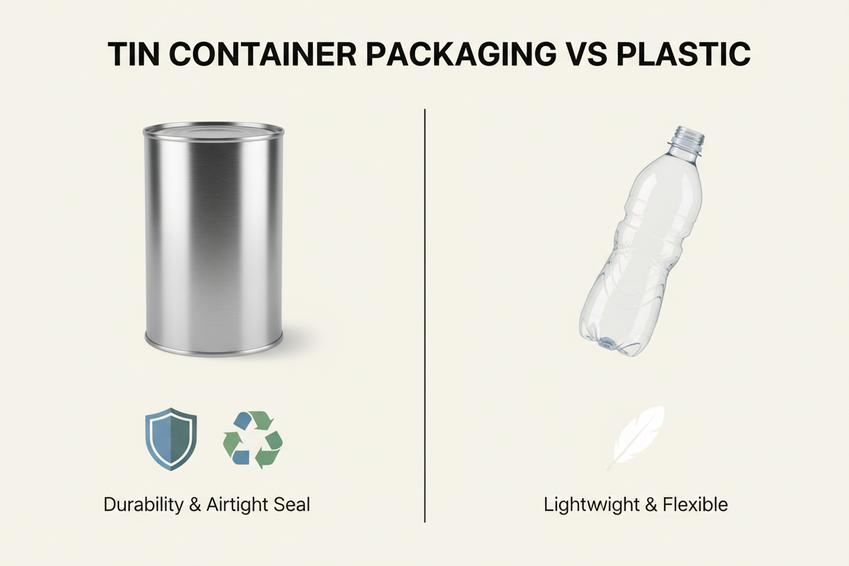

Blikbeholderemballage
The focus lands on structural impermeability and trust.
- Core Material Advantages
- Metal struktur
- Naturligt holdbar under impact
- Maintains shape under high burst pressure
- Beskyttende lag
- Internal coatings enhance korrosionsbestandighed
- Exterior finishes improve scratch tolerance
- Metal struktur
- Barriere & Safety Performance
- Airtight construction
- Strong seams create an lufttæt forsegle
- Prevents oxygen and moisture transfer
- Produktkompatibilitet
- Ideal for aerosol, maling, and chemical filling
- Certificeret fødevaregodkendt options for edible goods
- Airtight construction
- Bæredygtighed & Brand værdi
- Fuldt ud genanvendelig material stream
- Encourages genanvendelighed in consumer markets
- Custom shapes and printing make it kan tilpasses
Med tin container packaging, FANXUN delivers rigid, hermetic protection.
Plastemballage
Plastic offers fundamentally different properties.
- Materielle egenskaber
- Letvægts body reduces freight costs
- Fleksibel design adapts to many shapes
- Gennemsigtig options improve shelf display
- Functional Limits
- Lower heat resistance compared to tin container packaging
- Barrier performance depends on polymer type
- Often positioned as engangs
- Market Fit
- Works well for low-pressure goods
- Shatterproof handling in daily transport
- Broadly alsidig på tværs af brancher
When long-term barrier strength, absolute gas containment, and infinitely recyclable materials are non-negotiable, metal wins.
Committed to green manufacturing? FANXUN uses 100% recyclable tinplate and aluminum integrated with energy-saving production. Partner with us for packaging that protects the planet. Read about our Sustainability practices.
Do You Need Leak-Proof Metal Cans?
For aerosols and volatile chemicals, airtight reliability is paramount.

When Burst Pressure and Leakage Rate Matter Most
In high-pressure applications, compliance revolves around two præstationskriterier:
- Trykmodstand
- Product containment
Under these sit critical metrics of beholderintegritet:
- Sprængtryk
- Defines the maximum internal force a can tolerates (frequently tested to 15-18 bar)
- Directly reflects tætningsstyrke
- Lækagerate
- Measures micro-escape (often required to be ≤ 1.5 x 10^-3 mbar l/s)
- Impacts long-term produktindeslutning
Aerosol and chemical applications face:
- Storage in fluctuating temperatures
- Transportation vibration
- Long inventory cycles
Brands using FANXUN metal packaging prioritize these tolerances to eliminate recall risks.
Ifølge Smithers' 2025 globale udsigter til metalemballage, demand for high-performance aerosol and specialty cans continues to grow, driven by stricter safety and transport standards.
Key Valve Components for True Seal Performance
Lufttæt tin container packaging relies on micro-precision ventil komponenter.
- Aktuator
- Stilk
- Fjedermekanisme
- Gasket and O-rings
- Ventilkop
- Dyprør
Each element dictates the tætningsmekanismer og overordnet tætningsydelse:
- Material choice must guarantee chemical materialekompatibilitet.
- Spring tension dictates closure response.
- Gaskets and O-rings lock airtight lukkesystemer.
Experienced suppliers like FANXUN engineer the can geometry and valve as a cohesive unit.
Kvalitetssikring: Seam Integrity and Coating Adhesion Tests
Quality control follows strict testmetoder og fremstillingsstandarder.
- Structural verification
- Sømintegritet inspektion
- Valve crimp measurement
- Surface reliability
- Belægningsvedhæftning evaluering
- Internal lacquer checks
- Funktionel validering
- Verifikation af sprængtryk
- Leakage rate testing
Inspection teams execute:
- Visual inspection for surface flaws
- Random sampling for pressure resistance
- Documentation aligned with global kvalitetssikring rammer
FANXUN aligns QA directly with real-world thermal and kinetic stress scenarios.
Don’t leave quality to chance. FANXUN conducts 100% automated leakage testing and lab checks every 2 hours to ensure flawless performance under pressure. Learn more about our Manufacturing process or Contact Us to discuss your quality requirements.
Choosing Tin Cans—A Buyer’s Roadmap
Strategic procurement demands technical foresight.

Assess Material Composition: Genbrugsindhold & Alloy Choices
Focus on core metallurgical performance.
- Base Metal Options
- Blikplade
- Built on stål substrat
- Strong formability for deep drawing
- Aluminium
- Letvægts
- Naturlig korrosionsbestandighed
- Blikplade
- Material Source
- Genbrugsindhold
- Virgint materiale
- Stabil metal renhed
- Tekniske specifikationer
- Alloy type
- Impacts ductility and strength
- Materialemåler
- Thicker walls increase dent resistance
- Tin coating thickness
- Direct link to corrosion control
- Alloy type
FANXUN optimizes alloy and temper selections to ensure reliable forming without cost overruns.
Plan Logistics: Palle konfiguration & Shipping Container Types
Logistics planning dictates final landed costs.
- Palletization Strategy
- Standard pallet sizes
- Layer height control
- Corner protection
- Containerization Choices
- 20ft vs 40ft HC (kapacitet: 50,000–100,000 units) forsendelsesmetoder
- Moisture barriers inside container
- Bulk packaging vs inner cartons
- Operationelt flow
- Storage temperature range
- FIFO inventory logic
- Transport vibration tolerance
Optimeret packaging dimensions eliminate dead freight space.
Verify Quality Parameters: Dimensionstolerance & Visuel inspektion
-
- Dimensionsnøjagtighed
- Diameter/Height tolerance
- Neck alignment
-
- Strukturel integritet
- Sidesømslimning
- Ventilkrympepræcision
-
- Surface Integrity
- Scratch detection
- Belægningens ensartethed
FANXUN guarantees these parameters match automated filling line prerequisites.
Finalize Surface Finish: Fernis, Trykfarver & Base Coat Options
- Base Coat
- Improves ink hold
- Seals metal surface
- Trykteknikker
- Offset lithography
- UV curing systems
- Beskyttende belægninger
- Food-grade varnish types
- Abrasion resistance layers
Want to test our quality firsthand? FANXUN offers free samples for selected items with a rapid ~10-day turnaround. Request Your Free Sample Today.
FAQs about Tin Container Packaging
What makes tin container packaging suitable for industrial chemical applications?
It relies on three core strengths:
- Material backbone
- Tinplate over steel substrate (T4/T5 temper)
- Controlled gauge for high burst pressure
- Structural reliability
- Reinforced double-seam integrity
- Precision neck openings
- Chemical protection
- Advanced internal lacquers preventing reactive degradation
How do I define the right container dimensions for bulk orders?
Dimensions intersect logistics and engineering.
- Diameter/height dictate volume and pallet efficiency.
- Shoulder design alters compression strength.
- Neck openings must match metering valves.
Parameter Hvorfor det betyder noget Impact Area Diameter Filling line calibration Produktionshastighed Højde Palle konfiguration Freight cost Neck Opening Valve crimp accuracy Forebyggelse af lækage Sømintegritet Transport vibration Sikkerhedsoverholdelse Small measurement errors can slow an entire production shift.
What is the difference between two-piece and three-piece constructions?
- Two-piece construction Created via deep drawing. Zero side joints, higher burst tolerance, and ideal for sensitive formulas.
- Tredelt konstruktion Welded cylinder bodies. Superior dimensional flexibility and economical tooling costs.
Which quality checks should buyers confirm before OEM production?
Verify these parameters to mitigate risk:
- Sprængtrykstest (15+ bar)
- Micro-leakage rate measurement
- Cross-hatch coating adhesion tests
- Visual lithography and UV varnish checks
- Lagervalidering
When technical and logistical tolerances align, supply remains uninterrupted.
Ready to bring your packaging vision to life? From design to delivery, FANXUN provides a one-stop OEM/ODM solution with flexible MOQs starting at 3,000 stykker. Get a custom solution proposal in just 1 dag! Contact FANXUN Now or explore our Virksomhedsprofil.
Referencer
- sprængstyrke – single-market-economy.ec.europa.eu/European Commission
- Elektrolytisk blik – astm.org/ASTM International
- food-safe tin packaging compliance – accessdata.fda.gov/FDA
- ISO freight standards – iso.org/ISO
- BPA-free acrylics/polyesters – efsa.europa.eu/EFSA
- Saltspray timer – astm.org/ASTM International
- high recyclability rates exceeding 80% – worldsteel.org/World Steel Association
- 82.5% recovery rate – apeal.org/APEAL
- UV hærdning – radtech.org/RadTech
- Smithers' 2025 globale udsigter til metalemballage – smithers.com/Smithers
- stricter safety and transport standards – unece.org/UNECE
- Lavere CO2-fodaftryk – epa.gov/US EPA



