
 English
 العربية
 Bosanski jezik
 Čeština
 Dansk
Dansk Nederlands
 Wikang Filipino
 Suomi
Suomi Français
 Deutsch
 Magyar
 Íslenska
 Bahasa Indonesia
 Italiano
 日本語
日本語 한국어
한국어 Bahasa Melayu
 Polski
 Português
 Русский
 Cрпски језик
 Español
 ภาษาไทย
 Türkçe
 Tiếng Việt
A bad batch of automotive epoxy primer spray can doesn’t just scuff your finish—it eats margins, sparks callbacks, and wrecks trust faster than a rust bloom in July heat.
Buyers aren’t chasing chemistry trivia; they want fewer do-overs, steady application across crews, and coatings that don’t flake out under pressure or paperwork.
FANXUN engineers, in 2025 technical briefs, stress that dual-component curing systems remain the industry’s baseline for adhesion control, corrosion resistance, and repeatable film build in demanding automotive and industrial lines.
Key Takeaways: Automotive Epoxy Primer Spray Can Essentials
➔ Corrosion & Adhesion Control: Dual-component epoxy resin with corrosion inhibitors and hardener delivers superior film build, moisture barrier, and long-term bonding on metal and composites.
➔ Workflow Efficiency: Optimized drying time and recoat window streamline collision repair, ensuring consistent spray pattern and topcoat compatibility with minimal downtime.
➔ Regulatory & OEM Compliance: Meets VOC limits, OEM specifications, and safety standards via controlled solvent blends, clear labeling, and proper handling protocols.
3 Reasons To Choose 2K Primers

Serious paint jobs start long before color hits the panel. If you’re working with an automotive epoxy primer spray can, choosing the right 2K system can make or break durability, adhesion, and long-term finish quality.
Superior Corrosion Resistance with Epoxy Resin & Corrosion Inhibitor
When an automotive epoxy primer spray can is built around high-grade epoxy resin and active corrosion inhibitor chemistry, protection gets real—not just surface deep.
- Blocks moisture
- Slows oxidation
- Shields bare steel
In automotive repair, that matters. A quality automotive epoxy primer spray can creates chemical crosslinking that improves resistance in daily driving conditions.
Performance comparison:
| Substrate Type | Salt Spray Hours | Moisture Barrier Rating | Corrosion Creep (mm) | Film Density (g/cm³) |
|---|---|---|---|---|
| Bare Steel | 720 | High | 1.2 | 1.35 |
| Galvanized Steel | 680 | High | 1.5 | 1.32 |
| Aluminum Alloy | 600 | Medium-High | 1.8 | 1.30 |
| Welded Seams | 750 | High | 1.0 | 1.36 |
| Fiberglass | 500 | Medium | 2.1 | 1.28 |
Why this works:
- Epoxy resin layer
- Forms dense barrier film
- Reduces oxygen transfer
- Integrated inhibitor
- Reacts with metal ions
- Slows active rust spread
- Automotive-grade primer
- Designed for harsh road salts
FANXUN manufactures its automotive epoxy primer spray can to securely package formulations that maintain stable protection even under humidity swings.
Maximum Adhesion Strength from Dual-Component Hardener Component
Adhesion isn’t luck. It’s chemistry. A true dual-component system activates when the hardener mixes with the base inside the automotive epoxy primer spray can.
Think in layers:
- Substrate
- Bare metal
- Existing coating
- Chemical bond formation
- Crosslink density increase
- Improved bond strength
- Final cured coating
- Reduced peel risk
- Long-term adhesion stability
Short and simple: stronger grip, fewer callbacks.
Application flow with an epoxy primer spray can:
- Shake and activate hardener
- Spray even coat
- Allow chemical curing
- Inspect adhesion
FANXUN engineers its 2K can activation mechanisms to keep the mixing process reliable for busy body shops.
Outstanding UV Stability and Chemical Resistance via Advanced Pigment System
Sunlight kills weak coatings. Fuel spills do the rest. A high-quality automotive epoxy primer spray can relies on an advanced pigment system for UV stability and chemical resistance.
What makes the difference?
- Lightfast pigment blends
- Dense cured film
- Controlled film build
Here’s how it stacks up:
- UV exposure
- Minimal chalking
- Stable color tone
- Chemical splash
- Withstands brake fluid
- Resists fuel stains
- Long-term durability
- Maintains surface integrity
If you’re choosing an automotive epoxy primer spray can for serious automotive work, stable curing, strong adhesion, and weather resistance aren’t optional. They’re the baseline. That’s exactly where FANXUN positions its automotive epoxy primer spray can packaging—built to reliably dispense high-performance coatings for real garages, not just spec sheets.
2K Vs. 1K: Durability Showdown
Picking the right automotive epoxy primer spray can can feel like choosing between quick convenience and long-haul toughness. Both 2K and 1K options coat metal, seal surfaces, and prep an automotive finish—but the chemistry under the hood makes all the difference. Let’s break it down in plain talk.

2K Epoxy Primer Spray Can
A 2K automotive epoxy primer spray can runs on a true two-component system. Inside, epoxy resin meets hardener, kicking off a chemical reaction that drives a serious curing process.
- Core Build
- Resin chamber
- Internal hardener cartridge
- Activated mixing valve
- Performance Layers
- Strong adhesion to bare steel and aluminum
- High corrosion resistance in wet climates
- Long-term durability for full automotive finish jobs
| Property | 2K System | 1K System | Test Standard |
|---|---|---|---|
| Cure Type | Chemical reaction | Air dry | ASTM D5895 |
| Salt Spray (hrs) | 500+ | 120–240 | ASTM B117 |
| Adhesion (MPa) | 6–8 | 3–4 | ISO 4624 |
| Recoat Window | 24–72h | 1–4h | Lab Avg. |
For body shops pushing fleet repairs or restorations, this epoxy primer spray can type simply holds up longer. Canister manufacturers like FANXUN design 2K aerosol cans and valves with stable spray patterns, so the coating lays smooth instead of blotchy.
Bottom line: if the job demands muscle, 2K shows up ready.
1K Epoxy Primer Spray Can
A 1K automotive epoxy primer spray can is a one-component formula. No mixing, no activation button—just shake and spray.
- Relies on solvent evaporation
- Simple air dry mechanism
- Built for ease of use and quick fixes
Typical use flow:
- Clean panel
- Shake can
- Light, even coats
- Let it flash and dry
This type of epoxy spray primer works well for touch-up tasks and light duty protection. It’s great when speed matters and tools are limited.
Some DIY users prefer a 1K automotive primer spray because it’s low fuss and easy to store. For weekend repairs, that simplicity wins. Still, for deeper rust defense and long-term bonding, most pros step up to a 2K system packaged in reliable cans like those manufactured by FANXUN for heavier protection.
Collision Repair: 2K Spray Can Solution
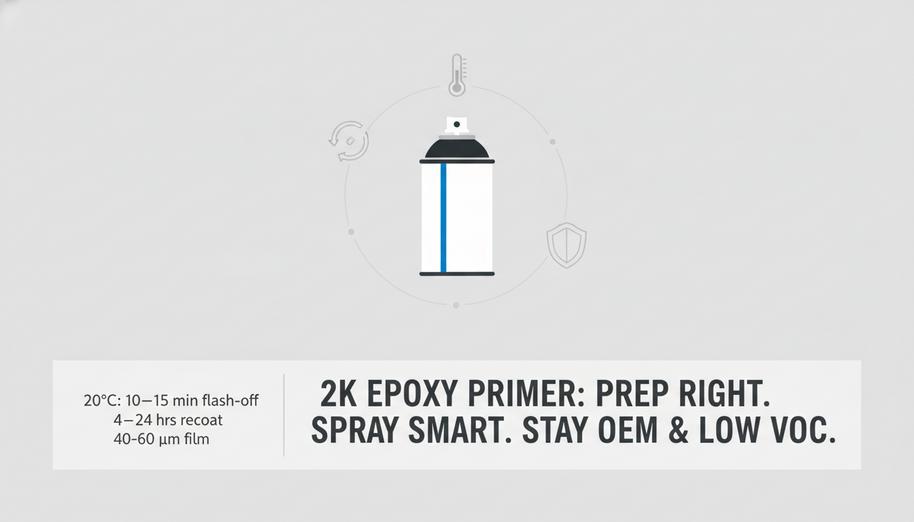
Collision repair moves fast, but shortcuts show up later as peeling paint or mismatched gloss. Using an automotive epoxy primer spray can the right way keeps repairs tight, clean, and long‑lasting. From prep to curing, this guide keeps it real and shop‑floor practical.
Surface Preparation & Pre-Treatment Step for Seamless Collision Repair
Solid repairs begin with tight surface preparation and smart pre-treatment. When applying an automotive epoxy primer spray can, every substrate reacts differently.
- Inspection & Cleaning
- Identify the substrate
- Plastic
- Bare metal
- Existing finish
- Perform deep cleaning
- Soap wash
- Panel wipe
- Final degreasing
- Identify the substrate
- Mechanical Profiling
- Controlled sanding
- P180–P320 for metal
- Grey pad for blends
- Dust removal
- Air blow
- Tack cloth
- Controlled sanding
- Adhesion Control
- Apply promoter if required
- Check adhesion through test patch
Using an epoxy primer spray can after proper prep helps the coating bite hard. Shops using formulations packaged in FANXUN OEM bulk solutions report smoother laydown when the surface is clean and oil‑free. Skip prep, and even the best automotive epoxy primer spray can won’t save the job.
Optimizing Drying Time and Recoat Window in 2K Auto Refinish
Timing matters in 2K refinish systems. The balance between drying time, flash-off, and the recoat window controls final gloss and bonding strength.
Typical 2K Epoxy Parameters
| Condition | Flash-off (min) | Recoat Window (hrs) | Film Thickness (µm) |
|---|---|---|---|
| 20°C Air Dry | 10–15 | 4–24 | 40–60 |
| 25°C Air Dry | 8–12 | 3–18 | 40–55 |
| 60°C Bake | 5–8 | 1–6 | 35–50 |
| Spot Repair | 5–10 | 2–12 | 30–45 |
Control the hardener and activator ratio inside the automotive epoxy primer spray can. Too thick a film thickness slows curing. Too thin, and protection drops. FANXUN designs its automotive epoxy primer spray can valves and actuators to keep atomization steady, making that sweet‑spot easier to hit.
Ensuring OEM Specification Compliance and VOC Regulation in Repair Bays
Modern repair bays run under tight OEM specification rules and strict VOC regulation targets.
- Regulatory Alignment
- Meet environmental standards
- Follow regional legislation
- Maintain documented compliance
- Material Handling
- Approved automotive coatings storage
- Clear hazard labeling
- Ventilated spray zones for worker safety
- Product Selection
- Low‑VOC solvent blend
- Certified 2K system
- Traceable batch coding
An automotive epoxy primer spray can that aligns with OEM specification reduces redo rates and audit stress. FANXUN provides highly sealed, leak-proof cans that safely contain compliant low-VOC formulations, so the job looks right and stays right.
Ready to upgrade your automotive packaging?
With over 30 years of expertise, FANXUN is a global leader in manufacturing highly reliable 2K aerosol cans, standard aerosol cans, and custom paint tin cans. Our 100% leak-tested, ISO-certified canisters ensure your formulations perform perfectly, every time.
Need custom sizing, precise valve systems, or vibrant lithographic printing? We offer an 8-Step Custom Project Flow with sample turnaround in just ~10 days.
Contact FANXUN today for a 1-day solution proposal, or explore our full range of Aerosol Canisters to see why clients in over 80 countries trust us to protect their brand.
References
- adhesion control, corrosion resistance – retech.com/Retech
- VOC limits – eng.mst.dk/Danish EPA
- make or break durability – reddit.com/r/AutoPaint
- high-grade epoxy resin – chemsol.com/Chemsol
- active corrosion inhibitor – hiwe.com/HiWe
- improves resistance – infinitalab.com/Infinita Lab
- chemical resistance – reddit.com/r/CafeRacers
- chemical reaction that drives a serious curing process – reddit.com/r/AutoPaint
- rust defense – car-rep.com/Car-Rep
- surface preparation – supersybon.com/SYBON
- OEM specification – evonik.com/Evonik
- VOC regulation – regulations.gov/EPA



