
 English
 العربية
 Bosanski jezik
 Čeština
 Dansk
Dansk Nederlands
 Wikang Filipino
 Suomi
Suomi Français
 Deutsch
 Magyar
 Íslenska
 Bahasa Indonesia
 Italiano
 日本語
日本語 한국어
한국어 Bahasa Melayu
 Polski
 Português
 Русский
 Cрпски језик
 Español
 ภาษาไทย
 Türkçe
 Tiếng Việt
Aerosol canisters are no longer a quiet packaging choice—they’re a pressure point in every bulk buying decision, where cost, compliance, and performance collide fast.
Suppliers pull in different directions, specs get picky, and one weak seal can wreck a whole shipment. Buyers want steady quality, clean certifications, and prices that don’t creep. This piece cuts through the noise and shows where smart sourcing is heading next now.
Quick Points: Aerosol Canisters
➔ Market Growth: Regional demand surges in North America’s premium aluminum and APAC’s high-volume steel, driving 32% volume growth by 2026.
➔ Green Packaging: High recycled content, CO₂ and hydrocarbon propellants, and water-based coatings cut VOC emissions and carbon footprints.
➔ Critical Specs: Precise fill volumes, consistent crimp diameters, and robust external finishes ensure leak-free performance and UN certification compliance.
➔ Sealing Solutions: Metered-dose vs. continuous-spray valves, bag-on-valve systems, annealing improvements, and burst-strength testing secure long-term shelf stability.
Data Shows Steady Growth In Metal Aerosol Canisters By 2034
Metal aerosol canisters are having a serious moment. From personal care sprays to industrial coatings, demand keeps climbing. Reports show a consistent rise toward USD 15.26 billion by 2034, driven by material upgrades, regional growth, and tighter compliance. Let’s break down what’s pushing the metal packaging market forward.
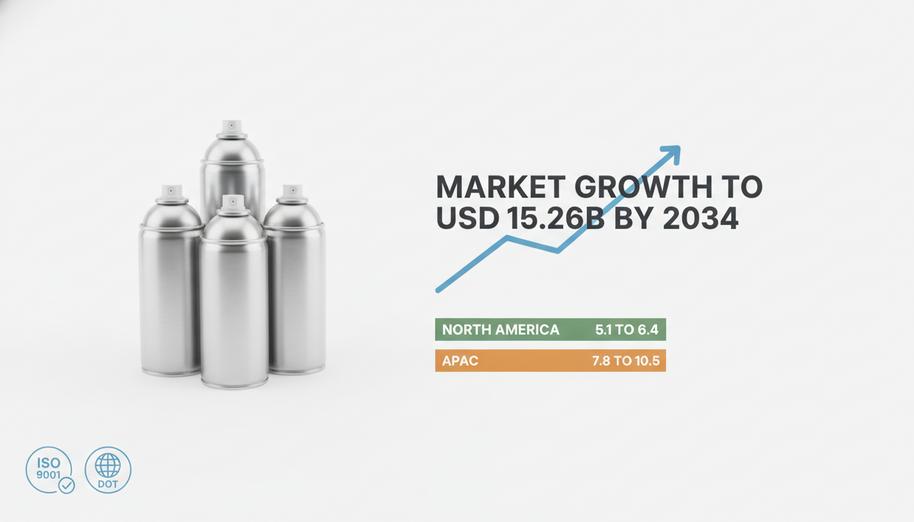
Regional demand surge: North America vs. APAC markets
Global demand for aerosol canisters splits clearly across regions, and the market dynamics are anything but flat.
- North America focuses on premium aluminum aerosol cans with strict consumption standards.
- APAC prioritizes high-volume steel production for FMCG expansion.
- Cost efficiency drives rapid output scaling in emerging economies.
- In North America
- Premium beauty and pharma packaging dominates.
- DOT transport approvals shape design specs.
- In APAC
- Steel and tinplate spray cans meet mass retail needs.
- Localized sourcing lowers production cost.
| Region | 2024 Demand (Bn Units) | 2026 Forecast (Bn Units) | CAGR % |
|---|---|---|---|
| North America | 5.1 | 6.4 | 12% |
| APAC | 7.8 | 10.5 | 15% |
| Europe | 4.6 | 5.8 | 11% |
Recent analysis (2025) notes:
“Asia-Pacific posts the fastest growth, supported by manufacturing scale and increasing consumption.”
Brands like FANXUN track these growth patterns closely, aligning output of custom spray cans with shifting consumption habits.
Steel and aluminum uptake driving volume gains
Material uptake explains the volume story in simple terms.
- Aluminum offers lightweight, anti-rusting properties and malleable features.
- Steel and tinplate keep price points sharp.
- Both metals support pressure-rated aerosol packaging.
Here’s how it plays out:
- Industrial segment
- Prefers steel for durability.
- Personal care segment
- Leans toward seamless aluminum aerosol canisters.
- Household products
- Mix of materials depending on distribution cost.
Short bursts of insight:
Aluminum cuts freight weight.
Steel reduces upfront spend.
Recyclability boosts brand image.
Metal tin manufacturers such as FANXUN balance materials selection to protect margins while pushing higher volume output of aerosol packaging formats. That mix keeps metal aerosol canisters competitive against plastic alternatives.
Impact extrusion innovations boosting production rates
Impact extrusion keeps production lines moving fast.
- Raw aluminum slug preparation
- High-force extrusion forming
- Trimming and necking
- Internal coating and curing
- Pressure testing
Inside modern manufacturing plants:
- Advanced servo presses lift efficiency.
- Wall thickness control improves pressure stability.
- Scrap rates drop below 3%.
★ Faster cycle times mean more aerosol can output per shift.
Multi-level process view:
- Tooling optimization
- Die alignment precision
- Lubrication management
- Line automation
- Robotic transfer arms
- Inline inspection systems
The result? Higher rates without sacrificing safety. FANXUN integrates upgraded extrusion technology to meet rising orders for aerosol canisters used in paints, lubricants, and healthcare sprays.
ISO 9001 and DOT compliance fueling buyer confidence
Strict ISO 9001 and DOT compliance builds serious confidence among global buyers.
- Traceable batch coding
- Hydrostatic pressure tests
- Documented certification trails
Multi-layer compliance flow:
- Quality management
- ISO 9001 audit cycles
- Continuous improvement logs
- Transport safety
- DOT pressure verification
- Hazard labeling accuracy
- Export readiness
- International standards alignment
- Regulatory documentation control
Short takes:
Quality checks protect brands.
Regulations reduce recall risk.
Clear paperwork speeds customs clearance.
For OEM clients sourcing aerosol canisters, these regulations are non‑negotiable. That’s why suppliers like FANXUN treat quality systems as core infrastructure, not just a box to tick. Confidence sells—and in this market, certified metal aerosol containers close deals faster than ever.
Need a Reliable Packaging Partner? FANXUN delivers globally compliant aerosol can solutions. With MOQs starting at just 3,000 pieces and free samples available, we make upgrading your packaging simple and secure. Contact us today for a 1-day solution proposal.
Why Aerosol Canisters Lead Green Packaging Trends
Aerosol canisters are no longer just spray containers sitting on retail shelves. From personal care to pharma, aerosol solutions and canisters now signal climate awareness. Brands pushing eco goals are rethinking empty spray cans, spray canisters, and metal packaging from the inside out.

Recycled content in aluminum and tinplate canisters
- High recycled materials content
- Lower emissions from aluminum re-melting
- Stronger compliance with sustainability targets
- Post-consumer content reduces virgin mining.
- Recycled tinplate cuts energy demand.
- Manufacturers are expanding recycled-aluminum capacity and closed-loop sourcing programs.
For metal packaging used in aerosol canisters:
- Material stream
- ♢ Collection of used aerosol cans
- ♢ Sorting into aluminum and steel fractions
- Reprocessing
- Melting with controlled alloy balance
- Rolling into new sheets for canisters
- Manufacturing
- Reforming into fresh aerosol canisters with minimal waste
FANXUN integrates high post-consumer content into its aerosol cans, helping OEM buyers tick regulatory boxes without sacrificing durability.
HFC alternatives and CO₂ propellants for eco impact
The talk around HFC alternatives is getting louder. Regulators tie greenhouse gases directly to packaging choices.
“Eco-friendly propellants such as compressed air and nitrogen” will dominate new aerosol technology investments, cutting environmental impact.
Inside modern aerosol canisters:
- Propellant layer
- CO₂ propellants for reduced climate change impact
- Nitrogen for pressure stability
- Hydrocarbons with low ozone depletion risk
- Valve compatibility
- Seal integrity
- Spray consistency
Switching to sustainable propellants keeps spray performance sharp while shrinking eco impact. FANXUN designs aerosol canisters ready for these next-gen gases.
Water-based internal coatings reducing VOC emissions
Water-based coatings are reshaping aerosol linings. Short story? Less smell, fewer VOC emissions, better air quality.
Key upgrades in internal coatings:
- Low VOC resin systems
- Improved corrosion resistance
- Compliance with strict environmental regulations
For food and pharma aerosol canisters, compatibility matters. The coating must:
- Protect product purity.
- Prevent metal interaction.
- Maintain shelf life.
Low VOC, high protection. That balance defines sustainable coatings today.
Seamless construction and energy-efficient lacquering
Seamless construction boosts material integrity in aerosol canisters and reduces scrap. No side seam means fewer weak spots and lighter metal use.
Production flow inside advanced plants:
- Forming
- Impact extrusion for single-piece bodies
- Surface treatment
- Thin, even lacquer layers
- Energy-efficient lacquering ovens lowering energy consumption
- Quality control
- Pressure testing
- Aerosol design validation
The result? Smarter manufacturing processes, tighter production efficiency, and aerosol cans that feel simple but carry serious green credentials.
3 Critical Specs For Industrial Aerosol Cans
Industrial aerosol canisters look simple on the outside, yet every detail—from pressure balance to surface coating—decides if a product sprays smoothly or fails on the shelf. When buyers compare aerosol cans and metal spray containers, these three specs usually separate average supply from pro-level manufacturing.

Fill volume accuracy and pressure rating optimization
Precision in fill level and propellant volume keeps aerosol canisters safe and consistent. Too much gas pushes beyond pressure limits. Too little affects product dosage. Getting this balance right is serious business.
Key control points:
- Calibrated filling precision systems
- Verified safety specifications
- Routine regulatory compliance audits
Performance reference table for industrial aerosol canisters:
| Can Size (ml) | Nominal Fill Level (ml) | Max Pressure Rating (bar) | Test Pressure (bar) | Dosage Variance (%) |
|---|---|---|---|---|
| 150 | 140 | 12 | 18 | ±1.5 |
| 250 | 235 | 12 | 18 | ±1.2 |
| 400 | 380 | 14 | 21 | ±1.0 |
| 500 | 475 | 14 | 21 | ±1.0 |
| 600 | 570 | 16 | 24 | ±0.8 |
Optimization techniques usually follow this path:
- Measure internal volume tolerance.
- Match propellant ratio (CO₂ or DME).
- Validate burst and deformation thresholds.
- Document for UN transport approval.
While FANXUN does not provide filling services, brands can buy a filling machine from us to manage optimization techniques in-house, helping them ship spray cans globally without stress.
Crimp diameter consistency with leak detection standards
A tight valve crimp protects the container seal. Even a 0.05 mm deviation in manufacturing tolerance can weaken sealing integrity.
Core quality control flow:
- Incoming valve inspection
- Crimp diameter calibration
- Inline defect detection
- Pressure-hold leak simulation
Technical breakdown:
- Industry standards require precise crimp ranges
- Proper compression supports leakage prevention
- Automated sensors flag micro-gas escape
For aerosol canisters used in chemicals or lubricants, small leaks mean big returns. FANXUN applies 100% online sealing tests, including water and air pressure testing, to keep spray can batches strictly within spec.
“Industrial packaging buyers are prioritizing certified pressure safety” and traceable quality data in procurement cycles.
That shift puts measurable crimp consistency front and center.
External finish quality and corrosion resistance testing
Looks matter. So does survival.
External protection of aerosol canisters relies on layered surface coating systems:
- Primer for adhesion
- Printed decorative layer for aesthetic quality
- Over-varnish as protective layers
Corrosion control is tested through:
- Salt spray exposure (≥72–240 hours)
- Humidity chamber simulation
- Impact abrasion trials
- Storage under variable environmental exposure
Multiple short checks keep performance honest.
Rust spots? Not acceptable.
Peeling ink? Brand damage.
Weak lacquer? Reduced material durability.
Advanced performance testing confirms rust prevention before shipment. FANXUN supports custom finishes for aerosol cans and metal tins with lids wholesale packaging that stay sharp during shipping, storage, and real-world handling.
Leaky Canisters? Advanced Sealing Solutions Explained
A leaking aerosol canisters unit is more than annoying—it risks product loss, pressure failure, and safety issues. From small aerosol can parts to full spray can assemblies, sealing tech keeps everything tight. Let’s break down how modern aerosol canisters, pressurized cans, and spray containers stay leak‑free.

Metered dose valve vs. continuous spray valve
In aerosol canisters, choosing the right aerosol can valve technology shapes performance and leak control.
- Metered dose systems focus on exact dosage control.
- Continuous spray setups prioritize steady aerosol delivery.
- Actuator fit defines the final spray pattern.
- Actuation mechanism design
- Spring tension calibration
- Gasket compression range
- Stem alignment tolerance
- Crimping integrity
- Curl thickness check
- Ferrule hardness balance
- Seal validation
- Vacuum decay testing
- Micro-leak inspection
| Valve Type | Output per Actuation | Typical Pressure (bar) | Leak Risk Level |
|---|---|---|---|
| Metered dose | 50–200 µL | 3–6 | Low |
| Continuous spray | Variable | 3–8 | Medium |
| High-viscosity metered | 100–300 µL | 4–7 | Low |
| Industrial spray | Continuous | 5–9 | Medium |
For aerosol can systems needing medical or precise spray can output, metered valves reduce waste. For household aerosol containers, continuous spray keeps flow smooth.
Bag-on-valve systems for zero-leak assurance
Bag-on-valve or BOV technology changes how aerosol canisters behave under pressure.
Core concept:
- Product sits inside a sealed laminate bag.
- Compressed air or nitrogen surrounds it.
- No direct propellant contact.
Leak prevention improves because of:
- Internal product separation
- Barrier film strength
- Heat-sealed seams
- External pressure stability
- Uniform compression
- Reduced valve stress
- Clean filling workflow
- Aseptic filling controls
- Propellant-free processing
Result? Barrier packaging that protects formula, lowers contamination risk, and keeps spray cans stable even when tossed in a gym bag.
Annealing and curing process improvements
Metal fatigue is sneaky. In aerosol canisters, small cracks can grow over months.
Annealing as a targeted heat treatment improves grain structure. The aluminum or tinplate gains ductility, resisting stress around the dome and curl.
Inside the can:
- Coating layers rely on tight polymer crosslinking.
- Smart curing cycles boost coating adhesion.
- Stronger bonding equals better seal integrity.
Process optimization usually follows this path:
- Temperature ramp calibration
- Hold-time adjustment
- Controlled cooling curve
- Adhesion pull testing
When done right, aerosol cans keep their structure even after long storage in hot delivery trucks.
Burst strength testing for shelf life stability
Pressure isn’t gentle on aerosol canisters.
Testing focuses on:
- Burst strength thresholds
- Long-term stability testing
- Real-world pressure resistance
Evaluation flow:
- Initial fill pressure measurement
- Thermal cycling (5°C–50°C)
- Fatigue simulation
- Final structural analysis
Quality teams track:
- Wall thinning patterns
- Dome deformation
- Valve cup displacement
- Overall container integrity
Strong burst performance protects shelf life and user safety. When aerosol packaging passes these checks, the spray container can handle transport shocks, temperature swings, and months on retail shelves without leaking a drop.
Secure Your Supply Chain with FANXUN
Sourcing reliable aerosol canisters shouldn’t be a bottleneck. With over 30 years of expertise and a footprint in 80+ countries, FANXUN is a leading aerosol can manufacturer offering one-stop solutions—from eco-friendly materials and vivid lithographic printing to 100% automated leak testing.
Whether you need rapid sample development (≈10 days) or a scalable OEM/ODM run, our team is equipped to meet UN, DOT, and ISO 9001 standards.
➔ Explore our customization depth or Contact us today to secure your packaging order.
References
- Aerosol Packaging Market Size, Industry Share, Forecast to 2034 – https://www.fortunebusinessinsights.com/aerosol-packaging-market-108053
- Aerosol Cans Market Size, Growth & Overview, 2026-2033 – https://www.persistencemarketresearch.com/market-research/aerosol-cans-market.asp
- Metal Aerosol Packaging Market Share & Size Forecast 2021-2031 – https://www.factmr.com/report/metal-aerosol-packaging-market
- Aerosol Packaging Market | Global Market Analysis Report – 2035 – https://www.futuremarketinsights.com/reports/aerosol-packaging-market



