
 English
 العربية
 Bosanski jezik
 Čeština
 Dansk
Dansk Nederlands
 Wikang Filipino
 Suomi
Suomi Français
 Deutsch
 Magyar
 Íslenska
 Bahasa Indonesia
 Italiano
 日本語
日本語 한국어
한국어 Bahasa Melayu
 Polski
 Português
 Русский
 Cрпски језик
 Español
 ภาษาไทย
 Türkçe
 Tiếng Việt
Metal cans wholesale isn’t just a line item on a spreadsheet—it’s the backbone of every spray, splash, and shelf-ready product you ship. When a batch fails pressure tests or coatings peel mid-transit, it’s not “just packaging.” It’s late nights, refund emails, and a brand reputation taking a hit.
Sourcing the right can should feel less like rolling dice in Vegas and more like locking in a solid handshake deal. You need strength under pressure, coatings that don’t flinch, and tin can manufacturers who actually pick up the phone.
That’s where this guide steps in.
Quick Insights for Metal Cans Wholesale
- Vet recyclable alloys and corrosion-resistant metals for pressure integrity and eco-compliance
- Benchmark seamless aluminum monobloc pricing by capacity, necking, and valve compatibility
- Confirm deep drawing or impact extrusion expertise for uniform wall thickness and strength
- Ensure internal lacquer, external UV-resistant coating, ISO certification, and TPED compliance
5 Steps To Source Metal Cans Wholesale Efficiently
Sourcing metal cans wholesale sounds simple, but real buyers know it’s a mix of pricing, compliance, and supplier trust. When you break down “metal,” “cans,” and “wholesale,” each word matters. Bulk metal packaging isn’t just about cost; it’s about safety, finish, and long-term supply. Here’s how smart buyers lock in reliable wholesale metal cans without headaches.

Step 1 – Vet Recyclable Metal and Corrosion-Resistant Alloy Vendors
When handling metal cans wholesale, material sourcing sets the tone.
- Vendor vetting starts with proof of recyclable metal content.
- Check metal composition certificates for aluminum purity or tinplate grade.
- Review third-party audits tied to supplier evaluation systems.
For aerosol and pressure packaging, focus on:
- Corrosion-resistant alloy performance in humid storage.
- Compatibility with LPG or DME propellants.
- Traceable batch documentation.
FANXUN supports buyers by documenting alloy origin, recycling ratio, and compliance data upfront. That cuts back-and-forth emails and speeds up bulk metal can procurement.
Step 2 – Compare Pricing for Seamless Aluminum Monobloc Cans
Cost comparison in metal cans wholesale is never just unit price.
- Neck diameter
- Wall thickness
- Valve fit tolerance
Under monobloc cans sourcing, review:
- Seamless aluminum cans formed in one piece.
- Capacity ranges (45ml–500ml typical for aerosols).
- Tooling fees hidden in wholesale aluminum quotes.
Ask suppliers to break down aluminum can pricing into raw material index, forming cost, and printing cost. FANXUN provides transparent manufacturing costs, helping buyers compare wholesale metal cans side by side without guesswork.
Step 3 – Evaluate Manufacturers Offering Deep Drawing and Impact Extrusion
Production capability decides durability.
- Deep drawing manufacturing ensures even base shaping.
- Impact extrusion process controls wall strength.
- Skilled metal forming avoids micro-cracks.
During can manufacturer evaluation, confirm:
- In-house tooling workshops.
- Pressure burst testing records.
- Automation level in production lines.
Reliable metal cans wholesale partners will share forming tolerances and sample reports without delay.
Step 4 – Assess Surface Treatments: Internal Lacquer and External Printing
Surface protection makes or breaks product shelf life.
For internal lacquer coating:
- Chemical resistance tests
- Adhesion rating
- Food-grade compliance
For external can printing:
- UV stability.
- Scratch resistance.
- Color consistency in bulk runs.
Strong protective coatings prevent leakage and branding fade. Wholesale packaging solutions should arrive retail-ready, not needing rework.
Step 5 – Finalize Orders with ISO Certification and TPED Compliance
Compliance closes the deal.
- Verify active ISO certification numbers.
- Confirm TPED compliance for transport in Europe.
- Cross-check regulatory compliance with DOT files.
Under strict quality standards, request:
- Pressure test reports.
- Batch inspection sheets.
- Signed certification requirements.
FANXUN aligns order finalization with documented audits, keeping your metal cans wholesale supply smooth, legal, and ready for global shipment.
How Do You Ensure Quality In Bulk Can Purchases?
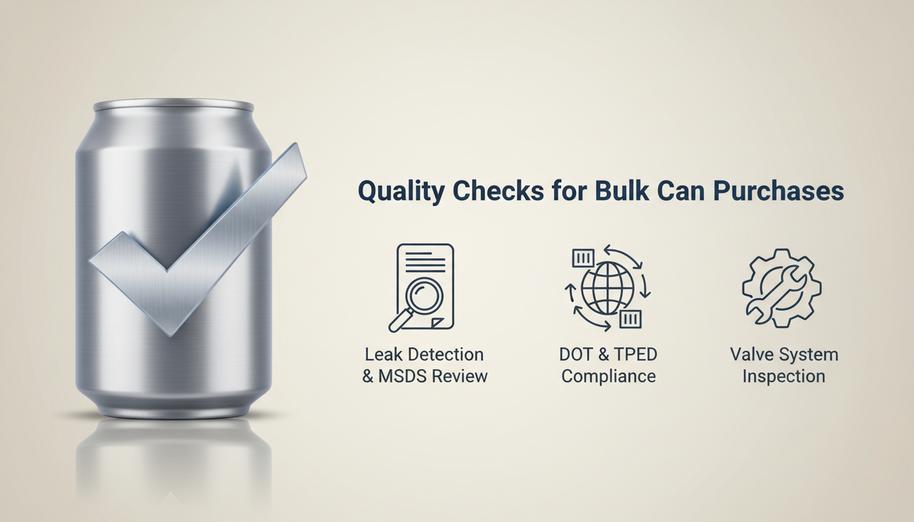
When sourcing metal cans wholesale, quality is not just a checkbox—it’s your brand’s reputation on the line. From coatings to compliance, smart buyers lock in strict checks before signing any bulk deal.
Conduct Comprehensive Leak Detection and Material Safety Data Sheet Review
When ordering metal cans wholesale, start with layered quality control:
- Batch Testing
- Pressure retention validation
- Automated leak detection systems
- Randomized destructive burst testing
- Documentation Audit
- Review the material safety data sheet
- Confirm chemical composition of internal coatings
- Verify propellant compatibility
- Check alignment with international safety standards
- Review the material safety data sheet
- Risk Screening
- Identify potential manufacturing defects
- Assess long-term product integrity under storage stress
For buyers working with aerosol can experts, these checks are built into production workflows, which makes sourcing metal cans in bulk far less stressful. Reliable metal cans wholesale partners never skip paperwork.
Verify DOT Regulations and TPED Compliance Across Shipments
Shipping aerosol containers is serious business.
- Regulatory Validation
- Confirm adherence to DOT regulations
- Cross-check TPED compliance for EU routes
- Inspect hazard labeling for hazardous materials
- Packaging Control
- Review outer carton packaging requirements
- Validate pallet stability for transportation safety
- Ensure marks meet global shipping standards
The IATA noted in its 2025 Dangerous Goods Report that compliance errors in aerosol labeling remain a leading cause of cross-border shipment delays.
That’s why smart buyers in metal cans wholesale double-check documents before containers even leave the plant. FANXUN aligns shipments with both domestic and international regulations, reducing costly hold-ups.
Inspect Valve System Components: Gaskets, Metering Valves, and Actuators
Performance issues usually trace back to the valve system.
- Component Inspection
- Test gaskets for elasticity and aging resistance
- Measure metering valves output accuracy
- Check actuators for smooth engagement
- Assembly Accuracy
- Dip tube alignment
- Crimp consistency
- Overall sealing performance
Functional testing under simulated use conditions confirms spray stability. When purchasing metal cans wholesale, consistent spray patterns protect brand trust. Reliable suppliers of wholesale metal packaging treat this as non-negotiable.
Confirm Food-Grade Lining and UV-Resistant Finish for OEM Food Aerosols
For OEM food projects, extra caution pays off.
- Internal Protection
- Validate food-grade lining compatibility
- Acid resistance
- Oil interaction stability
- Flavor neutrality for OEM food aerosols
- Validate food-grade lining compatibility
- External Durability
- Inspect UV-resistant finish
- Review surface surface treatment adhesion
- Assess branding color retention and shelf life preservation
In food applications, poor lining equals product recall. That’s not a gamble worth taking. Buyers sourcing metal cans wholesale from FANXUN gain traceable coating data and long-term storage assurance, keeping both compliance teams and customers happy.
Chemical Storage Scenario: Bulk Cans For Hazardous Liquids
Handling hazardous liquids in bulk is no small deal. From factory floors to home storage cabinets, safe packaging matters. For buyers exploring metal cans wholesale, choosing the right metal cans, wholesale metal packaging, and bulk metal cans can make or break safety and compliance goals.

Selecting Two-Piece Steel Pressure Vessels for Industrial Sprays
When sourcing metal cans wholesale for industrial sprays, start with two-piece steel cans built as certified pressure vessels. These are commonly formed by deep drawing or precision welding, ensuring uniform wall thickness and consistent can construction.
- Material Selection
- Carbon steel for strength
- Tinplate for corrosion resistance
- Internal lacquer lining for chemical isolation
- Performance Standards
- Burst pressure ≥ 1.8 MPa
- Deformation resistance under 50°C storage
- Compliance with UN transport codes
Within bulk orders of metal cans wholesale, buyers often compare:
| Parameter | Standard Range | Test Method |
|---|---|---|
| Wall Thickness | 0.18–0.28 mm | Micrometer gauge |
| Burst Pressure | 1.6–2.2 MPa | Hydraulic test |
| Weld Strength | ≥ 95% base metal | Tensile test |
For large industrial sprays, nested evaluation helps:
- Pressure Vessel Integrity
- Material grade certification
- Seam inspection
- Hydrostatic testing
- Propellant Compatibility
- LPG tolerance
- Hydrocarbon stability
- Supplier Audit
- ISO quality systems
- Batch traceability
Brands like FANXUN align car care and industrial sprays packaging with strict performance standards, which is why many buyers return for metal cans wholesale contracts year after year.
Ensuring Corrosion Inhibitor Coating for Household Chemical Storage
Household chemicals can be harsh. Bleach, solvents, and acidic cleaners attack untreated steel fast. That’s where corrosion inhibitor systems and smart coating application matter.
Key protection layers in wholesale metal cans:
- Epoxy phenolic liners
- Polyester-based liner materials
- BPA-NI alternatives for sensitive formulations
Protection planning usually runs like this:
- Chemical Compatibility Testing
- Salt Spray Exposure (≥ 72 hours)
- Adhesion and Cross-Hatch Testing
Inside the can:
- Base metal
- Tinplate substrate
- Intermediate layer
- Anti-corrosive primer
- Top layer
- Chemical-resistant coating
Short check. No rust. No leaks. Storage safety stays tight.
For buyers searching metal cans wholesale, asking about chemical compatibility reports is just smart business. FANXUN supports bulk engine oil can and chemical container orders with documented lab validation, helping reduce return rates and boosting long-term storage safety.
Integrating Dip Tubes and Continuous Valves for Safe Dispensing
Dispensing is where risk spikes. A poorly fitted dip tubes system or low-grade continuous valves can lead to splashing or vapor escape.
Critical components include:
- Precision-cut dip tubes matched to can height
- Crimped valve cups with tight valve seals
- Metered or non-metered dispensing mechanisms
Functional layout:
- Valve Assembly
- Actuator
- Stem
- Gasket
- Liquid Path
- Dip tube length calibration
- Flow rate control
- External Safety
- Child-resistant caps
- Anti-clog nozzles
Buyers in metal cans wholesale deals often request customization for specialty product delivery. It’s a small tweak, yet it sharply improves safe handling and reduces chemical exposure during daily use.
Optimizing LPG and DME Propellant Filling Procedures
For aerosol-grade packaging in metal cans wholesale supply, LPG and DME demand strict propellant filling discipline. Gas handling errors are expensive—and dangerous.
Standard control flow:
- Empty can vacuum check
- Valve crimp integrity inspection
- Precise propellant weight dosing
- Water bath leak detection
Under the hood:
- Gas Handling System
- Explosion-proof pumps
- Grounded transfer lines
- Pressure Control
- Inline gauges
- Automatic shut-off valves
- Safety Protocols
- Ventilation monitoring
- Fire suppression systems
Typical benchmarks in bulk metal cans filling:
- LPG fill tolerance: ±0.5 g
- DME temperature control: 20–25°C
- Leak rejection rate: < 0.3%
In large-scale metal cans wholesale programs, FANXUN integrates automated pressure control and digital weight calibration to keep compliance tight. For distributors dealing in metal bucket options and industrial aerosol supply, that level of control keeps operations smooth and inspectors satisfied.
FAQs
How can I identify reliable suppliers for metal cans wholesale orders?
Choosing the right partner protects your product and your brand.
Material credibility
- Offer aluminum, tinplate, or steel with verified recyclable metal content
- Use corrosion-resistant alloy or seamless aluminum for high-pressure aerosol container use
Process transparency
- Apply deep drawing or impact extrusion for monobloc can strength
- Maintain consistent necking, flanging, and coating application standards
Compliance proof
- Valid ISO certification
- Documented pressure testing and leak detection
- Clear material safety data sheet records for personal care products, household chemicals, or pharmaceutical aerosols
A serious supplier speaks confidently about pressure vessel safety—not just pricing.
What manufacturing and structural factors ensure durability in spray cans?
Durability begins in the forming stage and ends at the valve seal.
- Can structureTwo-piece can or three-piece can bodies formed through welding or impact extrusion maintain wall consistency under hydrocarbon propellant or compressed gas pressure.
- Surface protectionInternal lacquer or food-grade lining prevents formula reaction.
External printing with UV resistant finish preserves shelf appeal.
Protective coating and corrosion inhibitor extend storage life.
- Valve system integrityActuator alignment, secure valve cup crimping, compatible gasket material, and correct dip tube length prevent leakage in automotive products or industrial sprays.
When structure, coating, and aerosol valve system move in harmony, failure rates drop dramatically.
What compliance and propellant checks matter before shipping bulk aerosol containers?
Large-scale metal cans wholesale orders must satisfy both safety and transport rules.
① Propellant compatibility
- Test against LPG, DME, nitrogen, or carbon dioxide
- Confirm resistance to hydrocarbon propellant blends according to BAMA guidelines
② Regulatory alignment
- DOT regulations for domestic transport
- TPED compliance for pressure vessel movement across borders
③ Performance validation
- Batch pressure testing
- Automated leak detection before filling food aerosols or industrial sprays
When documentation matches real-world testing, shipments move without delays—and without costly recalls.
References
- Metal Packaging Recycling and Markets – worldsteel.org
- Mechanical and Physical Properties of Aluminum – aluminum.org
- Transportable Pressure Equipment Directive (TPED) – transport.ec.europa.eu
- ISO 9001 Quality Management Systems – iso.org
- PHMSA Hazardous Materials Registration and DOT Compliance – phmsa.dot.gov
- Dangerous Goods Regulations (DGR) and Shipping Standards – iata.org
- Fundamentals of the Deep Drawing Process – sciencedirect.com
- Impact Extrusion Mechanics and Applications – sciencedirect.com
- BPA-NI Transition and Metal Packaging Coatings – packaginglaw.com
- Global LPG Market and Propellant Safety – wlpga.org
- BAMA Aerosol Industry Standards and Guidelines – bama.co.uk
- DME Propellant Properties and Safety – aboutdme.org
- Packaging Food Contact Substances (FCS) and Compliance – fda.gov
- ASTM Packaging and Pressure Safety Standards – astm.org



