English
 العربية
 Bosanski jezik
 Čeština
 Dansk
Dansk Nederlands
 Wikang Filipino
 Suomi
Suomi Français
 Deutsch
 Magyar
 Íslenska
 Bahasa Indonesia
 Italiano
 日本語
日本語 한국어
한국어 Bahasa Melayu
 Polski
 Português
 Русский
 Cрпски језик
 Español
 ภาษาไทย
 Türkçe
 Tiếng Việt
How are tin aerosol cans made?
Metal Can Manufacturing Process
Welcome to our comprehensive Metal Can Manufacturing Process page, where we showcase the full production workflow behind our wide range of high-quality metal packaging solutions. From traditional tinplate aerosol cans to aluminum aerosol bottles, oil cans, brake fluid cans, and various industrial and consumer-grade metal containers, every product is manufactured through a highly controlled, technology-driven process designed for strength, safety, and durability.
Raw Material Preparation
Our manufacturing process begins with meticulous raw material preparation. We source high-quality tinplate from well-known supplies to ensure the durability and integrity of our tin aerosol cans.
Raw Material Handling


| Raw Materials | Size | Density | Solid Content | Spot Check |
|---|---|---|---|---|
| Steel | ✔ | ✔ | - | ✔ |
| White porcelain oil | - | ✔ | ✔ | ✔ |
| Sealant | - | ✔ | ✔ | ✔ |
| Plastic handles | - | ✔ | ✔ | ✔ |
| ... | ... | ... | ... | ... |
Coil Cutting (Large Sheets)
The steel coils are then cut into large tinplate sheets using high-precision shearing machines. Our automated lines guarantee uniform dimensions, low burr edges, and excellent flatness. Optimization of this stage minimizes waste and maximizes material utilization, contributing to cost efficiency for large-volume OEM aerosol can production.
Accurate sheet dimensions also ensure flawless printing registration and consistent body blank formation later in the process.
Printing
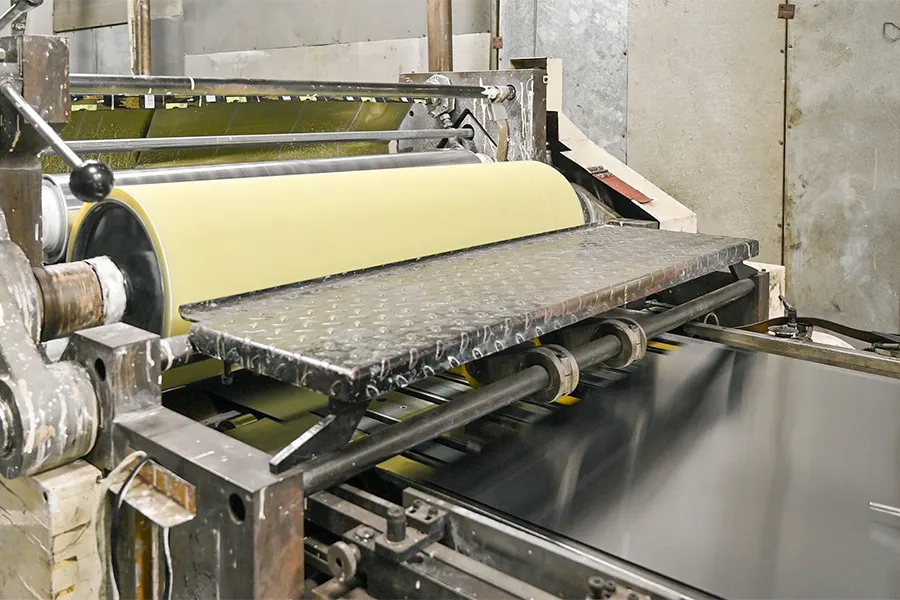
The large tinplate sheets are printed using advanced multi-color offset printing equipment. We apply protective coatings, brand artwork, safety instructions, and product information with high-definition clarity. Color accuracy is maintained through digital color correction systems and strict ink-control processes.
Each sheet may receive multiple layers of varnish, anti-scratch coatings, or corrosion-resistant finishes depending on the application requirements. This ensures the final aerosol can withstands harsh logistics conditions, chemical exposure, and long-term shelf storage without fading or peeling—critical for premium retail packaging.
Horizontal Cutting (Sheet Slicing)
After printing, the large sheets are horizontally cut into smaller pieces tailored to different aerosol can diameters. Precision slicing ensures consistent dimensions that directly impact the can-body rolling process.
This step requires high accuracy to avoid print misalignment, uneven edges, or deformation. Proper horizontal cutting is essential for maintaining a seamless appearance and reducing material waste in mass production.
Vertical Cutting (Final Body Blanks)
The horizontally sliced sheets are then vertically cut into final body blanks. Each blank undergoes quality checks for dimensional accuracy, print alignment, coating integrity, and smoothness.
Producing accurate body blanks is vital for stable welding performance and uniform can-body thickness. Properly prepared blanks help us achieve consistent cylindrical shapes, strong weld seams, and professional, clean-looking aerosol cans that meet global packaging standards.
Welding
Body blanks are rolled and welded into perfectly cylindrical can bodies using high-speed electric resistance welding technology. The weld seam is then reinforced, cleaned, and coated to enhance corrosion resistance and airtightness.
This is one of the most critical steps in aerosol can production since weld strength directly affects the can’s ability to withstand high internal pressure. Our advanced welding lines ensure that each can meets strict international safety standards, preventing leaks and deformation during filling, transportation, and storage.
Dome & Component Production
We manufacture all essential components—including domes, bottoms, and various accessories—in-house using high-precision stamping machines. This allows full control over quality, thickness, pressure tolerance, and dimensional accuracy.
Each component is engineered to handle high pressure and provide reliable structural support for different propellants. In-house production also ensures rapid delivery, stable supply, and fully customizable solutions for branding, OEM orders, and special-application aerosol cans.
Stamping & Final Assembly
The can body, dome, and bottom are assembled using automated stamping, curling, and seaming machines. During this stage, all parts are firmly joined to create a fully sealed, pressure-resistant structure.
Our assembly lines control every dimension—height, diameter, curl precision, and seam strength—to guarantee high compatibility with filling lines used in cosmetics, household cleaning, automotive care, and industrial applications. The result is a strong and consistent container ready for intensive testing.
Automated Pressure Testing (Inline Pressure Inspection)
Every aerosol can first goes through an automated inline pressure testing system, which is one of the most important steps in ensuring safety and performance. The machine applies controlled internal pressure to each can to evaluate its strength, seam stability, and resistance to deformation.
This high-speed testing line identifies any cans that may have potential issues—such as weak weld seams, shape deformation, or inconsistent metal thickness. The automated equipment ensures 100% inspection coverage, reduces human error, and guarantees that only structurally sound cans move forward in the production process.
Cans that pass the inline pressure test continue to packaging.
Cans that do not fully meet pressure criteria are automatically rejected and transferred to the manual verification stage for further inspection.
Manual Water Bath Testing (Secondary Leak Verification)
Any can flagged by the pressure-testing system is sent to our trained quality-control team for manual water bath leak testing. During this process, the can is submerged in a water tank while internal pressure is applied. Inspectors carefully observe for bubbles, which indicate small leaks or micro-defects.
This secondary manual check ensures that borderline units are thoroughly confirmed before disposal or rework. It also guarantees that no defective cans enter the market.
Our water bath testing follows strict QC protocols and international aerosol packaging safety standards, ensuring complete reliability in the final product.
Packaging (Carton Packing & Palletizing)
The approved cans are packed into strong export cartons and palletized using optimized stacking patterns to prevent deformation during transportation. Packaging can be customized based on client requirements, including brand printing, reinforced cartons, or protective inner layers for long-distance export.
We ensure each pallet is stable, moisture-protected, and compliant with international logistics standards to support reliable global delivery.
Raw Material Preparation
Our manufacturing process begins with meticulous raw material preparation. We source high-quality tinplate from well-known supplies to ensure the durability and integrity of our tin aerosol cans.
Raw Material Handling
The manufacturing process begins with the careful selection and preparation of high-quality aluminum ingots. We source only certified aluminum materials with stable chemical composition and excellent mechanical properties, ensuring consistent performance throughout the entire production cycle. Each incoming batch is tested for purity, density, hardness, and grain uniformity to avoid internal defects that may affect extrusion or pressure resistance later. By starting with superior raw material, we guarantee that every can we produce meets international standards for durability, corrosion resistance, and reliability in high-pressure aerosol applications.
Impact Extrusion – Forming the Can Body
The aluminum slug is placed into a high-speed impact extrusion press, where an immense force is applied in a single stroke. This process stretches the slug into a seamless cylindrical can body without any welding or joints. Seamless construction is one of the major advantages of aluminum aerosol cans, offering exceptional pressure tolerance and preventing leakage at high internal pressures. The extrusion press controls wall thickness, height, and dimensional stability with extreme precision. Each stroke ensures that the can maintains uniform distribution of material, resulting in consistent weight, excellent mechanical strength, and a perfectly smooth interior and exterior surface ready for further processing.
Precision Trimming
After extrusion, the can body is slightly taller than the final required size. A precision trimming machine cuts the top edge to achieve an exact, uniform height across the entire batch. This ensures compatibility with downstream processes such as necking, coating, and printing. Accurate trimming also removes any uneven or rough edges created during extrusion. Continuous automated sensors monitor each can to maintain strict height tolerances, ensuring perfect consistency for large-volume production and flawless performance on automated filling lines.
Surface Polishing & Mechanical Smoothing
The trimmed cans undergo mechanical polishing to refine the outer surface and remove microscopic irregularities. This step improves the aesthetic appearance and is crucial for achieving optimal adhesion for exterior coatings and printing inks. Our polishing systems use a combination of abrasive techniques and rotational brushing to produce a highly smooth, uniform finish. Polished surfaces not only enhance brand presentation but also reduce the risk of coating defects such as pinholes, streaks, or peeling during long-term storage.
Multi-Stage Washing & Degreasing
To ensure perfect cleanliness, cans pass through a fully automated multi-stage washing system. This system includes pre-washing, chemical degreasing, ultrasonic cleaning, hot water rinsing, and deionized water rinsing. These steps eliminate lubricants, metal residues, fine particles, and impurities left from the extrusion and polishing processes. Clean cans are essential for the adhesion and effectiveness of internal coatings and exterior paints. Any traces of contamination could lead to chemical reactions with the product or cause defects in the final appearance. After washing, the cans are dried in a hot-air oven to ensure no moisture remains.
Internal Coating – Protective Food-Grade or Chemical-Resistant Lacquer
Each can receives an internal coating, sprayed evenly via fully automated rotating guns that ensure complete coverage even in the deepest areas of the cylinder. This coating serves as a barrier between the aluminum material and the product contents, preventing corrosion, discoloration, or unwanted chemical reactions. Different formulas are available depending on customer requirements, such as food-grade epoxy, BPA-NI (non-BPA) coatings, or high-resistance lacquers for aggressive chemicals. Once applied, the coated cans enter a curing oven where the lacquer is baked at high temperature to form a strong, smooth, and long-lasting protective layer. Rigorous thickness testing and adhesion checks are performed to guarantee coating integrity.
Base Coat / Primer Application
Before high-quality printing can be applied, each can is coated with a base primer. This primer smooths the external surface, enhances color vibrancy, and improves ink adhesion. The coating must be extremely even to ensure the printed design appears sharp and consistent. Our primer systems allow custom colors, including white, metallic, matte, and glossy base layers, depending on the customer’s brand requirements. After application, cans pass through a drying oven to ensure the primer cures into a stable and scratch-resistant base layer.
High-Definition Multi-Color Printing
Using advanced multi-color dry-offset printing machines, your brand design is transferred onto the can with exceptional clarity and precision. These machines support complex patterns, gradients, fine text, and detailed logos, ensuring consistent quality even at high production speeds. Each ink layer is carefully aligned to prevent color overlap or distortion. Our printing lines use high-quality, UV-resistant inks that maintain color stability during storage, transportation, and end-user handling. After printing, the cans pass through another curing process to lock in the artwork permanently.
Over-Varnish Coating – Protective Gloss or Matte Finish
A final varnish is applied over the printed surface to protect the artwork against abrasion, fading, and environmental exposure. This topcoat can be glossy or matte depending on brand preferences. The varnish creates a smooth, protective barrier that enhances durability during filling, transportation, and consumer use. It also helps maintain a premium appearance even after extended shelf time. Once the varnish is applied, the can undergoes a final curing cycle to ensure long-term stability.
Necking & Mouth Forming – Precision Shaping for Valve Compatibility
In this crucial stage, the upper part of the can is gradually shaped through multiple necking rings to achieve the final mouth diameter required for aerosol valves. The necking process ensures perfect fitment with spray valves, actuators, and caps. Multiple steps guarantee smooth transitions, preventing cracks and maintaining pressure performance. Dimensional precision is vital here, as even minor deviations can affect sealing performance or filling-line efficiency. Each can is also visually and mechanically inspected to ensure flawless neck formation.
Final Inspection & Packaging
Before packaging, all cans undergo automated inspection systems to detect any deformation, coating irregularities, necking defects, or printing misalignment. Cans that pass inspection are counted, stacked, and packed into protective cartons or palletized according to shipping requirements. Our packaging methods minimize the risk of scratches, dents, and contamination during storage and international transport. Labels, batch numbers, and production dates are added to ensure full traceability and quality assurance for every shipment.
Raw Material Preparation
Our manufacturing process begins with meticulous raw material preparation. We source high-quality tinplate from well-known supplies to ensure the durability and integrity of our tin aerosol cans.
Material Preparation & Inspection
The foundation of a reliable can is high-quality metal. We source our raw materials exclusively from world-class steel mills. Before production begins, every batch of tinplate undergoes a comprehensive inspection in our laboratory. We verify the temper (hardness), tin-coating thickness, and surface finish to ensure the material is corrosion-resistant and robust enough to withstand industrial handling. Only materials that meet our strict ISO specifications are released to the production floor.
| Raw Materials | Size | Density | Solid Content | Spot Check |
|---|---|---|---|---|
| Steel | ✔ | ✔ | - | ✔ |
| White porcelain oil | - | ✔ | ✔ | ✔ |
| Sealant | - | ✔ | ✔ | ✔ |
| Plastic handles | - | ✔ | ✔ | ✔ |
| ... | ... | ... | ... | ... |
Coil Cutting & Tension Leveling
Raw material arrives in massive coils. Using our high-speed automated decoiling lines, we unroll and cut the steel into specific sheet sizes. Crucially, this process includes tension leveling, which eliminates internal stresses in the metal to create perfectly flat sheets. Flatness is critical for high-speed printing and precise welding later in the process. This step ensures that every sheet enters the printing line with zero curvature or distortion.
High-Definition Metal Printing
Your brand’s image depends on the quality of the print. We utilize state-of-the-art UV metal lithography (offset printing) technology to apply your artwork directly onto the flat metal sheets.
Color Accuracy: We use a computerized color management system to ensure strict adherence to Pantone standards or your specific brand colors.
Durability: After printing, the sheets pass through high-temperature ovens. This cures the ink and applies a protective varnish, ensuring the design is scratch-resistant, oil-resistant, and glossy (or matte) to stand out on the shelf.
Precision Body Blank Slitting
Once the ink is cured, the large printed sheets are fed into our precision gang slitters. The machine cuts the sheets into individual “body blanks”—the flat rectangles that will eventually form the cylinder or rectangular body of the can.
This stage requires extreme precision. We maintain micron-level tolerances on the cutting width and verify that all edges are burr-free. A clean, straight cut is the prerequisite for a flawless weld seam in the assembly stage.
Component Production
While the bodies are being prepared, a parallel production line manufactures the top cones, bottom ends, and handles.
Heavy-Duty Stamping: Using high-tonnage presses and multi-stage dies, we form rigid components designed to bear weight without deforming.
Compound Lining: This is a critical safety step. A liquid sealant (compound) is injected into the outer ring of the lids and bottoms. Once dried, this creates a rubber gasket that ensures a hermetic seal when the component is later attached to the can body, preventing any possibility of leakage.
Automated Assembly & Welding
This is where the parts become a finished product. Our fully automated assembly line performs three critical actions:
Rounding & Welding: The body blanks are rolled into shape and welded using Copper Wire Welding technology. This creates a seam that is stronger than the metal itself. We also apply a side-stripe powder coating over the weld to prevent rust.
Flanging & Beading: The body is flanged (edges prepared for the lid) and beaded (ribs added to the body) to increase vertical crush strength.
Double Seaming: The bottom end and top cone are mechanically locked onto the body using a double-seaming process, compressing the compound liner to create a leak-proof enclosure.
100% Online Pneumatic Leak Testing
We do not leave quality to chance. Every single can that comes off the assembly line passes through an automatic air-pressure tester. The machine injects air into the can and monitors it for even the slightest pressure drop over a set period. If a microscopic pinhole or a weak seam causes a pressure loss, the system automatically rejects the unit. This ensures that 100% of the cans shipped to you have been verified for structural integrity.
Water Bath Verification
To validate the accuracy of our air testers and ensure weld strength, we perform regular offline Water Bath Immersion Tests. Random samples are taken from the production line, submerged in water, and pressurized significantly beyond standard operating levels. This destructive testing method simulates extreme conditions, ensuring that our cans will perform reliably even under the stress of transport, temperature changes, and long-term storage.

Packaging & Logistics Preparation
The final step is preserving the quality we have created. Finished cans are automatically stacked onto pallets using robotic arms to maintain hygiene and prevent dents.
Protection: We use heavy-duty layer pads, corner guards, and stretch wrap to stabilize the load.
Optimization: Pallets are calculated to maximize container loading efficiency, saving you freight costs while ensuring the cans arrive at your filling plant in pristine condition, ready for immediate use.
Backbone of Precision
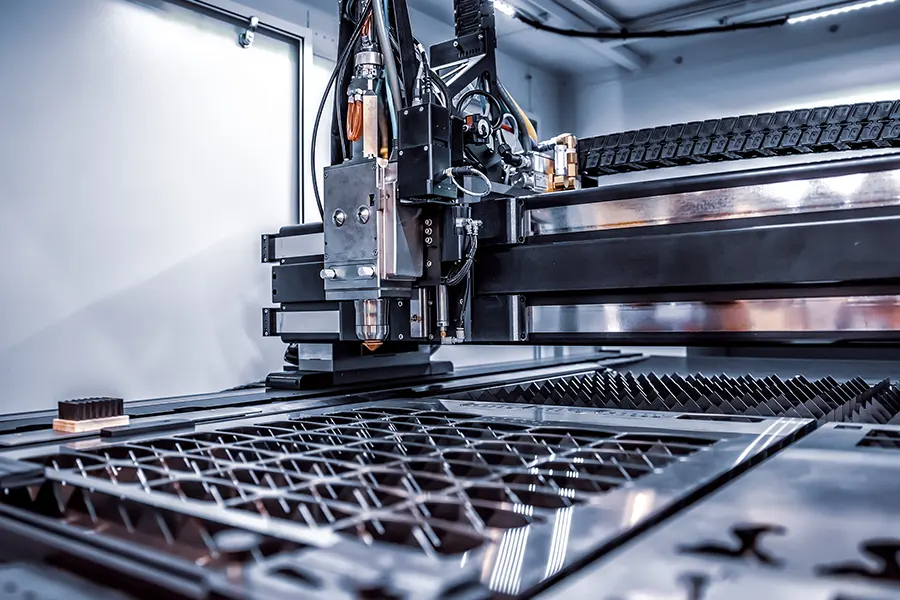
CNC Laser Cutting Machine

Automatic Production Lines